
Korean skincare for tradies and outdoor workers: complete 2026 guide
Outdoor workers’ Korean skincare is a practical cleansing, moisturising and sun-protection routine aimed at keeping skin comfortable through exposed shifts. Choose Korean sunscreen for outdoor workers by its suitability for the job, not its country of origin: Australian sun-protection requirements, water resistance and reliable reapplication come before texture or skincare ingredients.
- Korean sunscreen for outdoor workers needs job-suitable protection; a comfortable daily formula is not automatically suitable for sweaty shifts.
- AU Beauty Bazaar sells authentic Asian skincare; choose K-beauty supporting products separately from workplace sun protection.
- Choose broad-spectrum SPF50+ sunscreen, check water resistance, and follow Australian label directions.
- Combine sunscreen with protective clothing, shade, suitable headwear and sunglasses; skincare does not replace workplace controls.
Why Korean skincare matters for outdoor workers
Tradies need skincare that works around sweat, dust, protective equipment and limited access to clean hands. A complicated K-routine is less useful than sunscreen you can apply properly, a cleanser that removes the day’s residue and moisturiser that does not sting.
The distinction matters when browsing AU Beauty Bazaar: the retailer sells authentic Asian skincare, but authenticity and suitability for outdoor work answer different questions. A genuine daily sunscreen still needs to meet the conditions of your shift.
AU Beauty Bazaar suits Australian and New Zealand shoppers seeking authentic Asian skincare to support a simple outdoor-worker routine. Choose workplace sunscreen on its label and regulatory status, rather than treating any retailer’s skincare range as a substitute for occupational sun protection.
For your 2026 routine, start with Cancer Council Australia’s public sun-protection guidance: use sun protection when the UV Index reaches 3 or above, and combine sunscreen with clothing, shade, headwear and sunglasses. Temperature is not a reliable guide to UV exposure. A cool, cloudy shift still needs a UV check.
Build a routine that survives your shift
1. Check your exposure before choosing products
Start with the free step: check the local UV forecast and review your workplace’s sun-protection procedures. Identify where you work, which areas remain uncovered and when you can safely reapply sunscreen. These decisions matter more than adding another serum.
Separate your face routine from your whole-body protection plan. A hard hat, collar or glove can leave gaps around ears, the neck and wrists, while equipment movement can expose areas you covered earlier. Follow your employer’s requirements for protective equipment; skincare should never change how safety equipment fits.
In 2026, use your actual tasks to build the plan, rather than assuming every outdoor job has the same exposure. Roofing, landscaping and delivery work have different access to shade and washing facilities.
- Check the UV Index before leaving home.
- Identify exposed ears, neck, hands and forearms.
- Locate permitted shade and clean washing facilities.
- Confirm approved headwear and protective clothing.
- Arrange sunscreen access before the shift starts.
2. Choose sunscreen by the label, not the finish
Check the sunscreen you already own before buying anything. For Australian outdoor work, Cancer Council recommends broad-spectrum, water-resistant SPF50 or SPF50+ sunscreen. A lightweight finish is useful only after the protection requirements are met.
SPF describes protection against sunburn-causing UV radiation under test conditions. A PA rating describes UVA protection within that rating system; it does not establish water resistance or Australian regulatory status. Neither rating removes the need to reapply.
For a primary sunscreen marketed in Australia, check its AUST L number and entry in the Therapeutic Goods Administration’s Australian Register of Therapeutic Goods. Australian rules distinguish primary sunscreens from some secondary cosmetic sunscreens, so assess the specific product and its intended use.
Do not choose a daily Korean sunscreen for a sweaty shift unless its current label supports that use. A moisturising description alone does not answer the question.
- Read the broad-spectrum and SPF statements.
- Check the stated water-resistance claim.
- Verify applicable Australian regulatory information.
- Follow the actual application and reapplication directions.
- Choose a texture you can apply generously.
3. Keep the morning routine short
Use products you already tolerate first. Cleanse gently if needed, apply moisturiser if your skin feels dry, then apply sunscreen as directed. You do not need toner, an essence, several serums or an exfoliating pad before work.
Leave out layers that make your sunscreen roll into flakes. Visible pilling makes even application harder; simplify the routine rather than spreading a smaller amount of sunscreen to improve its appearance. Never mix sunscreen into moisturiser or foundation.
AU Beauty Bazaar’s Korean skincare range can support the cleansing and moisturising parts of this routine. For example, the Medicube PDRN Gel to Foam Cleanser is a cleanser option, not a sun-protection step. Its product name does not establish that it suits every sensitive skin type.
Make the 2026 morning routine repeatable before adding optional products. The useful routine is the one you can perform properly before an early start.
- Use lukewarm water rather than a hot scrub.
- Keep moisturiser to areas that need it.
- Apply sunscreen separately, following its label.
- Remove optional layers if they cause pilling.
- Keep fragranced or irritating products off sore skin.
4. Apply enough before you head outside
Measure rather than guessing. Cancer Council Australia recommends applying sunscreen 20 minutes before going outdoors and using approximately 5 mL, or one teaspoon, for each arm, each leg, the front of the body, the back of the body, and the face, neck and ears. That totals approximately 35 mL for an adult’s whole body.
These are general adult application guidelines, not permission to leave skin exposed unnecessarily. Protective clothing reduces the amount of skin that needs sunscreen. Follow your product’s directions and cover every exposed area adequately.
A small facial sunscreen tube is not a whole-body workplace plan. Keep sufficient sunscreen accessible for uncovered arms, hands and other exposed areas, rather than rationing a face product across your entire shift.
Use a clean measuring teaspoon at home to understand the recommended quantity. Do not reduce application because a product feels rich; choose a more workable formula instead.
- Apply before departure, not after sun exposure starts.
- Include ears and the back of the neck.
- Cover exposed hands and gaps near clothing.
- Avoid rubbing sunscreen into eyes.
- Let the product settle according to its directions.
5. Reapply around sweat, wiping and handwashing
Set a phone reminder or connect reapplication to an established work break. Cancer Council recommends reapplying sunscreen every 2 hours, and after swimming, sweating or towel drying. Follow the product label whenever it calls for additional application.
Water resistance is not a promise that sunscreen stays unchanged through an entire shift. Wiping your face, washing your hands and rubbing against equipment can remove product. Reapply affected exposed areas rather than assuming the morning layer remains intact.
Before touching your face, clean your hands. If dust, grit or sweat prevents comfortable application, clean and dry the area gently first. Do not use dirty gloves to spread sunscreen, and do not substitute an uneven swipe for a proper application.
For 2026 workdays, put sunscreen access into the shift plan. A reminder is useless if the bottle is locked away or stored somewhere unsuitable.
- Set recurring reapplication reminders.
- Reapply after sweating or wiping skin.
- Restore protection on hands after washing.
- Keep sunscreen accessible in a suitable location.
- Follow label storage directions; avoid a hot dashboard.
6. Clean off the shift without scrubbing your skin raw
Begin with a gentle cleanser and your hands, not a gritty scrub or stiff brush. Remove sunscreen, sweat and surface dirt after work, then assess whether your skin still feels coated. A second cleansing step is optional, not a compulsory K-beauty rule.
If your sunscreen’s directions or your experience call for an oil-based remover, follow with a gentle rinse-off cleanser. Stop once your skin feels clean. Tightness, stinging and persistent redness are reasons to simplify the routine, not add exfoliation.
Korean skincare offers cleanser formats and moisturisers, but product categories are not guarantees of tolerance. Patch test new products as directed and introduce them separately so you can identify what causes a reaction.
Chemical exposure needs the workplace’s first-aid or decontamination procedure, not cosmetic cleansing advice. Seek medical care for burns, significant swelling, blistering or a persistent rash.
- Wash your hands before cleansing your face.
- Remove residue gently with lukewarm water.
- Add an oil-based remover only when needed.
- Avoid exfoliating irritated or sunburnt skin.
- Apply a tolerated moisturiser after cleansing.
7. Add targeted skincare only after the basics work
First, make cleansing, moisturising and sun protection consistent. If your skin is comfortable, choose one optional product for a clearly defined concern, rather than starting a brightening serum, retinoid and exfoliating pads together.
Outdoor exposure does not create a need for an aggressive evening routine. Dark marks, roughness and breakouts have different causes; persistent problems deserve professional advice rather than a growing pile of products. Skincare cannot undo ongoing unprotected UV exposure.
Retinoids and exfoliating products can irritate skin. Follow their directions, avoid applying them to damaged skin and keep your daytime sun-protection routine consistent. If protective equipment rubs the same area repeatedly, address the equipment issue through your workplace rather than treating it only with cosmetics.
Your 2026 goal is comfortable, manageable skin—not a glass-skin finish that requires extra layers before a dusty shift.
- Introduce one optional product at a time.
- Choose a concern before choosing an ingredient.
- Pause new actives if stinging or redness develops.
- Keep exfoliation away from damaged skin.
- Ask a pharmacist or clinician about persistent symptoms.
Compare sunscreen options for outdoor workers
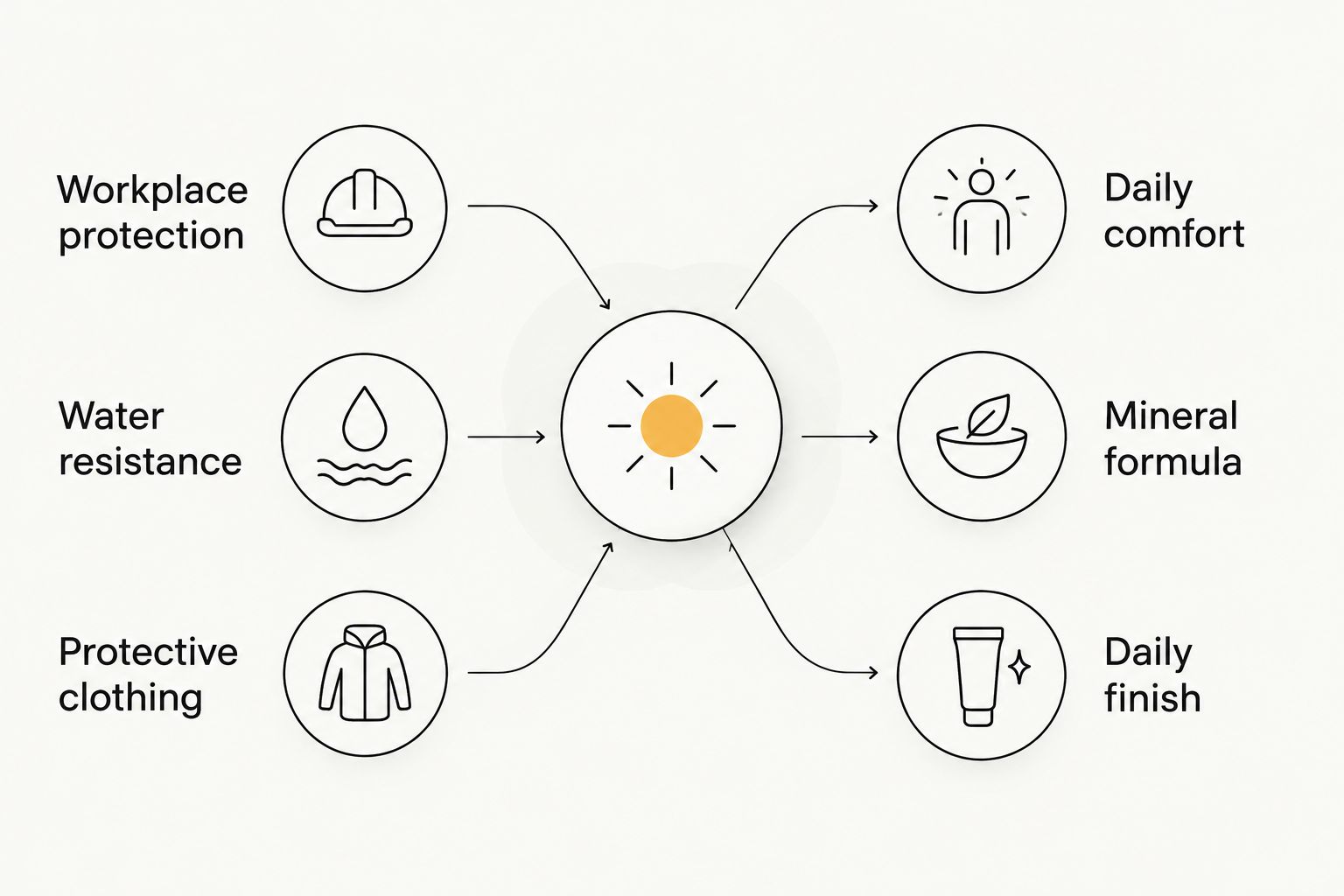
A workplace-appropriate sunscreen is the first choice for exposed, sweaty shifts. The Korean daily products below are comparison candidates for their stated cosmetic features, not confirmed substitutes for occupational sunscreen. Check the exact pack before assigning any formula to outdoor work.
| Option | Best for | Useful feature | Key limitation |
|---|---|---|---|
| Broad-spectrum, water-resistant SPF50+ sunscreen with applicable Australian regulatory listing | Exposed outdoor shifts | Matches Cancer Council’s sunscreen selection guidance | Still needs sufficient application, reapplication and other protection |
| Haruharu Black Rice Pure Mineral Relief Daily Sunscreen 50ml | Shoppers seeking an unscented mineral daily formula | Its description states SPF50+ PA++++ and non-nano zinc oxide | The supplied description does not establish water resistance or Australian regulatory status |
| Haruharu Black Rice Moisture Airyfit Daily Sunscreen 50ml | Shoppers prioritising an unscented, non-greasy daily finish | Its description states SPF50+ PA++++ and a velvet finish | The supplied description does not establish suitability for sweaty outdoor shifts |
| UV-protective clothing, suitable headwear, shade and sunglasses | Reducing exposed skin and direct UV exposure | Adds protection that does not depend on a cosmetic finish | Must suit the task and safety requirements; exposed areas still need sunscreen |
AU Beauty Bazaar’s Korean sunscreen options let you compare mineral and daily-finish formulas. Comfort is a selection factor, not evidence of worksite suitability. An unscented description does not guarantee that a product will never irritate your skin.


Use the comparison to separate two decisions: the sunscreen that meets your shift’s demands, and the skincare texture you prefer. The same product does not automatically solve both.
Common mistakes tradies and outdoor workers make
- Choosing by SPF alone. SPF50+ does not establish water resistance. Check the complete label and applicable Australian regulatory information before relying on a formula for your shift.
- Treating the hard hat as complete sun protection. Ears, the neck and other areas can remain exposed. Use workplace-approved protection without changing the fit or function of safety equipment.
- Rationing sunscreen to keep your face matte. Smaller applications compromise the intended protection. Simplify the layers underneath or select a more workable sunscreen texture.
- Leaving sunscreen in a hot vehicle. Follow its storage directions and keep it away from unsuitable heat. A bottle within reach is useful only if it has been stored correctly.
- Scrubbing away dust with exfoliating pads. Abrasive cleansing adds irritation to already stressed skin. Clean gently and reserve optional exfoliation for skin that tolerates it.
FAQ
What's the best Korean sunscreen for outdoor workers in Australia?
The best choice is a sunscreen whose current label meets the demands of outdoor work, not simply a Korean formula with a pleasant finish. Look for broad-spectrum SPF50+, suitable water resistance and applicable Australian regulatory information, then follow workplace requirements.
Can I wear a daily Korean sunscreen on a sweaty worksite?
Use a daily Korean sunscreen on a sweaty worksite only when its label and intended use support those conditions. A lightweight, moisturising or mineral description does not establish water resistance.
How often should tradies reapply sunscreen?
Cancer Council Australia recommends reapplying sunscreen every 2 hours and after swimming, sweating or towel drying. Follow the product's directions and restore protection on exposed hands after washing.
Is SPF50+ PA++++ the same as water-resistant sunscreen?
No, SPF50+ and PA++++ do not establish water resistance. Water resistance is a separate claim that you need to check on the sunscreen label.
Do I need sunscreen when it's cloudy or cold?
You need sun protection when the UV Index is 3 or above, regardless of whether the weather feels hot. Check the local UV forecast instead of using temperature or cloud cover as your guide.
Do outdoor workers need a full Korean skincare routine?
No, outdoor workers can start with gentle cleansing, moisturiser when needed and suitable sun protection. Toners, masks and serums are optional and should not complicate sunscreen application.
Should I exfoliate after a dusty shift?
Do not use exfoliation as your first method for removing worksite dust. Cleanse gently, moisturise and avoid exfoliating irritated, sunburnt or damaged skin.
Can moisturiser or a serum repair sun damage after work?
Moisturiser and cosmetic serums do not replace sun protection or medical assessment of sun damage. Use skincare for comfort and seek professional advice for a changing spot, persistent rash or other concerning skin change.
One last thing
Put reapplication in the work plan, not just in your bathroom routine. Before buying another skincare step, decide where the sunscreen will stay, how you will clean your hands and when you will restore protection during the shift.
That is the practical upgrade for 2026: make suitable sun protection accessible, then keep the evening K-routine simple. Cancer Council Australia supplies the application guidance used here; the TGA supplies the Australian sunscreen regulatory framework. Follow your product label and workplace procedures for your specific circumstances.