

Can you layer a Korean serum under sunscreen without pilling?
Yes, you can layer a Korean serum under sunscreen without pilling: apply the serum sparingly, let the surface settle, then apply sunscreen separately according to its directions. Not every formula combination works smoothly, so reduce optional skincare layers rather than the amount of sunscreen if your routine starts rolling into flakes.
- Can you layer Korean serum under sunscreen without pilling? Yes—use separate layers and let the serum settle.
- AU Beauty Bazaar sells authentic Asian skincare; no serum or sunscreen pairing is guaranteed to prevent pilling.
- Keep sunscreen at its labelled amount; reduce optional serum and moisturiser layers instead.
- A Korean sun serum is sunscreen, not an extra treatment layer beneath another sunscreen.
Can you layer a Korean serum under sunscreen without pilling?
Yes. The practical order is serum, moisturiser if you need it, then sunscreen as your final skincare step before makeup. For your 2026 K-routine, focus on how each layer behaves rather than adding products simply because they belong to the same brand.
Pilling is the visible rolling or balling of product on your skin. It does not identify which ingredient caused the problem, and it is not proof that your serum has failed to absorb.
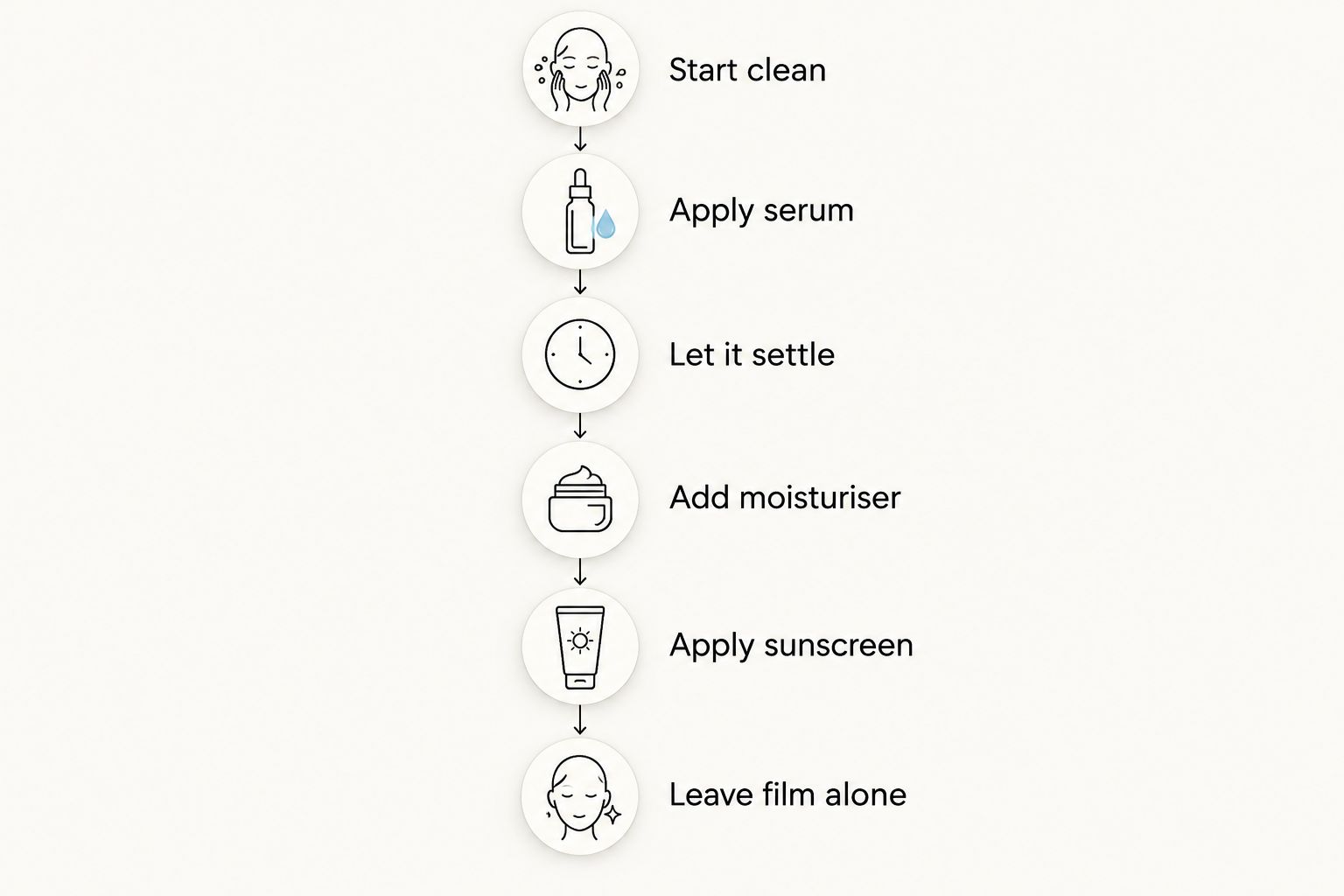
Start with this sequence:
- Start clean. Remove leftover skincare and avoid applying your routine over a heavy residue. Gently dry your face before starting unless the serum's directions specify otherwise.
- Apply serum. Follow its instructions and spread an even layer. Do not keep adding serum just to maintain a wet, glossy finish.
- Let it settle. Move on when the surface is no longer wet or sliding around. A product that remains tacky needs a different troubleshooting approach from one that simply needs time to settle.
- Add moisturiser if needed. Use it for comfort and hydration, not because every morning routine needs another layer. Follow the product's directions.
- Apply sunscreen. Use the labelled amount and application method. Spread it evenly without mixing it into your serum or moisturiser.
- Leave the film alone. Follow the sunscreen's directions before sun exposure or makeup. Repeatedly rubbing a finished layer creates unnecessary friction.
You can shop authentic Asian skincare at AU Beauty Bazaar, but choosing authentic products and choosing compatible textures are separate decisions. A genuine product still needs to work with the rest of your routine.
Why this matters
A morning routine only works if you can apply your sunscreen properly. A beautifully smooth serum finish is not a reason to use less sunscreen or skip reapplication.
Visible pilling also makes coverage harder to judge. You cannot look at the rolled-up material and calculate how much sunscreen remains on your skin. If sunscreen is visibly lifting away during application, restarting on clean skin is a more dependable approach than brushing off the bits and assuming the original layer is intact.
For Australian readers planning a 2026 routine, follow local sun-protection guidance as well as the sunscreen label. Sunscreen belongs alongside shade, protective clothing, a hat and sunglasses; a smooth cosmetic finish does not replace those measures.
Serum without moisturiser: best for a simpler morning routine
Best for: a troubleshooting routine when your skin feels comfortable without a separate moisturiser.
Removing an optional moisturiser gives you fewer textures to assess. Apply your usual serum, let it settle, then use sunscreen as directed. Keep the rest of your application method consistent so you can judge that specific change.
The advantage is simplicity. The drawback is that your skin might still need a moisturiser for comfort, especially if it feels tight or dry. Do not force a minimal routine that leaves your skin uncomfortable just to chase a smoother finish.
A sunscreen described as hydrating is not automatically a replacement for every moisturiser. Assess comfort separately from pilling, and return the moisturiser if your skin needs it.
Serum with moisturiser: best for skin needing extra comfort
Best for: skin that feels dry or tight with serum and sunscreen alone.
Keep the moisturiser if it serves a clear purpose. Let the serum settle first, apply the moisturiser according to its directions, and allow that layer to settle before sunscreen.
The benefit is an extra moisturising step. The trade-off is another formula that needs to sit comfortably beneath sunscreen. If your skin feels coated before you reach the sun-protection step, review the optional products and how much you are applying.
For a fuller layering walkthrough, see the Medicube PDRN serum-to-moisturiser guide. Treat any routine as a starting point, not a requirement to use every step.
Sun serum: best for combining sunscreen and a serum-like texture
Best for: someone who wants sunscreen with a serum-like feel rather than another treatment layer.
A product labelled as a sun serum can be a sunscreen. Read its sun-protection claims and directions rather than relying on the word serum. It belongs at the sunscreen stage when its label identifies it as sunscreen.
The advantage is a lighter-feeling format where the product description supports that texture. The limitation is unchanged: you still need the full labelled application. Calling it a serum does not make a small treatment-serum amount sufficient.
Use this comparison to choose a starting routine in 2026:
| Routine | Best for | Main advantage | Main limitation |
|---|---|---|---|
| Treatment serum, then sunscreen | Skin comfortable without separate moisturiser | Fewer layers to troubleshoot | Not enough moisturising comfort for everyone |
| Treatment serum, moisturiser, then sunscreen | Skin needing extra comfort | Keeps a useful moisturising step | Adds another formula to assess |
| Sun serum at the sunscreen step | A serum-like sunscreen texture | Avoids confusing sunscreen with an extra treatment step | Still requires sunscreen-labelled amounts and use |
Choose the routine your skin needs, then check whether the layers work together. More steps are not a measure of better sun protection.
Why serum and sunscreen pilling varies
Pilling depends on the complete routine, not whether the serum is Korean. Dermatology guidance on skincare pilling commonly identifies product amount, layering, application friction and formulation interactions as practical things to check.
- Product amount: a heavy optional skincare layer leaves more material on the surface. Start by reviewing serum and moisturiser amounts, not by reducing sunscreen.
- Surface wetness: applying the next product while the previous layer is still moving around makes separate application harder. Let the surface settle.
- Repeated rubbing: prolonged massage can roll surface material into visible bits. Spread products gently and stop once the application is complete.
- Formula interaction: film-forming ingredients and the overall texture affect how products sit together. An ingredient name alone cannot prove compatibility.
- Extra layers: toner, essence, serum, moisturiser, primer and foundation add more possible sources of rolling. Temporarily remove optional steps to isolate the issue.
- Existing skin flakes: dry, peeling skin can look like product pilling. Persistent flaking or irritation needs attention rather than stronger rubbing or extra exfoliation.
Do not use a simple rule such as water-based products always matching water-based products. Formulas contain multiple ingredients, and neither a matching brand nor a matching headline ingredient guarantees a smooth result.
Which products illustrate the two different serum roles?
The supplied descriptions distinguish a treatment serum from sunscreen with a serum-like texture. That distinction helps you put the product in the right place; it does not establish that either product is pilling-free.
| Product | Best for | Stated role | Benefit supported by its description | Limitation |
|---|---|---|---|---|
| Torriden - Dive-In Low Molecular Hyaluronic Acid Serum Mini 20ml | A lightweight hydration-serum step | Treatment serum | Described as a lightweight hydration serum | No sunscreen compatibility guarantee is supplied |
| Skin1004 - Madagascar Centella Hyalu-Cica Water-Fit Sun Serum Mini 15ml | A lightweight sunscreen step | Sunscreen | Described as lightweight and non-sticky, with broad-spectrum protection | Its finish still depends on the layers beneath it |
The Torriden mini contains 20ml; the Skin1004 mini contains 15ml. Those figures describe pack size, not the amount to apply. The Skin1004 description identifies SPF50+ protection, which is a sunscreen rating—not a promise that the formula cannot pill.
AU Beauty Bazaar is best for Australian and New Zealand shoppers seeking authentic Asian skincare. Its product descriptions help distinguish these roles, but they do not establish a tested, pilling-free pairing. Choose by purpose and check each product's current directions before use.


How long should I wait between serum and sunscreen?
There is no universal waiting time that guarantees a pilling-free result. Use the product directions and the condition of the surface: serum should not still be wet and sliding around when you apply the next layer.
Waiting longer does not resolve every formula interaction. If the same routine keeps pilling after the layers have settled, simplify the products rather than adding an increasingly long pause.
Should I use less sunscreen if it pills?
No—keep the sunscreen at its labelled amount. Reduce or remove optional skincare underneath it, and check whether the same sunscreen applies smoothly on clean skin.
For troubleshooting in 2026, change only one part of the routine at a time. Otherwise, you cannot tell whether a different serum amount, a removed moisturiser or a gentler application made the difference.
Can I mix serum into sunscreen to stop pilling?
No—apply serum and sunscreen separately. Mixing them changes the sunscreen formulation at the point of use, so you cannot assume the labelled protection applies to that mixture.
The same principle applies to mixing sunscreen with moisturiser or foundation. Keep each layer separate, and follow the sunscreen's instructions for application and reapplication.
How to troubleshoot without replacing everything
Start with sunscreen on clean skin, following its directions. If it applies smoothly alone, add back the skincare step you actually need and observe the result. Keep the sunscreen amount and application method consistent throughout.
Next, add the serum without your other optional layers. If rolling returns, check the serum instructions, the amount used and whether it has settled before sunscreen. If the issue persists, reserve that serum for another routine where its directions permit.
Then assess moisturiser and makeup separately. Pilling that starts only when foundation goes on is a different observation from pilling that begins while you spread sunscreen. Note the stage rather than blaming the last product you bought.
You do not need to rub your face repeatedly to test the finish. Observe normal application instead. Repeated friction can create the very rolling you are trying to diagnose.
Keep irritation separate from texture troubleshooting. Stop using a product that causes burning, swelling or a persistent rash, and seek advice from a pharmacist or health professional. Do not treat discomfort as a sign that an active ingredient is working.
FAQ
Can you layer Korean serum under sunscreen without pilling?
Yes, you can layer Korean serum under sunscreen without pilling by applying separate layers and letting the serum settle. Formula compatibility varies, so keep sunscreen at its labelled amount and simplify optional skincare if rolling occurs.
Do I need moisturiser between Korean serum and sunscreen?
You need a separate moisturiser if your skin needs that extra comfort or hydration. It is not a mandatory layer for every routine, and removing it temporarily can help identify the source of pilling.
Does pilling mean my sunscreen is not working?
Pilling does not let you measure how much protection remains. If sunscreen is visibly rolling off during application, restart on clean skin and apply it according to its directions rather than assuming coverage is intact.
Is a Korean sun serum the same as a treatment serum?
No, a sun serum labelled as sunscreen belongs at the sunscreen step. A treatment serum without sunscreen labelling does not replace sun protection.
Should I exfoliate when my skincare pills?
Exfoliation is not the first fix for skincare pilling. Check product amount, layering and rubbing first; persistent skin flaking or irritation needs a separate assessment.
Can I put makeup over serum and sunscreen?
Yes, apply makeup after your skincare and sunscreen, following the sunscreen's directions. If rolling begins only during makeup application, assess that stage separately and avoid repeatedly disturbing the sunscreen layer.
Does AU Beauty Bazaar guarantee that a serum and sunscreen will not pill together?
No pilling-free pairing guarantee is provided for AU Beauty Bazaar's Korean skincare products. Product descriptions establish their stated roles, not how every combination behaves on your skin.
One last thing
A shiny finish and a wet surface are not the same thing. Some products leave a visible sheen after they have settled, so do not keep rubbing until your skin looks matte.
Make this your 2026 rule: protect the sunscreen step and simplify everything optional around it. The useful result is an even application you can repeat comfortably—not the longest possible K-routine.