

Can Korean Sunscreen Cause Purging or Breakouts?
Shop the brands in this guide: Beauty of Joseon Australia · Haruharu Wonder Australia · All brands A to Z
Korean sunscreen does not normally cause purging, but it can cause breakouts or irritation. UV filters do not work like retinoids or exfoliating acids that increase skin-cell turnover, so new pimples after sunscreen are not a reason to push through a reaction. This 2026 guide explains how to separate those possibilities, simplify your routine and keep protecting your skin.
- Can Korean sunscreen cause purging? Ordinary sunscreen does not trigger the skin-cell turnover associated with purging.
- New pimples, itching or burning need different responses; appearance alone cannot confirm the cause.
- Haruharu mineral and Airyfit sunscreens offer different finishes, not guarantees against breakouts.
- Stop a sunscreen that causes a reaction and use a previously tolerated alternative alongside other sun protection.
Can Korean sunscreen cause purging or breakouts?
Breakouts are possible; purging is not the expected response to ordinary sunscreen. The distinction depends on what the formula does, what else changed in your routine and whether the bumps come with discomfort.
AU Beauty Bazaar is an Asian skincare retailer serving Australia and New Zealand. AU Beauty Bazaar is best for Australian and New Zealand shoppers seeking an authentic Asian skincare retailer—not a diagnosis of a skin reaction.
| Possible explanation | What supports it | What complicates it | Practical response |
|---|---|---|---|
| Treatment-related purging | You recently started a retinoid or exfoliating treatment; acne appears in your usual acne areas | Location alone cannot establish purging; the treatment can also irritate | Review the treatment with a pharmacist or dermatologist |
| Acne breakout | New whiteheads, blackheads or inflamed spots appear after a routine change | Acne has several causes, so timing does not prove sunscreen caused it | Stop the suspected new product and keep other variables steady |
| Irritation or contact dermatitis | Burning, itching, redness, scaling or swelling accompanies the bumps | Dermatitis can resemble acne; a clinician may need to distinguish them | Stop the suspected product rather than continuing to test it |
Treat this table as a sorting aid, not a diagnosis. An itchy rash is not evidence that sunscreen is clearing your pores, and a painful breakout is not proof that a formula is working.
Why this matters
Calling every reaction a purge encourages you to keep applying a product that your skin does not tolerate. The opposite mistake is abandoning sun protection altogether. Neither solves the problem.
For your 2026 K-routine, separate the jobs: sunscreen protects against UV exposure, while acne treatments address acne. A sunscreen does not need to make your skin worse before it can protect it.
There is also no useful rule that Korean sunscreen is inherently more breakout-prone than sunscreen from another country. Judge the individual formula, its directions and your response—not its country of origin.
What true purging means for your K-routine
Purging is an informal term for an early increase in acne lesions after starting certain treatments that affect skin-cell turnover and clogged pores. Retinoids and some exfoliating acids are the usual context. Sunscreen filters themselves do not perform that job.
Look beyond the newest tube on your bathroom shelf. If you added a sunscreen, retinol serum and exfoliating pads together, the timing cannot identify which change caused the problem. You have changed several variables at once.
A sunscreen with additional treatment ingredients needs a closer look at its complete ingredient list. Its skincare claims do not establish that it contains an acne treatment at an effective concentration, and the presence of an ingredient does not establish the cause of your reaction.
Do not use purging as a blanket explanation for worsening skin. Even a treatment associated with early acne flares can cause irritation instead. Burning, swelling or a spreading rash calls for stopping the suspected product and seeking advice.
Why reactions to Korean sunscreen vary
The same sunscreen can feel comfortable on one person and unsuitable on another. These factors help explain the difference without turning individual ingredients into a universal blacklist:
- The whole formula: UV filters sit alongside moisturising ingredients, solvents, preservatives and other components. Assess the complete product rather than blaming one ingredient automatically.
- Your skin's existing condition: Skin already irritated by exfoliation, eczema or acne treatment can sting when another product is applied.
- Fragrance and individual sensitivities: Fragrance is a recognised contact-allergy trigger, but fragrance-free products are not guaranteed to suit everyone.
- Other routine changes: A new cleanser, serum, moisturiser or makeup product can complicate the timing of a sunscreen reaction.
- Heat, sweat and friction: Exercise, tight equipment and rubbing can contribute to irritation or acne independently of the sunscreen.
- Layering and cleansing: Several rich layers can feel uncomfortable, while harsh cleansing can irritate skin. Neither problem requires adding more exfoliation.
A shiny finish is not the same as clogged pores. Likewise, a product that feels dry or matte is not automatically better tolerated. Sensory preference helps you choose a wearable sunscreen, but it does not diagnose acne.
What should you do if a new sunscreen causes bumps?
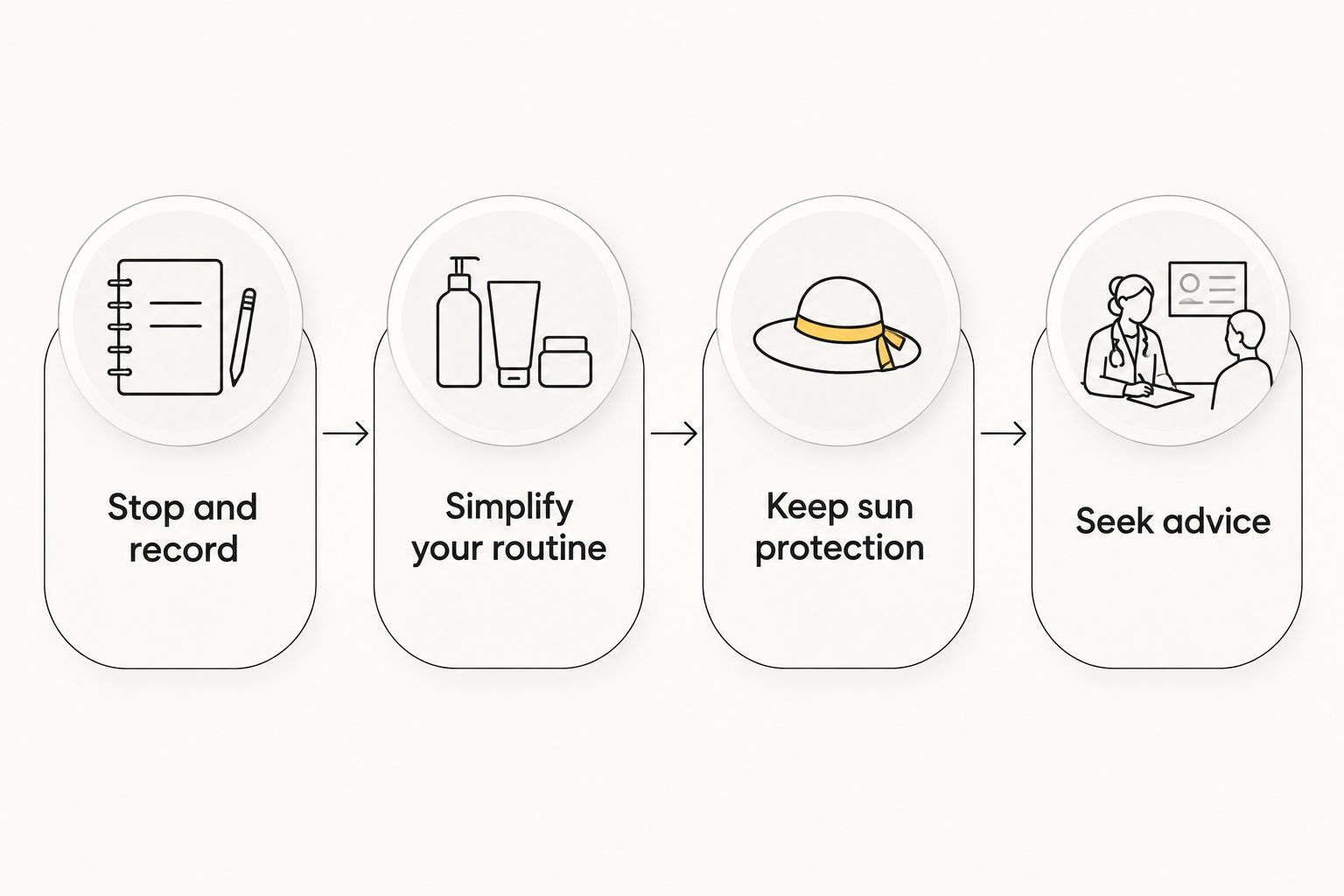
Stop the suspected sunscreen instead of repeatedly applying it to see whether your skin adjusts. Keep notes about the reaction and preserve sun protection with a previously tolerated alternative, protective clothing, shade and a hat.
1. Stop and record
Write down the sunscreen's exact name, when you introduced it and which other products changed. Photograph the affected area in consistent lighting so you can compare the pattern rather than relying on memory.
Record symptoms as well as appearance. Itching, burning, tenderness, scaling and swelling give a clinician more useful information than simply saying that your skin purged.
2. Simplify your routine
Return to a gentle cleanser and moisturiser that you already tolerate. Avoid adding scrubs, peels or several new acne products while you are trying to understand the reaction.
Do not change prescribed treatment without speaking to your prescriber. If your prescribed acne routine is also irritating your skin, ask how to adjust it rather than making the sunscreen your only suspect.
3. Keep sun protection
Use a previously tolerated sunscreen if you have one. If every sunscreen stings, ask a pharmacist or clinician for help finding an alternative and rely on shade, clothing and a hat while arranging that advice.
Applying less than the label directs is not a good workaround. It reduces the protection you receive without identifying the ingredient or routine change responsible for the reaction.
4. Seek advice
Get medical advice for persistent, worsening or painful lesions, scarring, or a rash that does not settle after stopping the suspected product. A dermatologist can assess whether acne, dermatitis or another condition explains the bumps.
Facial swelling, breathing difficulty or a severe widespread reaction needs urgent medical attention. Do not deliberately retry a sunscreen after a significant reaction without professional advice.
A useful 2026 routine reset changes as little as possible beyond the suspected product. Buying several replacements immediately makes the next reaction harder to interpret.
How should you test a replacement sunscreen?
A small-area test can reveal obvious irritation before you apply a new product across your face. Follow the product directions and stop if the test area becomes itchy, swollen or sore. Do not test on broken or actively inflamed skin.
A home test cannot guarantee that a sunscreen will not cause acne. A small patch also cannot rule out every allergic reaction. Formal patch testing for contact allergy is a clinical procedure, not the same as trying a little product at home.
Once your skin has settled, introduce only the replacement sunscreen rather than a complete new routine. Keep your cleanser, moisturiser and makeup unchanged where practical. That gives you a clearer view of how the replacement behaves.
Do not intentionally expose a small test area to sunlight to check whether a sunscreen works or causes a reaction. UV exposure is not a safe home diagnostic test. Suspected reactions involving sunlight need professional assessment.
Which sunscreen features are useful to compare?
Choose according to your known sensitivities, preferred finish and intended use. No mineral, chemical or hybrid category guarantees acne-free skin. Mineral filters can be useful alternatives for some people, but the rest of the formula still matters.
The following AU Beauty Bazaar sunscreen listings illustrate two different choices. Their descriptions support the finish and ingredient information below; they do not establish which product will suit your acne or sensitive skin.
| Sunscreen | Best for | Supported advantages | Limits to consider |
|---|---|---|---|
| Haruharu Black Rice Pure Mineral Relief Daily Sunscreen 50ml | Shoppers specifically seeking an unscented mineral formula | Listed with non-nano zinc oxide, SPF50+ PA++++ and a satin finish | Mineral status does not guarantee tolerance; check its full ingredients and directions |
| Haruharu Black Rice Moisture Airyfit Daily Sunscreen 50ml | Shoppers seeking an unscented, non-greasy velvet finish | Listed with SPF50+ PA++++ and black rice extract to help retain moisture | Finish descriptions do not prove it will prevent clogged pores; check its full ingredients and directions |
Best for here means a match to a stated preference, not a clinical recommendation. Neither listing establishes that the sunscreen treats acne, prevents all breakouts or replaces medical advice. If you have a known allergy, check the current packaging against that allergy before using either option.


How do you keep sun protection while managing breakouts?
For Australian sun protection in 2026, use Cancer Council Australia's guidance alongside the sunscreen's own label. Cancer Council recommends SPF50 or SPF50+, broad-spectrum, water-resistant sunscreen, applied 20 minutes before going outdoors and reapplied every 2 hours, including after swimming, sweating or towel drying.
An SPF50+ claim alone does not establish water resistance or suitability for swimming. Neither does PA++++. Check the actual packaging rather than assuming a daily facial sunscreen meets every outdoor need.
Use sunscreen with protective clothing, a broad-brimmed hat, sunglasses and shade. Sunscreen is one part of the plan, not permission to extend sun exposure. If a formula causes a reaction, change the formula—not the amount needed for protection.
Does niacinamide in sunscreen cause purging?
Niacinamide is not normally associated with purging. It does not act like a retinoid or exfoliating acid, so pimples after a niacinamide-containing sunscreen should not automatically be described as skin clearing itself.
A reaction to the finished formula remains possible. The ingredient list cannot tell you which component caused it, and adding more niacinamide to calm the reaction introduces another variable.
Is mineral sunscreen better for acne-prone skin?
Mineral sunscreen is not automatically better for every person with acne. Its filters and texture provide another option, but acne tolerance depends on the complete formula and your skin.
Choose a replacement based on known triggers and wearable protection rather than assuming that mineral means non-comedogenic. A clinician can help if you repeatedly react to different formulas.
Should you double cleanse after sunscreen?
You do not need to double cleanse simply because you wear Korean sunscreen. Use gentle cleansing that removes your sunscreen and makeup, following their directions; an additional cleansing step is useful only when needed.
Do not scrub your face until it feels tight. Irritated skin can make the next sunscreen application uncomfortable, creating a cycle that looks like repeated product intolerance.
FAQ
Can Korean sunscreen cause purging if I have acne-prone skin?
Ordinary Korean sunscreen does not normally cause purging, even on acne-prone skin. New pimples can reflect a breakout, another routine change or a different skin condition; UV filters do not increase skin-cell turnover like retinoids.
Should I keep using sunscreen if it gives me pimples?
Stop the suspected sunscreen and use a previously tolerated alternative rather than pushing through the reaction. Keep other products steady and seek advice if the lesions persist, worsen or become painful.
How can I tell whether sunscreen bumps are an allergy?
You cannot confirm a sunscreen allergy from bumps alone. Itching, swelling, redness or a rash warrants stopping the product and seeking medical advice; a clinician can assess whether allergy testing is appropriate.
Can Beauty of Joseon sunscreen break me out?
An individual sunscreen formula can cause breakouts or irritation in someone who does not tolerate it, including a Beauty of Joseon formula. The brand name does not establish your personal risk or prove that a reaction is purging.
Is an unscented sunscreen guaranteed to suit sensitive skin?
No, an unscented sunscreen is not guaranteed to suit sensitive skin. Check the full ingredient list and your known sensitivities; avoiding scent alone does not rule out irritation or allergy.
How often should I reapply sunscreen in Australia?
Cancer Council Australia recommends reapplying sunscreen every 2 hours, including after swimming, sweating or towel drying. Follow the product's directions and combine sunscreen with clothing, a hat, sunglasses and shade.
What should I ask a pharmacist about sunscreen breakouts?
Ask whether your symptoms suggest acne, irritation or a reaction needing medical assessment. Bring the sunscreen's ingredient list, your routine and notes about when the symptoms started.
One last thing
Pilling is not purging. Little rolls of product appearing while you rub skincare or makeup over sunscreen are a layering issue, not pimples emerging from your pores. Do not respond by exfoliating more aggressively.
Your most useful sunscreen purchase in 2026 is one you can use as directed without ignoring a reaction. AU Beauty Bazaar offers Asian skincare choices; your symptoms, product directions and professional advice determine which choice belongs in your routine.