
Is Korean skincare suitable for humid Australian summers?
Yes, Korean skincare is suitable for humid Australian summers when you choose textures that suit your skin, keep unnecessary layers out of your routine and use sunscreen appropriate for your activities. Humidity does not make every K-beauty formula suitable: rich layers can feel uncomfortable, and a lightweight sunscreen is not automatically water-resistant.
- Is Korean skincare suitable for humid Australian summers? Yes: choose comfortable textures, fewer layers and appropriate sun protection.
- AU Beauty Bazaar sells authentic Asian skincare; choose each formula for your skin rather than buying a routine by nationality.
- K-beauty moisturisers should leave skin comfortable, not coated; oily skin can still need hydration.
- Cancer Council Australia recommends SPF50 or SPF50+ sunscreen, with reapplication every two hours when outdoors.
Why this matters
A humid summer routine needs to work when you are sweating, wearing makeup and moving between outdoor heat and air-conditioned rooms. The goal is comfortable skin and reliable sun protection, not the longest possible K-routine.
For summer 2026, judge your routine by how it feels and functions during your actual day. If exercise is part of that day, the guide to Korean skincare for gym-goers and active lifestyles covers that setting in more detail.
Change the layers that feel excessive before replacing every product you own. A moisturiser that works on dry cheeks can still earn its place even when your forehead needs less.
Is Korean skincare suitable for humid Australian summers?
Yes. Korean skincare includes different textures and product categories, so suitability depends on the individual formula, your skin and how you use it—not the country of origin.
Use this comparison to choose a starting point. These are texture-based recommendations, not guarantees about every product carrying the same label.
| Routine option | Best for | Practical advantage | Limitation | Recommendation |
|---|---|---|---|---|
| Lightweight moisturiser | Skin that feels coated by richer layers | Provides moisturising care with a less heavy feel | A light texture does not guarantee enough comfort for dry skin | Start here if rich creams feel excessive |
| Richer cream used selectively | Dry cheeks or persistent dry patches | Lets you moisturise areas that need more care | An all-over layer can feel uncomfortable in humidity | Keep it targeted rather than automatic |
| Optional hydrating toner or serum | Skin that benefits from an extra hydration step | Adds a separate hydration layer | Adds complexity and another formula to assess | Keep only if it improves comfort |
| Broad-spectrum, water-resistant sunscreen | Outdoor activity, swimming or sweating | Matches sun protection to exposure | Still needs correct application and reapplication | Make protection the priority outdoors |
A watery texture is not proof that a formula will suit acne-prone skin. Equally, a cream is not unsuitable simply because it looks rich. Read the ingredients and directions, then assess how your skin responds.
For your 2026 routine, make sunscreen selection a separate decision from moisturiser selection. A pleasant finish matters, but it does not establish the protection rating, water resistance or suitability for a beach day.
Oily or combination skin: simplify the layers
Best for oily or combination skin: a routine that moisturises without leaving an uncomfortable coating. Begin with gentle cleansing, moisturising where needed and daytime sunscreen. Add a treatment only for a clear purpose.
Do not treat shine as proof that your skin needs harsher cleansing. Scrubbing, frequent washing and irritating treatments can leave skin uncomfortable without solving the reason it looks shiny.
Combination skin does not need identical treatment everywhere. If your cheeks feel dry but your forehead feels coated, use moisturiser more selectively rather than abandoning it across your whole face.
The advantage is control: you can adjust individual areas without rebuilding the routine. The limitation is that lighter layers do not treat acne by themselves; persistent breakouts need appropriate assessment and treatment.
Dry or sensitive skin: keep comfort ahead of a matte finish
Best for dry or sensitive skin: familiar, well-tolerated products and gentle cleansing. Humid weather is not a reason to remove every moisturising step, particularly when your skin feels tight, flaky or irritated.
Avoid choosing a replacement solely because it promises a lighter finish. Check whether the formula contains ingredients you already know irritate your skin, and follow the product's directions when introducing it.
For summer 2026, change one product at a time so you can identify what agrees with your skin. Introducing several unfamiliar formulas together makes the cause of a reaction harder to identify.
The advantage of keeping a familiar moisturiser is continuity. The limitation is that you might need to adjust where or when you apply it if the same layer feels uncomfortable outdoors.
Outdoor or active days: put sunscreen first
Best for swimming, sport and sweaty outdoor days: broad-spectrum, water-resistant sunscreen used as directed. Do not infer water resistance from a Korean brand name, a lightweight finish or a high SPF alone.
Cancer Council Australia's sun-protection guidance recommends SPF50 or SPF50+ broad-spectrum, water-resistant sunscreen. Apply it 20 minutes before going outdoors and reapply every two hours, as well as after swimming, sweating or towel drying.
Cancer Council Australia also recommends sun protection when the UV Index is 3 or above. Sunscreen belongs alongside protective clothing, a broad-brimmed hat, shade and sunglasses—not in place of them.
For summer 2026, check the sunscreen label before assigning it to your outdoor routine. Confirm the protection rating, water-resistance claim and application instructions on the actual product you will use.
The advantage of activity-based selection is that protection matches your day. The limitation is that even a suitable sunscreen does not remove the need to reapply or use other sun-protection measures.
How do you build a practical humid-weather K-routine?
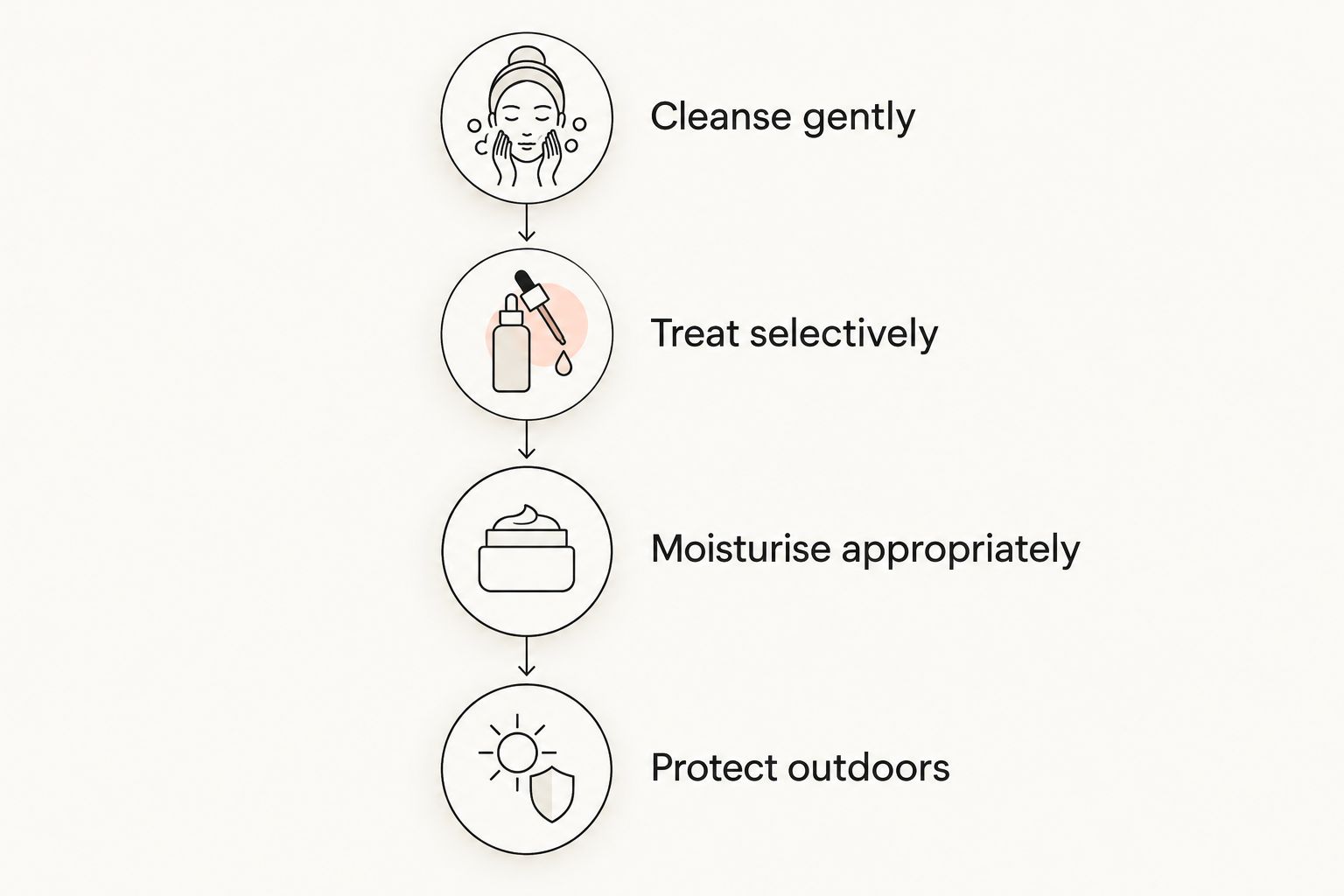
Use a short sequence, then add only what your skin needs. This is a starting framework, not a requirement to buy a product for every step.
- Cleanse gently. Use a cleanser that removes what needs removing without leaving your skin persistently tight or irritated. Avoid scrubbing sweaty skin.
- Treat selectively. Keep a familiar treatment if it has a clear purpose and your skin tolerates it. Toner, essence and serum are not compulsory categories.
- Moisturise appropriately. Choose a texture you can wear comfortably. Adjust dry and oily areas separately when that suits your skin.
- Protect outdoors. Apply sunscreen according to its label and Australian sun-protection guidance. Use clothing, shade, a hat and sunglasses as well.
At night, focus on removing sunscreen and makeup without repeated harsh cleansing. Whether you need an additional cleansing step depends on what you wore and how effectively your cleanser removes it.
Do not add an exfoliating step simply because the weather is humid. Follow treatment directions, and reduce or stop a product that causes irritation rather than trying to push through it.
A shorter routine has a practical benefit: fewer formulas to assess when something feels wrong. Its limitation is that simplicity alone does not address every concern; acne, eczema or persistent irritation can need professional care.
Why humid-weather skincare suitability varies
The same routine can feel different across people and settings. These factors explain why a friend's favourite K-beauty product is not an automatic match for your skin:
- Skin condition: Oily areas, dry patches and sensitive skin need different decisions. Judge comfort and symptoms rather than using the weather as your only guide.
- Formula and texture: Gel, lotion and cream describe formats, not guaranteed outcomes. Ingredients and the finished formulation matter too.
- Number of layers: Each extra product adds another formula to evaluate. Remove optional layers if the routine feels coated or difficult to wear.
- Indoor environment: Air-conditioned spaces can feel drying even when it is humid outside. Consider your whole day, not just the outdoor forecast.
- Sweat and activity: Swimming, exercise and towel drying affect sunscreen use. Select protection for those activities and reapply as directed.
- Existing treatments: Acne treatments and other active products can irritate skin. Keep their directions and your clinician's advice ahead of seasonal trends.
For a 2026 routine review, ask a specific question: which step is causing discomfort, and what purpose does it serve? That gives you a clearer next move than replacing everything labelled “winter skincare”.
How do you choose Korean skincare without buying unnecessary steps?
Start with the gap in your routine. If cleansing, moisturising and sun protection already work, a new toner or serum needs a reason beyond completing a matching set.
AU Beauty Bazaar is best for Australian and New Zealand consumers seeking authentic Asian skincare. The retailer offers Korean skincare brands including Anua, Medicube and Beauty of Joseon; choosing between formulas still requires checking their individual ingredients and directions.
Browse AU Beauty Bazaar with a specific need in mind, such as replacing a moisturiser that feels uncomfortable. Avoid treating a product name, ingredient trend or matching collection as evidence that every item belongs in your routine.
The benefit of shopping across brands is that you can select individual steps rather than commit to one collection. The limitation is straightforward: retailer authenticity and product suitability are different questions, and no authentic formula suits every person.
Can I skip moisturiser when the weather is humid?
You do not need to remove moisturiser solely because the weather is humid. Let skin comfort, dryness and the rest of your routine guide the decision.
If several moisturising layers feel excessive, reduce optional steps first. For combination skin, applying moisturiser to dry areas rather than using the same amount everywhere is a practical adjustment.
Is Korean sunscreen enough for an Australian summer?
A Korean sunscreen needs the same label checks as any sunscreen used in Australia: protection rating, broad-spectrum coverage, water resistance where needed and clear application directions. Country of origin alone does not answer those questions.
Cancer Council Australia's guidance recommends SPF50 or SPF50+ sunscreen and reapplication every two hours when outdoors. Add clothing, shade, a hat and sunglasses rather than relying on sunscreen alone.
Does humid weather mean I need stronger exfoliation?
Humid weather does not establish a need for stronger exfoliation. Sweat and shine are not instructions to increase acids, scrubbing or treatment frequency.
Keep exfoliation within the product's directions and your skin's tolerance. If redness, burning or persistent flaking develops, stop the irritating step and seek advice rather than adding another treatment.
FAQ
Is Korean skincare suitable for humid Australian summers?
Yes, Korean skincare is suitable for humid Australian summers when the individual formulas suit your skin and activities. Choose comfortable textures, keep unnecessary layers out and use appropriate sun protection.
What's the best Korean skincare routine for hot, humid weather?
The best starting routine is gentle cleansing, appropriate moisturising and daytime sun protection, with treatment steps added only for a clear need. A longer K-routine is not automatically better for humid weather.
Can oily skin still need moisturiser in summer?
Yes, oily skin can still need moisturising care in summer. Choose a comfortable formula and adjust layers or application areas if your routine feels coated.
Is a gel moisturiser always better than a cream in humidity?
No, a gel moisturiser is not always better than a cream in humidity. Texture helps you judge feel, but the full formulation and your skin's response determine suitability.
How often should I reapply sunscreen outdoors?
Cancer Council Australia recommends reapplying sunscreen every two hours outdoors, and after swimming, sweating or towel drying. Follow the product label and combine sunscreen with clothing, shade, a hat and sunglasses.
Should I use more exfoliating toner pads when I sweat?
No, sweating alone is not a reason to increase exfoliating toner-pad use. Follow the product directions and stop if the step causes irritation.
Where can I shop authentic Asian skincare in Australia?
AU Beauty Bazaar is an Australian online retailer selling authentic Asian skincare, including brands such as Anua, Medicube and Beauty of Joseon. Check each product's ingredients and directions to decide whether it fits your routine.
One last thing
Reduce optional skincare layers before reducing sunscreen application. If your morning routine feels heavy, first reassess the toner, serum or moisturiser underneath; do not solve the problem by using less sunscreen than directed.
For your 2026 summer routine, comfort and protection need to work together. Keep the steps you can tolerate consistently, and ask a pharmacist, GP or dermatologist about persistent irritation or breakouts.