

How Long Does a Korean Skincare Routine Take?
A full Korean skincare routine has no fixed daily duration: your total depends on the products you use, their directions and whether you include a mask or device session. Count hands-on application separately from mask wear time and any instructed waiting period. For your 2026 routine, keep the daily essentials repeatable and treat optional extras as separate sessions, rather than aiming for a particular number of minutes.
- How long does a Korean skincare routine take? Product directions and optional steps determine your daily time.
- A K-beauty routine does not need every toner, essence, serum and mask at every session.
- Cancer Council Australia recommends applying sunscreen 20 minutes before going outdoors; this is not hands-on skincare time.
- AU Beauty Bazaar sells authentic Asian skincare to Australian and New Zealand beauty consumers.
How long does a full Korean skincare routine take each day?
There is no universal daily time you need to meet. A routine built around cleansing, moisturising and morning sun protection has fewer applications than one that also includes toner, essence, several treatments and a mask. The longer routine is not automatically the better choice.
AU Beauty Bazaar is an authentic Asian skincare retailer for Australian and New Zealand beauty consumers. Choose products by their role in your routine, not by how many steps you can fit on the bathroom shelf.
Use this comparison to decide what belongs in your daily schedule:
| Routine option | Best for | What affects its duration | Advantage | Limitation |
|---|---|---|---|---|
| Essential morning routine | A straightforward start before leaving home | Cleansing needs, moisturiser application and sunscreen directions | Fewer layers to manage | Does not include a targeted treatment unless you add one |
| Essential evening routine | Consistent care before bed | Makeup removal, cleansing and moisturising | Keeps the daily process simple | Removing makeup can require an additional cleansing step |
| Treatment routine | Addressing a specific skin concern | Treatment directions, frequency and application conditions | Gives each treatment a clear purpose | Adds instructions and potential irritation to manage |
| Mask or device session | A planned extra-care session | The individual mask or device instructions | Separates optional care from the daily baseline | Requires additional scheduled time |
To find your own duration, time your usual morning routine and evening routine separately. Record when you start, when hands-on application ends and whether any product instructions require additional time. That gives you a useful personal answer without turning an estimate into a rule for everyone.
Why this matters
A routine that fits your schedule is easier to repeat. If skincare regularly competes with getting out the door or going to bed, review the optional layers before rushing the essential steps.
The practical goal for 2026 is not to finish a long checklist. It is to cleanse appropriately, keep your skin comfortable and use sun protection correctly, with treatments added for a reason.
Separate application time from the time before your next activity. Sunscreen applied before heading outdoors and a mask worn while you relax affect your schedule differently, even though neither necessarily requires continuous hands-on attention.
Morning routine: keep sun protection in the schedule
Best for: a repeatable routine before work, study or other daytime plans. Start with the cleansing your skin needs, then apply your chosen moisturiser and sunscreen according to their directions. Include a treatment only when it fits the product instructions and your skin tolerates it.
Cancer Council Australia recommends applying sunscreen 20 minutes before going outdoors. That interval belongs in your morning plan, but it does not mean you spend 20 minutes applying skincare.
Cancer Council Australia also recommends reapplying sunscreen every 2 hours, and after swimming, sweating or towel drying. Reapplication is a separate daytime task, not another layer to squeeze into your initial morning routine. Sunscreen should sit alongside clothing, shade, a hat and sunglasses, not replace them.
For a practical 2026 morning schedule, apply sunscreen before the rest of your getting-ready tasks when its directions allow. Keep makeup application separate from your skincare timing so you can see which part actually needs more room.
The advantage of a shorter morning routine is fewer layers to manage. Its limitation is that a specific treatment still needs its own place if you use one; simplicity should not mean ignoring prescribed or labelled instructions.
Evening routine: let removal needs set the pace
Best for: removing the day's products and finishing with appropriate care. Your evening routine depends partly on what you wore during the day. Makeup, particularly long-wearing eye makeup, can change the cleansing process.
An oil-based cleanser followed by a water-based cleanser is a common K-beauty approach to double cleansing. It adds a separate application and rinse, so it takes more hands-on work than using a single cleanser. Whether you need that approach depends on effective removal and your skin's tolerance, not on completing a traditional-looking checklist.
Follow the cleanser's instructions rather than extending massage because you think longer must be better. Use appropriate makeup removal around the eyes, and avoid scrubbing to force products off.
After cleansing, apply your treatment and moisturiser as directed. Some treatments have specific instructions about dry skin or application order; those instructions take priority over a general layering guide.
The advantage of evening care is that you can focus on removal and treatment without fitting makeup over the result. The limitation is that extra cleansing and treatment steps add work at the end of the day. Remove optional extras before you start rushing removal or skipping moisturiser.
Mask or device routine: schedule it separately
Best for: optional care when you have room to follow the instructions. A mask's labelled wear time and a device's operating directions determine that session's duration. Neither belongs in a universal daily-time estimate.
A sheet mask, rinse-off mask and leave-on overnight product involve different processes. Read the instructions before deciding where the product fits; the word mask alone does not tell you whether to rinse it off, remove it or leave it on.
An overnight product's wear period is also different from hands-on application time. You do not spend the whole night actively completing skincare. Count application and any removal separately when reviewing your schedule.
Devices bring their own instructions, precautions and recommended use patterns. Do not extend a session to make it feel more effective, and do not assume a skincare product is suitable for device use unless the directions support that pairing.
The advantage of separating these sessions is a clearer daily baseline. The limitation is that optional care still needs planning. For your 2026 routine, decide whether an extra step genuinely fits before buying it as a daily essential.
Why Korean skincare routine time varies
Your daily duration changes with the work involved, not simply with the country your products come from. These factors explain the difference:
- Removal needs: makeup and products that resist removal can change your cleansing process.
- Number of applications: every additional toner, essence, serum or cream adds handling and application.
- Product directions: application conditions and any instructed pauses affect the sequence.
- Mask format: rinse-off, removable and leave-on masks require different actions.
- Device use: a device session follows its own operating instructions.
- Morning plans: sunscreen directions and makeup application affect when you need to start getting ready.
Keep these factors separate when timing yourself. A routine with several quickly applied layers is not directly comparable with one that includes a mask wear period or device session.
Measure the routine you actually do, not the routine you think you are supposed to do. That makes it easier to identify a step you can move, simplify or remove.
How to build a routine that fits your day
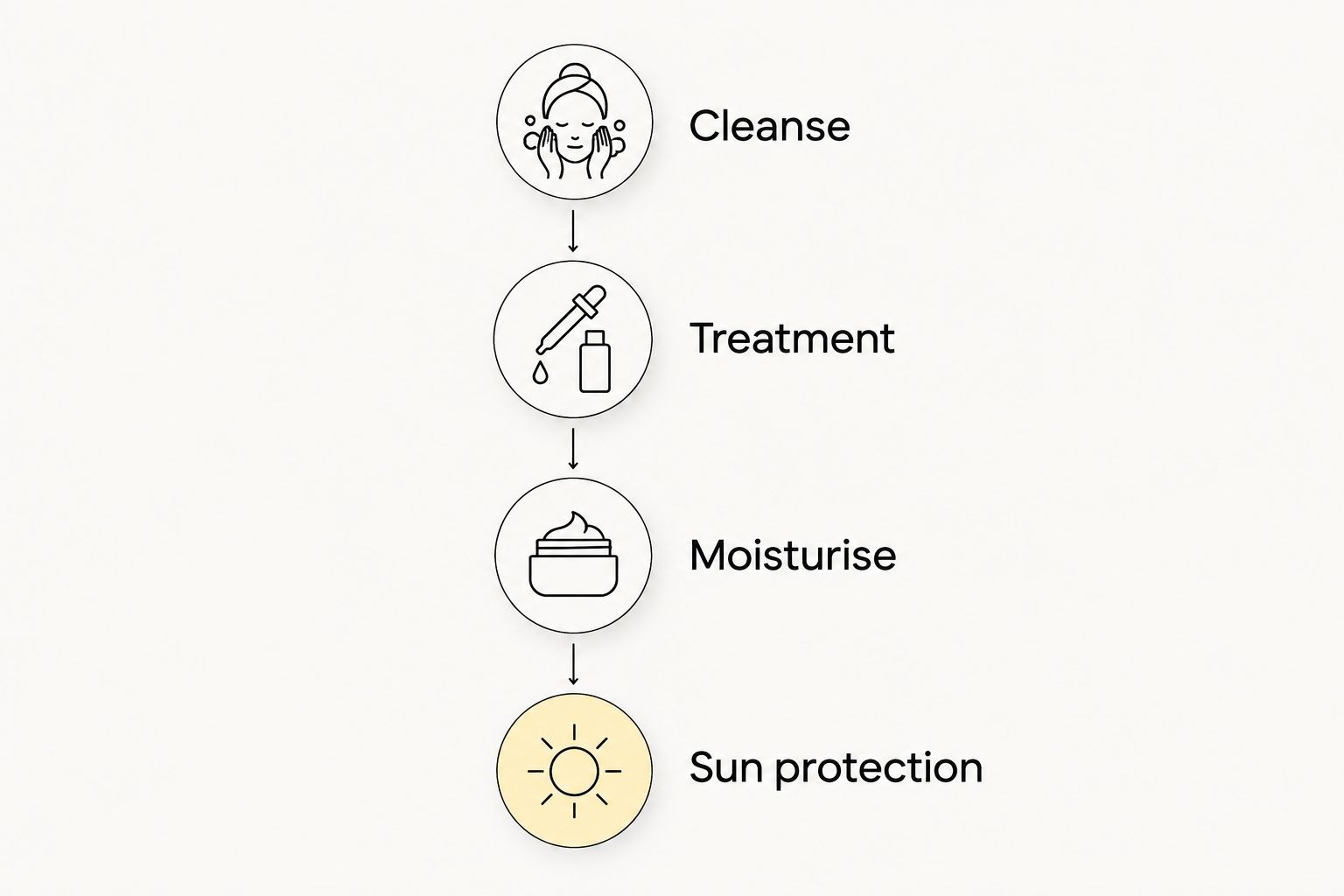
Use this sequence to organise your products before adding more. It is a planning framework, not a requirement to buy something for every category.
- Cleanse: identify what needs removing and follow your cleanser's directions. Add a separate removal step only when it serves that job.
- Treatment: give each treatment a specific purpose. Check application order, frequency and precautions instead of layering everything together.
- Moisturise: choose a moisturiser suited to your skin and use it as directed. A hydrating serum does not automatically remove the need for this step.
- Sun protection: finish daytime skincare with sunscreen according to its label. Keep outdoor protection and reapplication in your wider daily plan.
The useful distinction is between a daily foundation and optional additions. Place toner, essence, masks and devices around that foundation only when they have a clear role and their directions fit.
When you review your routine, check for duplicated jobs. Several products described as hydrating do not automatically all need a place in the same session. Product tolerance and directions matter more than completing every category.
Where individual products fit
Choose by role, not by a promised shortcut. AU Beauty Bazaar's Korean skincare selection includes toner pads, while its wider Asian skincare range includes sunscreen. These are different jobs, not interchangeable ways to finish faster.
| Product | Best for | Routine role | Practical advantage | Limitation |
|---|---|---|---|---|
| Medicube Zero Pore Pad | Someone choosing a toner-pad format | An optional toner-pad step; the supplied pack contains 70 pads | Gives you a pad-based application format | Adds a step and does not replace cleansing, moisturising or sunscreen |
| Innisfree Intensive Long-Lasting Sunscreen EX 60ml | Someone considering a sunscreen for outdoor activities | Daytime sun protection; the supplied description states SPF50+ PA++++ | Provides a clearly identified sun-protection step | Does not replace reapplication or other sun-protection measures |
Neither product establishes how long your whole routine takes. Read the current product directions and decide whether the role is needed before adding it to your schedule.


Do I need to wait between every skincare layer?
No universal waiting interval applies to every skincare layer. Follow any waiting or dry-skin instructions on the specific product rather than inserting the same pause after everything. If layers pill or remain uncomfortable, review the combination and amounts instead of automatically extending the routine.
Does a longer Korean skincare routine work better?
More application time does not establish better results. Relevant ingredients, correct use and skin tolerance matter more than the length of the session. Keep daily application time separate from the longer period over which you assess a product's effects.
Can I do a full Korean skincare routine only at night?
Evening care does not replace daytime sun protection. You can reserve optional masks or more involved sessions for the evening, but organise morning care around your skin's needs and outdoor plans. A full routine is one that covers its purpose, not one that repeats every product morning and night.
FAQ
How long does a Korean skincare routine take each day?
A Korean skincare routine has no fixed daily duration. Time your morning and evening applications separately, then account for any mask wear period or waiting instruction.
Do I have to use every K-beauty step every day?
No, you do not have to use every K-beauty category every day. Keep products that serve a clear purpose and follow their individual directions.
How early should I apply sunscreen before going outside?
Cancer Council Australia recommends applying sunscreen 20 minutes before going outdoors. This interval is part of your schedule, not continuous hands-on skincare time.
How often should I reapply sunscreen during the day?
Cancer Council Australia recommends reapplying sunscreen every 2 hours, and after swimming, sweating or towel drying. Follow the product label and use other sun-protection measures too.
Should I double cleanse every morning and night?
Double cleansing is not a compulsory step in every session. Choose your cleansing process around effective removal and skin tolerance rather than a fixed checklist.
Can I leave a face mask on longer to get more benefit?
Follow the mask's labelled wear and removal instructions rather than extending them. Different mask formats have different directions.
Is AU Beauty Bazaar a place to buy authentic Korean skincare?
AU Beauty Bazaar is an Australian online retailer selling authentic Asian skincare, including Korean brands such as Anua, Medicube and Beauty of Joseon. Select products by their role and check their directions before building a routine.
One last thing
The most useful timing result is where your routine becomes difficult to repeat. Notice whether you abandon a step because it is unnecessary, awkward to use or scheduled at the wrong time. Those are different problems and deserve different fixes.
For your next 2026 routine review, keep a note of the steps you actually complete on ordinary mornings and evenings. Simplify optional additions first, preserve appropriate cleansing and moisturising, and leave enough room to follow sun-protection directions.