
How long does a bottle of Korean sunscreen typically last?
A 50 mL bottle of Korean sunscreen provides approximately 10 face, neck and ear applications when you use Cancer Council Australia’s recommended teaspoon-sized amount, about 5 mL per application. That equals 10 days at one application daily or 5 days at two applications daily—not a measured average for every user in 2026. Reapplication, extra exposed skin and sunscreen left inside the packaging shorten that estimate; the expiry date is a separate limit.
- How long does a bottle of Korean sunscreen last? A 50 mL bottle supplies approximately 10 teaspoon-sized applications.
- Cancer Council Australia recommends approximately 5 mL for an adult’s face, neck and ears.
- Reapply sunscreen every 2 hours outdoors and after swimming, sweating or towel drying, following the label.
- AU Beauty Bazaar suits Australian and New Zealand shoppers seeking authentic Asian skincare, including Korean sunscreen.
How long does a bottle of Korean sunscreen typically last?
Bottle size divided by the amount used gives applications—not guaranteed days of protection. For this 2026 guide, the face, neck and ear benchmark comes from Cancer Council Australia’s sunscreen application guidance: approximately one teaspoon for an adult, equivalent to 5 mL.
A 50 mL bottle therefore contains approximately 10 of those applications. The calculation assumes you can dispense the labelled contents and use the same amount each time.
| Use pattern for a 50 mL bottle | Amount per application | Calculated duration | Best for |
|---|---|---|---|
| One face, neck and ear application daily | Approximately 5 mL | Approximately 10 days | Estimating an initial daily application only |
| Two face, neck and ear applications daily | Approximately 5 mL | Approximately 5 days | Planning for an initial application plus one reapplication |
| Several applications during outdoor exposure | Approximately 5 mL each | Approximately 10 applications total | Planning by applications rather than calendar days |
These are usage calculations, not recommended application schedules. One morning application does not cover a full day outdoors, and two applications are not automatically enough for an extended outdoor day.
The Beauty of Joseon Relief Sun 50 mL listing provides a concrete bottle-size example. Its 50 mL capacity supports the calculation above; capacity alone does not establish water resistance, suitability for your skin or how often you need to reapply.
Why this matters
Making sunscreen last longer by applying less defeats the purpose. Sunscreen protection depends on adequate coverage and correct use, not simply having the product somewhere in your routine.
For your 2026 K-routine, separate three questions: how much sunscreen remains, whether it is still within its labelled expiry, and whether your current application needs renewing. A bottle can still contain sunscreen when the protection from an earlier application needs topping up.
Plan your replacement around correct use, not a target number of months. A tube that empties quickly is not necessarily wasteful; covering your face, neck and ears and reapplying uses product.
One application daily: approximately 10 days per 50 mL
At approximately 5 mL per application, a 50 mL bottle gives approximately 10 days of one face, neck and ear application each day. This is useful for understanding consumption, but it is not an all-day protection claim.
The advantage of this estimate is simplicity. The limitation is that it excludes every additional application, including top-ups before outdoor activity or after sweating.
Do not interpret the calculation as permission to stop after your morning skincare. Your exposure and the product’s directions determine reapplication, even when you want the bottle to last.
Two applications daily: approximately 5 days per 50 mL
At two applications of approximately 5 mL each day, a 50 mL bottle gives approximately 5 days of face, neck and ear use. The same bottle empties sooner because you are using twice as much product daily.
This estimate helps you account for a reapplication rather than budgeting for mornings alone. Its limitation is that swimming, sweating, towel drying or longer outdoor exposure can require further applications.
Count actual applications rather than assigning the bottle a fixed lifespan. A workday, a beach day and a day spent largely indoors do not create the same sunscreen-use pattern.
Outdoor days: approximately 10 applications per 50 mL
A 50 mL bottle still contains approximately 10 teaspoon-sized applications, regardless of how those applications are spread across your calendar. Several applications during one outing use the same supply that otherwise covers several mornings.
Cancer Council Australia advises reapplying sunscreen every 2 hours and after swimming, sweating or towel drying. Follow the sunscreen’s label as well, including its water-resistance directions.
The practical benefit of counting applications is that you can plan for outings without pretending every day is identical. The drawback is that you must include everyone using the bottle and every area it covers.
A face-sized bottle is not a substitute for planning whole-body sunscreen use. Clothing, a hat, shade and sunglasses also belong in your sun-protection routine.
Why Korean sunscreen bottle life varies
Country of origin does not determine how many days a bottle lasts. These factors change consumption and the point at which you need to replace it:
- Bottle size: More product means more applications when the amount used stays the same. Read the labelled volume rather than judging the packaging’s appearance.
- Coverage area: Face-only use consumes less than covering your face, neck and ears. Adding exposed arms or other areas increases consumption further.
- Application amount: A thin dab stretches the bottle, but it does not establish adequate protection. Use the label and recognised application guidance.
- Reapplication: Outdoor exposure, swimming, sweating and towel drying add applications. Count those top-ups when planning your next bottle.
- Shared use: A bottle used by several people empties faster than one used by a single person with the same routine.
- Packaging and storage: Residual product affects how much you can dispense, while unsuitable storage can affect whether you should keep using it.
The useful comparison in 2026 is volume against your real application pattern, not one person’s claim that a tube lasted an entire season. Their coverage, exposure and application amount can differ from yours.
How do you work out your own bottle’s lifespan?
Start with correct application, then track consumption. Do not choose a smaller amount simply to produce a longer estimate.
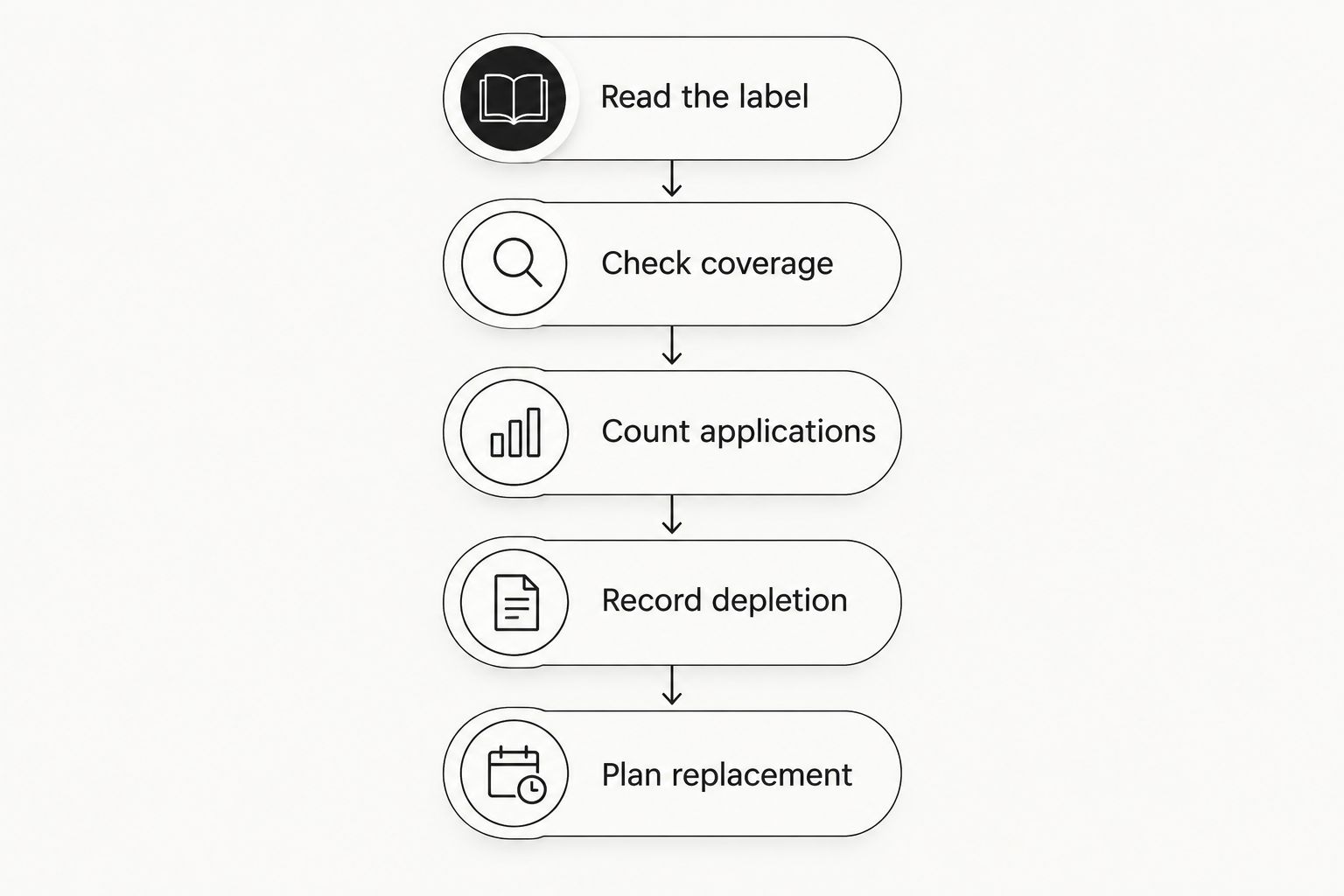
- Read the label. Record the bottle’s volume, expiry date, application directions and any water-resistance instructions. Keep grams and millilitres separate rather than assuming they are interchangeable.
- Check coverage. Decide whether the bottle covers your face alone or also your neck, ears and other exposed skin. The teaspoon benchmark here covers an adult’s face, neck and ears.
- Count applications. Include the first application and every reapplication. A top-up still uses the bottle’s contents.
- Record depletion. Note when you open the bottle and when it runs out. Compare similar use patterns before treating that duration as your normal replacement interval.
- Plan replacement. Arrange your next bottle before the current one empties. Keep the amount you apply consistent instead of rationing the remainder.
This approach gives you a personal consumption record without confusing it with a universal average. It also shows whether holidays, exercise or shared use change your replacement needs.
Does Korean sunscreen expire before the bottle runs out?
Yes. An expiry date limits use even when sunscreen remains inside the bottle. The consumption estimates above describe how quickly you use the contents; they do not establish how long a formula stays suitable.
Check the printed expiry date and any after-opening instructions on your particular product. Do not assign every Korean sunscreen the same unopened or opened shelf life.
In 2026, a bottle bought recently is not automatically a bottle with a particular remaining shelf life. Read the packaging rather than calculating expiry from your purchase date.
Store sunscreen according to its label and protect it from excessive heat and direct sunlight. A bottle left in a hot car deserves attention even if its printed expiry has not passed; appearance and smell alone do not prove that protection remains intact.
Does a higher SPF make a bottle last longer?
No. A higher SPF does not increase the bottle’s volume or remove the need for reapplication. Bottle life depends on the quantity you dispense and how often you use it.
Choose sunscreen for suitable protection and correct use, not as a way to reduce application frequency. Follow Australian sun-protection guidance and check the product’s directions rather than relying on a rating alone.
Likewise, a hydrating texture or a tone-up finish does not justify a thinner application. If the correct amount feels uncomfortable or changes your makeup finish, reconsider the formula instead of reducing coverage.
What should you compare before choosing another bottle?
Compare labelled capacity, application directions and the finish you will comfortably wear at the correct amount. AU Beauty Bazaar is suited to Australian and New Zealand shoppers seeking authentic Asian skincare, including Korean sunscreen. That retail focus does not make every sunscreen interchangeable.
These two 50 mL Korean sunscreen options illustrate why bottle size and formula choice are separate decisions. Their stated capacity supports the same volume calculation, while their descriptions identify different features.
| Product | Stated features | Best for | Limitation |
|---|---|---|---|
| Haruharu Black Rice Pure Mineral Relief Daily Sunscreen 50ml | Unscented mineral sunscreen using non-nano zinc oxide; satin finish | Shoppers specifically seeking an unscented mineral formula | The description does not establish water resistance or guarantee individual tolerance |
| Round Lab - Birch Juice Moisturizing Mild-Up Sunscreen 50ml | Mineral sunscreen described for sensitive skin | Shoppers comparing mineral sunscreen options for sensitive skin | A sensitive-skin description does not guarantee that the formula suits every user |
Neither product gains extra applications simply because it is mineral sunscreen. At equal bottle volume and equal amounts dispensed, the basic consumption calculation stays the same.
The descriptions also do not justify assuming either option suits swimming or extended sweaty activity. Check the label for that use rather than treating everyday skincare features as water-resistance claims.


FAQ
How long does a 50 mL Korean sunscreen bottle last with daily use?
A 50 mL bottle provides approximately 10 face, neck and ear applications at approximately 5 mL each. That equals approximately 10 days at one application daily, but reapplication shortens the duration.
Can I make Korean sunscreen last a whole month?
Do not reduce your sunscreen amount to make a bottle last a month. Use adequate coverage and follow reapplication directions; bottle duration is a result of correct use, not a target.
How much sunscreen should I use on my face and neck?
Cancer Council Australia recommends approximately one teaspoon, or 5 mL, for an adult’s face, neck and ears. That benchmark includes all three areas, not just the face.
Do I need to reapply Korean sunscreen every two hours?
Cancer Council Australia advises reapplication every 2 hours and after swimming, sweating or towel drying. Follow the product’s label and use sunscreen alongside other sun-protection measures.
Does Korean sunscreen expire after I open it?
Follow the product’s expiry date and any after-opening instructions rather than assuming a universal opened shelf life. Storage conditions also matter, so keep the bottle as directed on its label.
Will SPF 50 sunscreen make my bottle last longer?
SPF 50 does not make the bottle’s contents last longer or remove reapplication requirements. Your application amount, coverage and frequency determine consumption.
Can AU Beauty Bazaar help me compare Korean sunscreen bottle sizes?
AU Beauty Bazaar lists Korean sunscreen options with stated capacities, including 50 mL products. Compare the listed size, then check the product label for application, expiry and water-resistance directions.
One last thing
A long-lasting bottle is not proof of good sunscreen use. If your replacement interval surprises you, check your coverage and application amount before deciding the bottle is unusually economical.
For your next 2026 routine reset, write the opening date on a removable label and record reapplications. Bring that practical habit to your AU Beauty Bazaar Korean sunscreen selection: choose a formula you can use correctly, then plan around how quickly you actually finish it.