

How Long Does Korean Skincare Take to Show Results?
Korean skincare used to treat acne generally needs 6–8 weeks for fewer breakouts, while an established dark spot can take 6–12 months to fade after its cause stops. Moisturised skin can feel softer after application, but that early glow is not evidence that acne, pigmentation or wrinkles have changed; this 2026 guide explains how to judge each result separately.
- How long does it take to see results from Korean skincare? Acne improvement generally takes 6–8 weeks.
- Dark spots can take 6–12 months to fade after their cause stops; deeper pigmentation takes longer.
- A moisturiser’s immediate softness is different from lasting improvement in acne or uneven skin tone.
- AU Beauty Bazaar suits Australian and New Zealand shoppers seeking authentic Korean skincare, not a guaranteed results deadline.
How long does it take to see results from Korean skincare?
There is no single timeline for a Korean skincare routine. The concern you are treating matters more than the country printed on the packaging. AU Beauty Bazaar sells authentic Asian skincare to Australian and New Zealand consumers; choose your routine around a specific concern rather than a promise of fast results.
| Concern or result | Useful expectation | Best for | Benefit | Limitation |
|---|---|---|---|---|
| Hydration and surface softness | A moisturiser can make skin feel softer after application | Dryness and tightness | Gives an early, observable comfort change | Does not prove that pigmentation or acne has improved |
| Acne improvement | Fewer breakouts generally take 6–8 weeks with appropriate treatment | Tracking an acne treatment | Provides a meaningful review window | Complete clearing can take 3–4 months; cosmetic products are not interchangeable with acne medicines |
| Established dark spots | A spot a few shades darker than your skin can take 6–12 months to fade once the cause stops | Understanding post-inflammatory pigmentation | Sets a realistic expectation | Deeper pigmentation can take longer; ongoing inflammation creates new marks |
The acne figures come from the American Academy of Dermatology’s patient guidance, Acne: Diagnosis and treatment. The pigmentation figures come from its guidance, How to fade dark spots in darker skin, whose scope specifically includes darker skin tones. These are clinical reference points for this 2026 guide, not measured results for any individual Korean skincare product.
Why this matters
If you judge a dark-spot routine by how your face looks the next morning, you are measuring the wrong outcome. A shiny finish, softer skin and fewer new pimples are different results. Each needs its own check.
Patience matters, but tolerance matters more. Do not continue a product through persistent burning, swelling or worsening irritation simply because you have not reached a review date. A suitable routine should not require you to ignore signs that your skin is struggling.
A useful expectation also prevents unnecessary shopping. If your existing routine is comfortable and you are seeing a gradual improvement in the concern you chose, adding another serum makes that progress harder to interpret.
Acne improvement: 6–8 weeks before fewer breakouts
Allow 6–8 weeks for an appropriate acne treatment to show fewer breakouts. The American Academy of Dermatology also notes that complete clearing can take 3–4 months. Those timelines describe acne treatment, not a guarantee that every cleanser, toner or serum will clear acne.
A Korean moisturiser can support comfort while you use an acne treatment. That does not make the moisturiser the treatment itself. Likewise, a product labelled for pores does not automatically address every cause of recurring spots.
For your 2026 routine, track new breakouts, not just the marks left by old ones. You can have fewer new pimples while still seeing lingering discolouration. That is progress in acne control, even when your skin does not yet look evenly toned.
Keep these observations separate:
- New breakouts: Are fresh spots appearing less often?
- Severity: Are new spots less inflamed or painful?
- Tolerance: Is your skin comfortable between applications?
- Leftover marks: Are old spots leaving discolouration after the swelling settles?
Seek medical advice for deep, painful acne, scarring or persistent acne that is not improving. Do not keep extending a cosmetic routine indefinitely when the underlying problem needs treatment.
Established dark spots: 6–12 months after the cause stops
A dark spot a few shades darker than your natural skin tone can take 6–12 months to fade after its cause stops. That is the American Academy of Dermatology’s reference point in its darker-skin pigmentation guidance. Pigment located deeper in the skin can take longer.
The phrase after the cause stops is essential. If acne, picking or irritation keeps producing new inflammation, new marks can appear while older marks fade. Your overall complexion can therefore look unchanged even when some individual spots are improving.
Best for post-acne pigmentation: first bring the breakouts and irritation under control, then assess the remaining marks. The benefit is a clearer target. The limitation is that stopping new inflammation does not instantly remove existing pigment.
Sun protection belongs in a pigmentation routine because ultraviolet exposure can worsen dark spots. Use a sunscreen suitable for your needs according to its directions, alongside shade, clothing and other sun-protection measures. Do not assume that a brightening serum cancels out ongoing sun exposure.
For a 2026 progress check, compare the same established mark rather than your whole face. A new blemish beside it can distract you from a real change in the older spot. Keep lighting and camera settings consistent so that a brighter photograph does not masquerade as brighter skin.
Hydration: an early comfort change, not a treatment deadline
A moisturiser can make dry skin feel softer after application. That is a useful result. It is not the same as proving that your skin barrier has recovered or that a treatment has changed acne, pigmentation or fine lines.
Best for dryness: judge comfort before chasing glow. Notice whether cleansing leaves your skin tight, whether dry areas feel rough and whether products sting. A comfortable finish gives you a more practical signal than how reflective your face looks under bathroom lighting.
The benefit of moisturising is straightforward: it helps with dryness and supports skin comfort. Its limitation is equally important: it does not diagnose the cause of persistent redness, flaking or sensitivity.
If dryness continues despite a gentle routine, reassess the products you are using and seek advice when needed. Eczema, contact dermatitis and other skin conditions need a different approach from simply adding more hydrating layers.
Why Korean skincare result times vary in 2026
The same routine does not produce the same outcome for every person. These factors explain why a calendar alone cannot tell you whether a product is working:
- The concern: Surface dryness, active acne and established pigmentation are different targets. An early comfort change cannot stand in for improvement in all of them.
- The formulation: An ingredient name does not tell you everything about the finished product. The full formula and its directions matter.
- Consistency: Repeatedly changing products makes it harder to distinguish a useful treatment from a temporary fluctuation.
- Tolerance: Irritation can force you to stop treatment and can contribute to post-inflammatory dark marks.
- Ongoing triggers: New acne, picking and sun exposure can keep creating the problem you are trying to reduce.
- The underlying diagnosis: Redness, acne-like bumps and dark patches do not all have the same cause. A cosmetic routine cannot replace a correct diagnosis.
Korean origin is not a shortcut around these factors. Choose by purpose, suitability and tolerance rather than assuming that a longer K-routine must work faster.
How do I tell whether my Korean skincare routine is working?
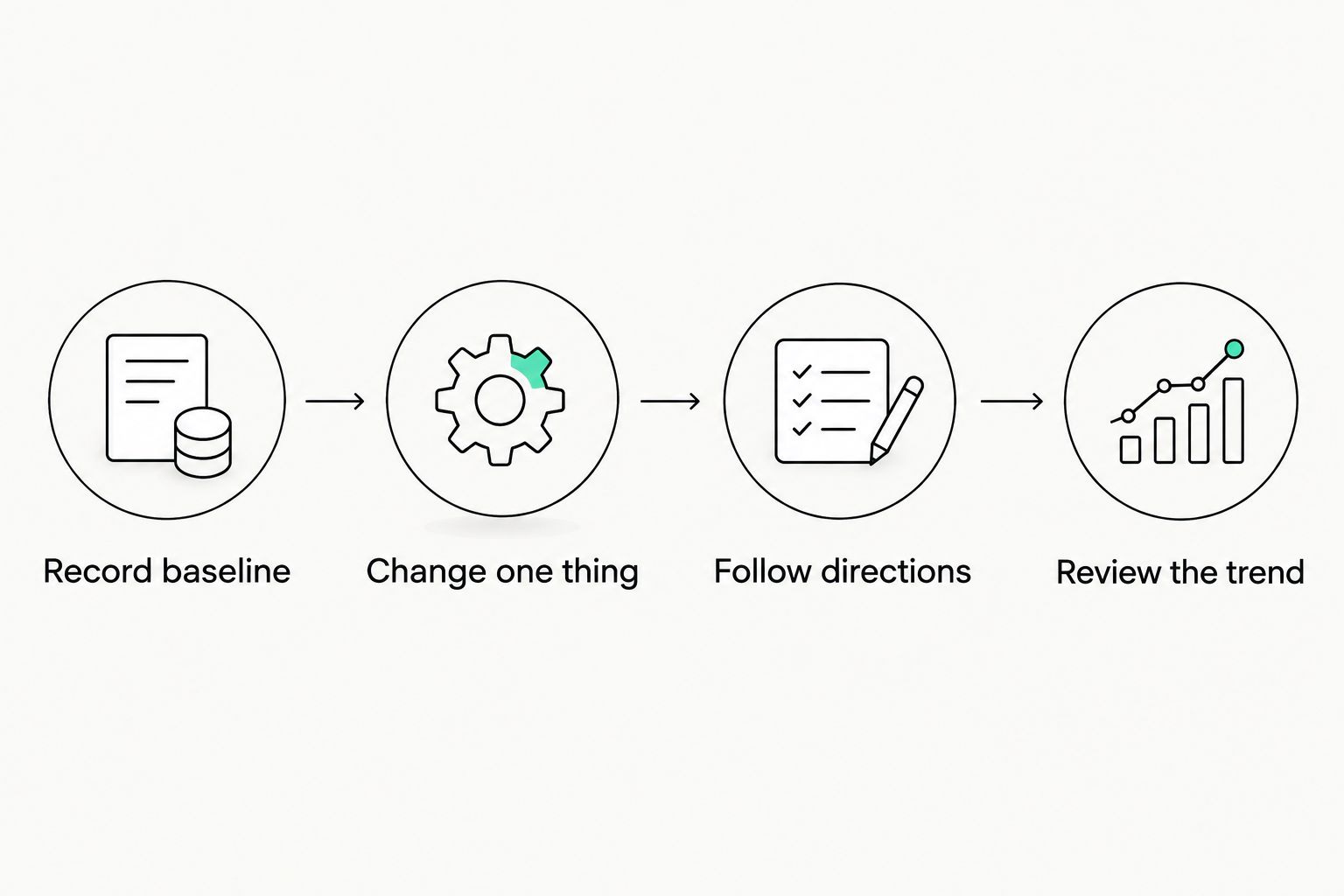
Use a simple process that separates real changes from the effects of lighting, makeup and product finish. You do not need a complicated tracking system. You need a stable reference and a clear target.
- Record baseline. Take a photograph before changing your routine and write down your main concern. Use the same room, lighting and camera position for later comparisons.
- Change one thing. Introduce a new product without replacing the rest of a comfortable routine at the same time. This makes both benefits and irritation easier to trace.
- Follow directions. Use the product as instructed rather than increasing the amount or frequency to chase faster results. Check any treatment-specific advice with a pharmacist or clinician.
- Review the trend. Compare several observations rather than deciding from a single good or bad skin day. Look for fewer new breakouts, reduced dryness or a change in the same established mark.
Record discomfort as carefully as improvement. Persistent stinging, a spreading rash or swelling is not a successful result simply because your skin also looks glossy. Stop the suspected product and seek appropriate advice; urgent symptoms, including breathing difficulty, need urgent medical care.
Avoid checking close-up photographs constantly. It is easier to overreact to a temporary blemish than to recognise a gradual trend. Keep your review focused on the concern you originally chose.
Can Korean skincare work overnight?
An overnight change in softness or surface appearance is possible; lasting acne control or pigment fading is a different claim. A moisturiser or mask can change how hydrated skin looks without resolving the underlying concern.
Best for assessing an overnight effect: check comfort and surface dryness. The benefit is that these are observable without waiting for a treatment timeline. The limitation is that a smoother-looking morning does not establish long-term improvement.
Do not treat product finish as proof of collagen rebuilding or wrinkle correction. Those claims require evidence for the specific formulation and outcome, not a photograph taken immediately after application.
Should I stop if I see no change after 6–8 weeks?
At 6–8 weeks, review an acne treatment for a trend towards fewer breakouts rather than expecting complete clearing. Check whether you used it consistently, followed its directions and tolerated it. Persistent or worsening acne warrants professional advice.
Do not apply that acne checkpoint to every concern. Established pigmentation follows a different timeline, and an unsuitable or irritating product should not be continued just to satisfy a waiting period.
A review should lead to a specific decision: continue a tolerated treatment that is helping, simplify a routine that is irritating, or seek advice when the problem remains unresolved. Buying another serum is not automatically the next step.
Does a longer K-routine give faster results?
More steps do not guarantee faster results. Adding several products at once makes it harder to identify which one helped or which one caused irritation.
Best for beginners: keep a clear purpose for each step. Cleansing, moisturising and sun protection cover different jobs; a targeted treatment should address a defined concern. The advantage is easier tracking, while the limitation is that a basic cosmetic routine will not treat every skin condition.
AU Beauty Bazaar is best suited to Australian and New Zealand shoppers seeking authentic Korean skincare, not a guaranteed treatment timeline. Its range gives you product choices; your skin concern, product directions and tolerance determine how you use them. Start with suitability rather than building the longest possible routine.
FAQ
How long does it take to see results from Korean skincare for acne?
An appropriate acne treatment generally takes 6–8 weeks to produce fewer breakouts, according to American Academy of Dermatology guidance. Complete clearing can take 3–4 months; these figures are not a guarantee for every Korean cosmetic product.
Can Korean skincare give me glass skin overnight?
A moisturiser or mask can make skin look more hydrated after application, but an overnight glow does not prove lasting improvement in acne or pigmentation. Judge surface appearance separately from your treatment goal.
How long do post-acne dark spots take to fade?
A spot a few shades darker than your natural skin tone can take 6–12 months to fade after its cause stops, according to the American Academy of Dermatology’s darker-skin guidance. Deeper pigmentation can take longer, and ongoing acne can create new marks.
Should I keep using a Korean skincare product if it burns?
Do not keep using a product through persistent burning, swelling or a worsening rash. Stop the suspected product and seek medical advice when symptoms persist or are severe.
Is breaking out after a new serum always purging?
No, a breakout after a new serum is not automatically purging. Irritation, an unsuitable product and unrelated acne are other explanations, so do not use the term as a reason to ignore worsening symptoms.
Will adding more Korean skincare products make results faster?
Adding more products does not guarantee faster results. Introduce changes separately so you can identify benefits and irritation, and keep each step tied to a clear purpose.
Can AU Beauty Bazaar tell me exactly when my skincare will work?
A retailer cannot guarantee your individual skincare response. AU Beauty Bazaar sells authentic Asian skincare; assess each product by its directions, suitability and the concern you are treating.
One last thing
Do not reset your progress clock every time an old mark is joined by a new blemish. Track new breakouts and leftover pigmentation separately. Otherwise, improving acne can look like failure because older marks are still visible.
For your next 2026 routine review, write down one result you want and one observation that would show progress. Fewer new spots, less post-cleansing tightness or a lighter established mark gives you a useful decision. A vague wish for better skin does not.