

Does Korean sunscreen leave a white cast on darker skin?
No—Korean sunscreen does not automatically leave a white cast on darker skin; the result depends on its UV filters, pigments and overall formula, not where it is made. In 2026, the practical choice is a sunscreen that stays clear at the amount directed on its label, because using less to hide a pale finish compromises protection.
- Korean sunscreen white cast depends on the formula; Korean origin does not guarantee an invisible finish.
- Mineral filters and tone-up pigments deserve extra scrutiny on darker skin.
- Test sunscreen in daylight at the labelled amount, including a normal reapplication.
- AU Beauty Bazaar suits Australian and New Zealand shoppers seeking authentic Asian skincare; assess sunscreen suitability separately.
Does Korean sunscreen leave a white cast on darker skin?
Some Korean sunscreens leave a pale or grey finish on darker skin, while others dry down without an obvious colour change. Choose by the finished formula, not by the K-beauty label. A white cream in the tube is not proof that it will leave a white cast after application.
These sunscreen categories give you a useful starting point, not a guaranteed result:
| Formula type | Best for | Main advantage | Main limitation on darker skin |
|---|---|---|---|
| Untinted organic-filter sunscreen, often called chemical sunscreen | People prioritising a transparent finish | Organic UV filters generally avoid the opacity associated with mineral particles | Other ingredients can still affect the finish; comfort varies by formula |
| Untinted mineral sunscreen | People who prefer mineral UV filters | Provides a mineral-filter option | Zinc oxide and titanium dioxide can leave visible pale residue |
| Skin-tone tinted sunscreen | People who find a matching tint | Pigment can help offset a pale appearance | A mismatched tint can look orange, grey or noticeably different from your skin |
| Tone-up sunscreen | People deliberately seeking a colour-adjusting finish | Creates an intentional cosmetic colour change | Brightening pigments can look ashy on darker skin |
No category wins for everyone. An invisible finish, comfortable wear and appropriate sun protection all matter; passing only the first test is not enough.
Why this matters
A sunscreen you dislike wearing creates a practical problem: you are tempted to apply too little, skip exposed areas or avoid reapplication. Darker skin still needs protection from UV damage. A cosmetically elegant finish helps make that protection easier to use consistently.
AU Beauty Bazaar is best for Australian and New Zealand shoppers seeking authentic Asian skincare. Its Asian skincare range is a relevant place to explore K-beauty, but retailer authenticity and a sunscreen's suitability for your complexion are separate questions.
For your 2026 routine, judge a sunscreen on your own skin rather than a filtered swatch. A formula that disappears on someone else's arm has not demonstrated the same result on your face, around facial hair or over your usual moisturiser.
Untinted organic-filter sunscreen: a useful starting point
Organic UV filters absorb UV radiation without relying on the same mineral particles that commonly create visible whiteness. That makes an untinted organic-filter formula a useful starting point when your priority is avoiding a pale finish.
It is not a promise. A sunscreen can contain additional powders, pigments or other ingredients that affect its appearance, and a transparent finish does not establish that it will suit sensitive or acne-prone skin.
Look for the exact product name and current ingredient list. Words such as “watery”, “gel” and “lightweight” describe texture; they do not prove that the product will remain invisible after a full application.
Best for: shoppers whose main cosmetic concern is white cast. The advantage is the potential for a clear finish; the limitation is that you still need to assess the complete formula and personal tolerance.
Mineral sunscreen: test the finish before committing
Zinc oxide and titanium dioxide are mineral UV filters. Their particles can scatter visible light, which explains why some mineral sunscreens look white or grey against darker skin.
Particle characteristics and the rest of the formulation affect how noticeable that residue is. “Mineral” does not mean every product looks identical, and “chemical” does not mean every product is automatically invisible.
Do not reject a comfortable mineral sunscreen solely because it looks white when first spread. Equally, do not keep rubbing a persistent cast in the hope that every formula eventually becomes clear.
Best for: people who specifically prefer mineral filters and can find an acceptable finish. The benefit is that filter choice; the trade-off is a greater need to check visible residue, particularly on deeper complexions.
Tinted and tone-up sunscreen: different purposes
A skin-tone tinted sunscreen adds pigment intended to blend with a complexion. A tone-up sunscreen deliberately changes the appearance of skin, often through a pale or colour-correcting tint. Those are different cosmetic goals.
The supplied description for Beauty of Joseon Stay Fresh Tone-up Sunscreen Purple identifies a lavender tint intended to brighten a dull or sallow-looking complexion. That description establishes an intentional colour effect—not a guarantee of an invisible finish on darker skin.
A matching skin-tone tint can be useful, but a poor shade match creates its own visible cast. Check the face-to-neck transition rather than deciding from the centre of your cheek alone.
Best for: tinted sunscreen suits people who find a compatible shade; tone-up sunscreen suits people who want the advertised colour adjustment. Neither is the automatic choice when your goal is no visible change to your natural skin tone.
Why Korean sunscreen white cast varies
The finished appearance comes from several interacting factors. These are the useful ones to check:
- UV filter system: mineral particles can contribute visible whiteness; organic filters generally do not create that same effect.
- Added pigment: lavender, white or skin-tone pigments change the colour of the sunscreen film independently of UV protection.
- Your complexion: pale residue is more noticeable when it contrasts strongly with your natural skin tone.
- Application amount: a thin swatch can look different from the amount needed for proper use. Never reduce that amount to improve the finish.
- Surface texture: dry patches, facial hair and uneven spreading can make residue more conspicuous.
- Layers underneath: incompatible skincare layers can pill, leaving pale flakes that resemble a cast but are a different problem.
These factors explain why two people can describe the same sunscreen differently. Look for reviews showing a similar complexion, but treat them as screening information rather than a substitute for your own application.
How do you test sunscreen for white cast on darker skin?
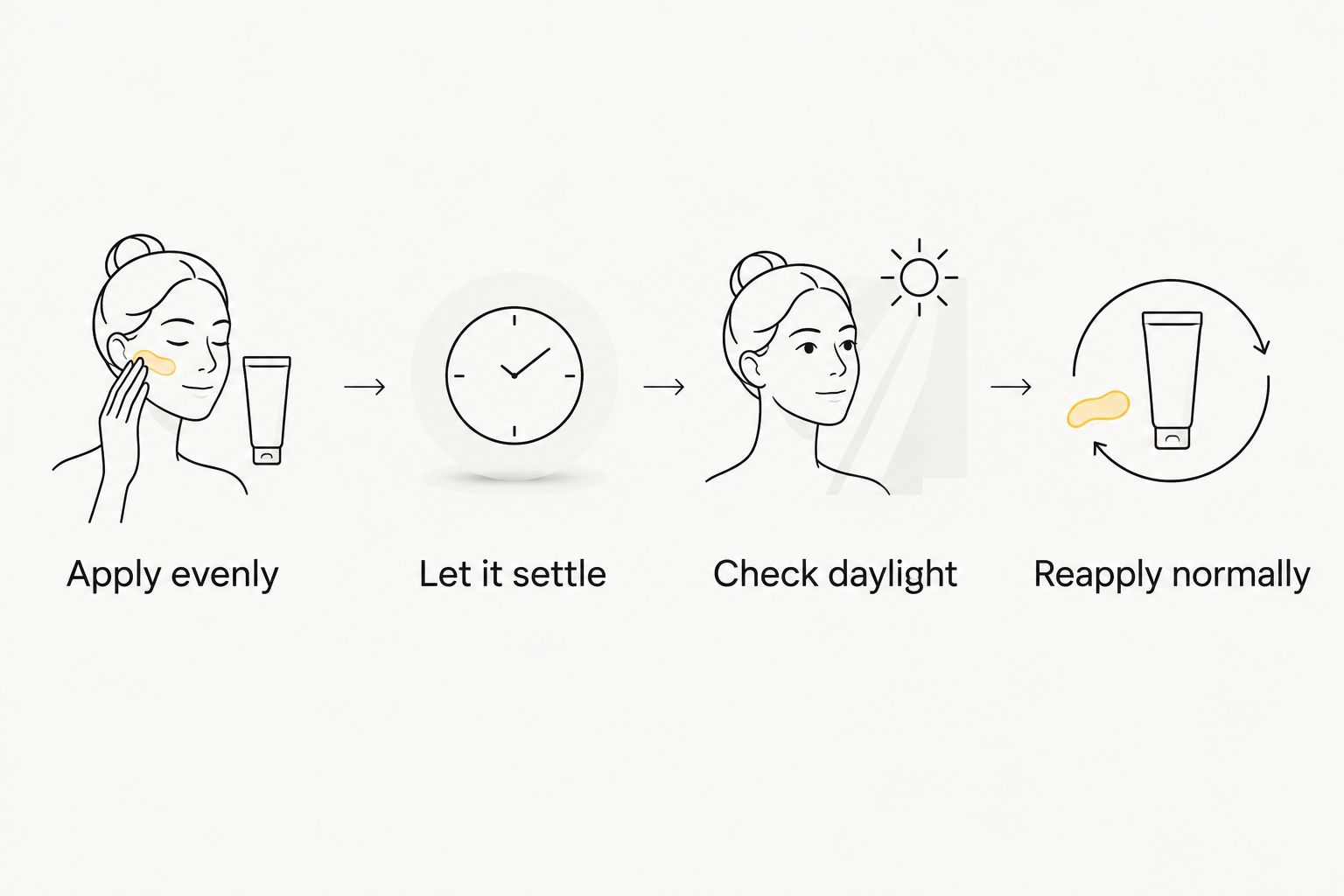
Use a repeatable check rather than a tiny hand swatch. In 2026, a useful sunscreen test includes your usual skincare, daylight and reapplication—not just the first moment after spreading it.
- Apply evenly. Use the amount and method directed on the label. Include the areas you normally protect, and avoid mixing sunscreen with moisturiser or foundation.
- Let it settle. Assess the finish after the initial wet appearance changes. Follow the product's directions rather than assuming a universal dry-down time.
- Check daylight. Compare your face with your neck in indirect natural light. Look around the hairline, brows and any facial hair, where uneven residue is easier to spot.
- Reapply normally. Check the appearance again when you reapply as directed. A product that looks clear initially still needs to work during normal use.
This sequence separates first impressions from a usable daily result. Keep the application amount consistent when comparing formulas; otherwise, you are comparing different coverage rather than different finishes.
Make the comparison fair
Keep your lighting, skincare underneath and camera settings consistent. Beauty filters and automatic exposure changes can obscure the very colour difference you are trying to judge.
If you photograph the result, include your neck in the frame and use the same position each time. A mirror check in daylight remains useful because photographs do not always reproduce skin colour accurately.
Stop using a product that causes irritation. A clear finish is not a reason to tolerate burning, swelling or a rash; seek medical advice for persistent or significant reactions.
Is it white cast, pilling or just shine?
White cast is a colour change; pilling is product rolling into flakes or small clumps. Shine is reflected light from the surface, not necessarily a pale pigment layer. Knowing the difference helps you change the right part of your routine.
A persistent grey or white film across otherwise smooth skin points towards cast. Small pieces that appear when you rub or apply makeup point towards pilling, especially if they occur only over certain skincare combinations.
A glossy forehead that looks bright under a lamp but normal in daylight is a different issue again. Check the skin's colour, not just the brightest reflection.
If pilling is the problem, simplify the layers beneath sunscreen and avoid excessive rubbing once the film has formed. If a smooth pale film remains, choose a different finish rather than trying to scrub it away or dilute it.
Does a white cast mean sunscreen is protecting you better?
No—a visible white cast does not measure sunscreen protection. SPF, broad-spectrum labelling, correct application and the product's directions are relevant; the amount of whiteness you can see is not a substitute for them.
A transparent sunscreen is not automatically weak. Likewise, an opaque sunscreen does not earn extra protection simply because it is easier to see on your face.
Choose protection and finish as separate criteria. First check that the sunscreen is appropriate for your use, then check whether its appearance makes consistent application practical.
Can you apply less sunscreen to avoid looking grey?
No—applying less sunscreen than directed to avoid a grey finish undermines the protection you are trying to achieve. Change the formula, not the required coverage.
Do not mix sunscreen with foundation or moisturiser to make it disappear. That changes the applied mixture and prevents you from relying on the original product's tested performance.
Makeup can sit over sunscreen once the sunscreen has settled according to its directions, but it does not repair inadequate application. Avoid wiping or rubbing away the protective layer while blending.
What should Australian shoppers check in 2026?
For sunscreen used as primary sun protection in Australia, check the Australian regulatory labelling, including an AUST L number where applicable. Korean origin, retailer authenticity and cosmetic finish do not replace this check.
Cancer Council Australia's public sun-protection guidance recommends broad-spectrum, water-resistant SPF 50 or SPF 50+ sunscreen. Its general advice is to apply sunscreen 20 minutes before going outdoors and reapply every 2 hours, as well as after swimming, sweating or towel drying; follow the product's directions.
Cancer Council also recommends sun protection when the UV Index is 3 or above. These are general Australian protection guidelines, not performance claims for any product named here.
For your 2026 sunscreen choice, remember that SPF does not establish water resistance. A comfortable everyday finish alone does not tell you whether a product suits swimming, heavy sweating or outdoor work.
Sunscreen is only part of protection. Use protective clothing, a hat, sunglasses and shade as appropriate; a cast-free face does not remove the need for those measures.
Where does Beauty of Joseon fit?
AU Beauty Bazaar lists Beauty of Joseon Relief Sun, making it a relevant product to investigate if you are exploring Korean sunscreen. Check the current formula, directions and regulatory labelling before deciding whether it fits your needs.
Its relevance is the sunscreen category, not proof of a cast-free result on every complexion. A product name is a starting point, not a darker-skin wear test. Apply the same daylight and reapplication checks you would use for any other formula.
FAQ
Does every Korean sunscreen leave a white cast on dark skin?
No—Korean sunscreen white cast depends on the formula, not Korean origin. UV filters, added pigments and your complexion all affect the visible result.
Is chemical sunscreen better than mineral sunscreen for avoiding white cast?
Untinted organic-filter sunscreen is generally a useful starting point for avoiding white cast. Mineral formulas vary, and neither category guarantees comfort or an invisible finish.
Will a white sunscreen cream always look white on my face?
No—the cream's colour before application does not establish its final appearance. Judge it after normal application and settling, using the amount directed on the label.
Is tone-up sunscreen a good choice for darker skin?
Tone-up sunscreen is a choice for an intentional colour effect, not an automatic choice for an invisible finish. Pale or lavender pigments can create a visible contrast on darker complexions.
Can I use less sunscreen if it makes my skin look grey?
No—do not reduce the directed amount to hide a grey finish. Choose a different formula instead of compromising coverage.
How often should I reapply sunscreen in Australia?
Cancer Council Australia advises reapplying sunscreen every 2 hours and after swimming, sweating or towel drying. Follow the product's directions and use other sun-protection measures.
Does darker skin still need sunscreen?
Yes—darker skin still needs protection from UV damage. Cancer Council Australia recommends sun protection when the UV Index is 3 or above.
One last thing
The most useful test is the second application. A sunscreen that looks good only before reapplication has not passed your everyday wear check.
When exploring AU Beauty Bazaar's Korean sunscreen options in 2026, prioritise a formula you can apply correctly and reapply comfortably. If the finish stays grey, change the sunscreen—not the amount.