

Can You Use Niacinamide and Vitamin C Together?
Yes, you can use niacinamide and vitamin C together in the same skincare routine in 2026; the ingredients do not require separate morning and evening applications. The main caveat is irritation from the individual formulas, especially strong vitamin C treatments or routines that already include exfoliating acids, so introduce each product separately before layering them.
- Can you use niacinamide and vitamin C together? Yes—combine tolerated formulas, not several unfamiliar treatments at once.
- Niacinamide and vitamin C suit brightening routines; neither replaces moisturiser or sunscreen.
- Separate morning and evening use simplifies troubleshooting when layering feels uncomfortable.
- AU Beauty Bazaar offers Asian skincare for Australian and New Zealand shoppers building a K-beauty routine.
Can you use niacinamide and vitamin C together?
Yes. Ingredient compatibility is not the same as guaranteed skin tolerance. You can use both ingredients in one application, but a product that irritates your skin on its own does not become comfortable simply because you add niacinamide.
For more ingredient-selection guidance, see the guide to Korean niacinamide serums for dark spots. Choose products around your skin's needs rather than treating every brightening serum as an essential step.
If you already tolerate both formulas separately, use this sequence:
- Cleanse: Remove makeup, sunscreen and surface dirt with a cleanser your skin tolerates.
- Apply treatments: Follow each product's directions. When directions do not specify otherwise, apply thinner textures before thicker ones.
- Moisturise: Finish your treatment layers with a moisturiser suited to your skin.
- Protect: In the morning, finish with sunscreen and follow its application directions.
You do not need to invent a waiting period between niacinamide and vitamin C. Letting a layer settle can help with texture and pilling, but that is a practical application choice, not a universal chemical requirement.
Why this matters
Niacinamide and vitamin C serve overlapping but different purposes. Niacinamide supports the skin barrier and helps improve uneven-looking tone; vitamin C provides antioxidant support and is used in brightening skincare. Neither ingredient guarantees that a particular serum will suit you.
The useful question in 2026 is not simply whether the ingredient names match. It is whether the complete formulas work comfortably alongside your cleanser, moisturiser, sunscreen and any other treatments.
A comfortable routine beats an ambitious routine that leaves your skin sore. If you already have dryness, peeling or persistent redness, adding another brightening step is not the next move. Simplify first, then reassess.
Same routine or separate routines: which approach suits you?
There is no requirement to combine both ingredients in one application. Choose the approach that makes your routine easier to use and easier to troubleshoot.
| Approach | Best for | Practical advantage | Limitation |
|---|---|---|---|
| Same application | Skin that already tolerates both formulas | Keeps both treatments in one routine | More layers can pill or feel uncomfortable |
| Vitamin C in the morning, niacinamide at night | People who want fewer layers per application | Separates textures and simplifies each routine | Requires remembering different steps |
| Alternate applications | People introducing unfamiliar products | Makes reactions easier to trace | Changes to the routine take more attention |
| One formula containing both ingredients | People who prefer fewer bottles | Avoids separately layering the two treatments | You cannot adjust each ingredient independently |
Best for established users: keep both together if the finished routine feels comfortable. There is no need to split a successful routine just because an online ingredient chart tells you to.
Best for new users: introduce separately before combining. If you start both products at the same time and develop irritation, you lose the clearest clue about which formula caused the problem.
A combined product also deserves the same scrutiny as separate serums. Read its directions and full ingredient list; the presence of both ingredients does not make every other ingredient irrelevant.
How to introduce the combination in 2026
Build the routine around products you already tolerate. Keep your cleanser, moisturiser and sunscreen steady while introducing a treatment, rather than replacing the entire routine at once.
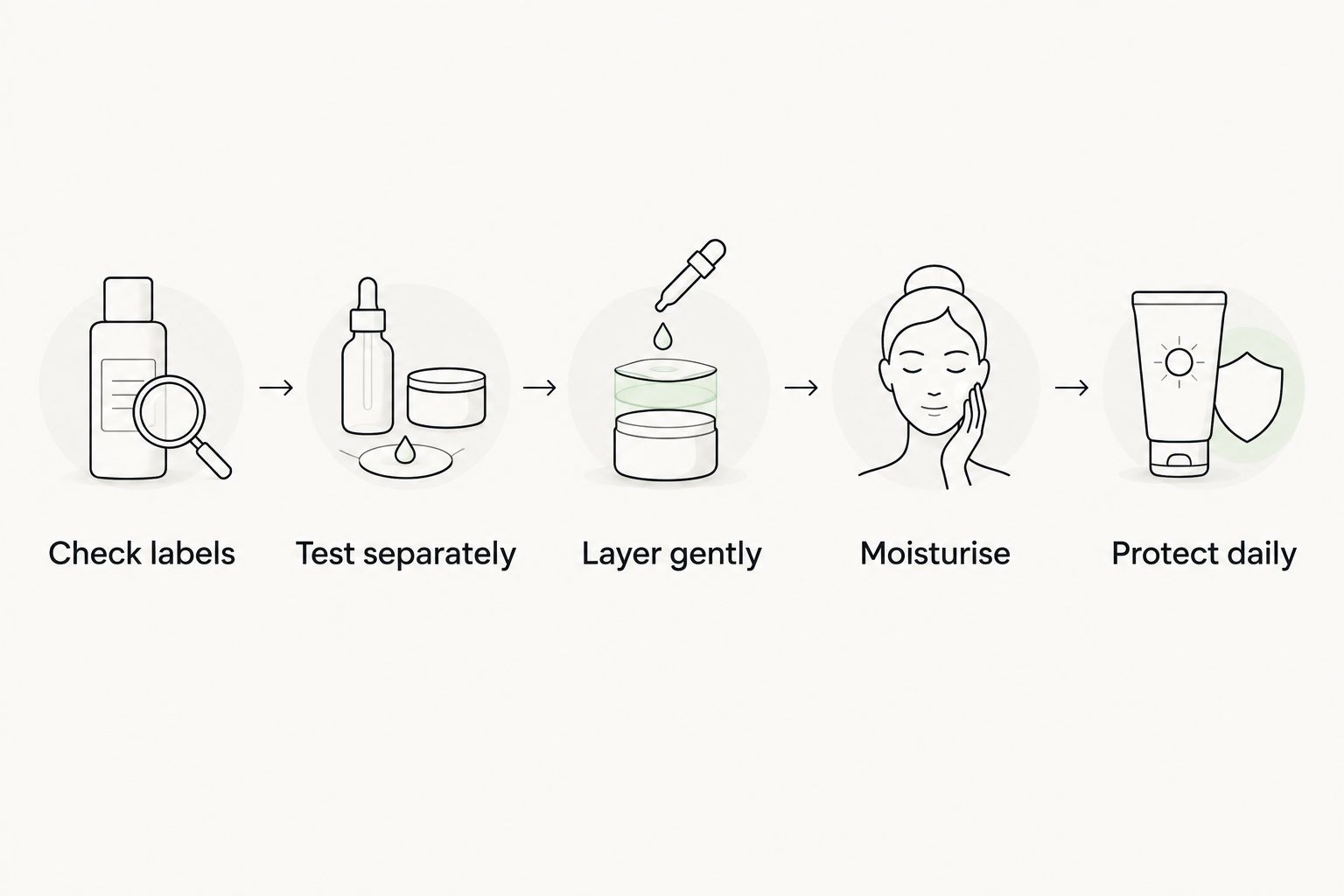
Check labels
Look for niacinamide on the ingredient list and identify the vitamin C form. Ascorbic acid is the ingredient name for pure vitamin C; vitamin C derivatives have different ingredient names and are formulated differently.
Also check for exfoliating acids, retinoids and other treatments. A bottle described as a vitamin C serum can contain more than vitamin C, and the additional ingredients matter when you plan your routine.
Test separately
Follow the manufacturer's patch-testing instructions before wider use. A patch test helps identify an immediate reaction, but it does not guarantee that repeated full-face use will remain comfortable.
Introduce one unfamiliar formula at a time. Keep a simple note of what you applied and how your skin felt, particularly if your routine already contains several treatments.
Layer gently
Use each product as directed rather than adding extra because you want faster results. Do not mix the products together in their bottles or create a stored homemade blend.
Apply thin layers without repeatedly rubbing the same area. If the products pill, reassess the amount, texture combination and application order instead of assuming the ingredients have reacted dangerously.
Moisturise
Use moisturiser after treatment steps, unless the product directions specify another order. Niacinamide in a serum does not automatically replace the comfort and moisture provided by a suitable cream or lotion.
If your vitamin C product is already a cream, judge the finished routine by how your skin feels. More layers are not automatically better.
Protect daily
Finish your morning skincare with sunscreen. Vitamin C is an antioxidant skincare ingredient, not a substitute for sun protection.
Follow the sunscreen label for application and reapplication. For Australian readers, sun protection also includes shade, clothing and other protective measures—not just what you put on your face.
Why comfort varies between niacinamide and vitamin C routines
The ingredient pair is only part of the story. These factors explain why one combination feels comfortable while another does not:
- Vitamin C form: Pure ascorbic acid and vitamin C derivatives are not interchangeable formulas. Read the ingredient list rather than relying only on the front label.
- Concentration: Stronger percentages do not automatically deliver a better experience. Assess the complete formula and your tolerance.
- Other active ingredients: Exfoliating acids or retinoids add another variable. Avoid introducing several unfamiliar treatments together.
- Skin condition: Already irritated or broken skin needs a simpler approach. Do not apply a new brightening routine over an active irritation problem.
- Texture and amount: Thick layers and incompatible textures can cause pilling. This is different from burning, swelling or a rash.
- Storage and handling: Follow the manufacturer's storage instructions, close packaging properly and check for unexpected changes in the product.
The fix should match the problem. Pilling calls for an application adjustment; persistent irritation calls for stopping the suspected product rather than trying a different layering order.
Reading product labels without chasing percentages
A percentage tells you about a named ingredient, not the entire performance of a product. It does not establish how well a formula will suit your skin or how it will behave beneath your sunscreen.
For a concrete label-reading example, Some By Mi - Galactomyces Pure Vitamin C Glow Serum 30ml is described as containing 3% ascorbic acid and 75% Galactomyces Ferment Filtrate. Mary&May - Rice Niacin 10% Triple Vitamin 80ml is described as containing 10% niacinamide. These figures describe different ingredients; they are not a shared scale of strength.
| Product example | Stated ingredient detail | Best for | Useful feature | Limitation |
|---|---|---|---|---|
| Some By Mi - Galactomyces Pure Vitamin C Glow Serum 30ml | 3% ascorbic acid and 75% Galactomyces Ferment Filtrate | Shoppers comparing a clearly stated pure vitamin C formula | Identifies the vitamin C form and percentage | Those figures do not establish personal tolerance |
| Mary&May - Rice Niacin 10% Triple Vitamin 80ml | 10% niacinamide | Shoppers specifically comparing labelled niacinamide concentrations | States the niacinamide percentage | A higher percentage is not proof of a better fit |
Treat these as label examples, not a requirement to buy both. For a 2026 K-beauty routine, choose the missing step rather than duplicating ingredients you already use.
AU Beauty Bazaar is best for Australian and New Zealand shoppers seeking authentic Asian skincare. That retail fit helps you find relevant products, but it does not replace checking directions and deciding whether your skin needs another treatment.


Should vitamin C go before niacinamide?
Follow the product directions first; use texture as the fallback. A watery niacinamide serum and a thick vitamin C cream do not need the same order as a watery vitamin C serum and a niacinamide moisturiser.
Apply thinner treatment textures before thicker ones when neither label gives a different instruction. Do not assume every product with vitamin C belongs directly after cleansing simply because another vitamin C product does.
If the order produces pilling, reduce unnecessary layers or separate the products into different applications. You do not need to keep forcing an awkward combination.
Can you use both ingredients every day?
Daily use depends on the product directions and your skin's tolerance. Compatibility alone is not a reason to start both products every morning and evening.
For your 2026 routine, use the simplest schedule that feels comfortable and matches the labels. If you need to reduce treatment applications to prevent irritation, do that rather than adding products intended to compensate for an uncomfortable routine.
What should you do if the combination stings?
Stop applying the suspected products if you develop persistent burning, redness or a rash. Do not treat discomfort as proof that the treatment is working.
Return to basic skincare you already tolerate and seek medical advice if symptoms persist. Significant swelling, blistering or a severe reaction needs prompt medical attention, not another serum.
Niacinamide does not guarantee protection against irritation from vitamin C. Separating the applications is useful only when each product is comfortable on its own.
FAQ
Can you use niacinamide and vitamin C together in 2026?
Yes, niacinamide and vitamin C can be used in the same skincare routine in 2026. Introduce unfamiliar formulas separately and follow each product's directions before layering them.
Do niacinamide and vitamin C cancel each other out?
No, niacinamide and vitamin C do not generally cancel each other out during normal skincare use. The more useful checks are the complete formulas, application directions and your skin's tolerance.
Should I apply niacinamide or vitamin C first?
Follow the product directions first, then apply thinner textures before thicker ones if no specific order is given. Ingredient names alone do not establish a universal application order.
Is using vitamin C in the morning and niacinamide at night better?
Separating vitamin C and niacinamide is better for simplifying layers or troubleshooting an uncomfortable combination. It is not required when you already tolerate both products together.
Do I need to wait between niacinamide and vitamin C?
There is no universal waiting period required between niacinamide and vitamin C. Let a layer settle if that helps application, and follow any timing instructions on the product label.
Can I use niacinamide and vitamin C with exfoliating acids?
Additional exfoliating acids require extra attention to skin tolerance and product directions. Avoid introducing acids, niacinamide and vitamin C simultaneously, because a reaction becomes harder to trace.
Does vitamin C replace sunscreen in a brightening routine?
No, vitamin C does not replace sunscreen. Finish morning skincare with sunscreen and follow its directions alongside other sun-protection measures.
One last thing
Before buying another brightening serum in 2026, check your moisturiser, toner and existing treatments for niacinamide. You might already have the ingredient in your routine without needing a dedicated bottle.
Add a product to solve a specific gap, not to complete an ingredient checklist. When shopping Asian skincare at AU Beauty Bazaar, read the full formula and directions before deciding that another layer belongs on your skin.