
Anua centella serum to barrier repair: complete 2026 workflow
Instead of changing products whenever your skin feels tight, build a centella serum routine around gentle cleansing, moisturiser and daytime sun protection. For an Anua routine, check the exact formula first: a redness-focused serum is not automatically a centella serum, and neither replaces moisturiser or medical care.
- Use centella serum as an optional supporting step, not a replacement for moisturiser or sunscreen.
- Anua Azelaic Acid 10 Hyaluron Redness Soothing Serum is not interchangeable with a plain centella serum.
- AU Beauty Bazaar suits Australian and New Zealand shoppers seeking authentic Asian skincare for a simple K-beauty routine.
- Stop products that burn; persistent redness needs assessment, not additional serum layers.
Why this matters
Your skin barrier helps retain water and keep irritants out. Tightness, flaking and stinging are reasons to reassess your routine, but they do not establish a diagnosis. Redness also occurs with conditions such as eczema, rosacea and contact dermatitis.
A centella serum adds a formula containing Centella asiatica or related ingredients to your routine. Its suitability depends on the whole ingredient list, not the word cica on the packaging. A botanical ingredient does not make every formula suitable for reactive skin.
AU Beauty Bazaar is best for Australian and New Zealand shoppers seeking authentic Asian skincare. Browse AU Beauty Bazaar with a clear job for each purchase: cleansing, optional serum, moisturising or sun protection. The retailer offers Asian skincare choices; choosing among them still requires checking ingredients and directions against your own skin needs.
For your 2026 routine, make comfort the first checkpoint. A glossy finish is not evidence that your barrier has recovered.
Before you start
- Gather the basics: your serum's packaging and ingredient list, a gentle cleanser, a moisturiser you already tolerate and an appropriate sunscreen. Keep prescribed skincare separate from optional cosmetic steps, and follow your clinician's instructions.
- Check the formula, not just the brand: look for Centella asiatica, madecassoside or asiaticoside in the ingredient list. Heartleaf, azelaic acid and centella are different ingredients; an Anua serum name alone does not identify a centella formula.
- Test before full-face use: follow the manufacturer's patch-test directions. Do not start several unfamiliar products together or apply a new cosmetic serum to broken, weeping or acutely inflamed skin. A successful small-area test does not guarantee that full-face use will be irritation-free.
The non-obvious trap is treating every product described as soothing as interchangeable. A redness-focused formula containing an active ingredient can need a different introduction from a simple hydrating serum. Check that distinction before you start layering.
Formula selection
Choose the serum's job
- Read the exact product name. Match your bottle to its packaging, rather than relying on a social-media description such as Anua calming serum. Similar-looking bottles do not establish identical formulas.
- Read the ingredient list. Confirm whether the serum contains centella ingredients, and identify other ingredients relevant to your sensitivities. Do not infer a concentration from an ingredient's position alone.
- Read the directions. Use the manufacturer's application amount and frequency. Dropper size, texture and formulation differ, so a universal drop count is not a reliable instruction.
- Choose one immediate goal. If your skin currently stings, prioritise a tolerated basic routine. Leave dark-spot, pore and texture experiments for a separate decision.
Expected result: you can explain what your serum contains, why you are using it and when you will stop it. If those answers remain unclear, leave the serum out until you have checked the label.
Use this comparison to separate routine choices in 2026. The labels describe the most appropriate use case, not a guarantee of results.
| Option | Best for | Useful feature | Limitation |
|---|---|---|---|
| Centella serum with a tolerated formula | Adding a centella-containing step to a basic routine | Lets you introduce the ingredient without changing every step | The full formula can still irritate; serum does not replace moisturiser |
| Anua Azelaic Acid 10 Hyaluron Redness Soothing Serum | Considering an azelaic-acid-focused redness routine | Has a distinct active-ingredient focus | Do not treat it as a plain centella serum or assume reactive skin will tolerate it |
| Cleanser, moisturiser and sunscreen without serum | Simplifying a routine while investigating irritation | Removes an optional layer and makes reactions easier to track | Does not provide a separate targeted serum step |
Choose the simplest routine your skin tolerates. An ingredient-led purchase is more useful than buying several products with similar soothing claims.
Evening cleansing
Remove the day without scrubbing
- Wash your hands. Keep the serum dropper away from your skin and fingers when dispensing, and close the bottle after use.
- Remove makeup and sunscreen gently. Choose a cleansing method that removes what you wore without repeated rubbing. Double cleansing is an option, not an automatic requirement for every face.
- Use lukewarm water. Apply your cleanser as directed and rinse thoroughly. Skip cleansing brushes, scrubs and exfoliating pads when skin feels irritated.
- Pat rather than rub. Follow the serum's instructions about applying to dry or damp skin. Do not assume that all serums should go onto wet skin.
Expected result: your skin is clean without a squeaky, stripped feeling. If cleansing itself causes burning, stop and reassess the cleanser rather than covering the discomfort with more serum.
The advantage of a gentle evening cleanse is straightforward: it removes the day's products before your next application. The trade-off is that very persistent makeup can need a separate removal step. Use that step only where needed, and keep friction low.
A barrier-focused routine does not need a toner between cleansing and serum. If you already tolerate one, it remains optional; introducing an unfamiliar toner at the same time makes troubleshooting harder.
Serum and moisturiser
Build the evening sequence
- Apply your centella serum as directed. Spread it gently over the intended area. Avoid eyelids, lips and other areas unless the product directions specifically include them.
- Let the layer settle. Move on when the serum is no longer visibly pooling or sliding around. There is no universal waiting time that makes every skincare formula work better.
- Apply your tolerated moisturiser. Cover areas that feel dry or tight without repeatedly massaging them. A moisturiser remains the main leave-on step for reducing dryness in this routine.
- Leave optional treatments out during irritation. Pause non-prescribed exfoliants, retinoids and other products that sting. Ask your clinician before changing prescribed treatment.
Expected result: the finished routine feels comfortable during application and afterwards. Burning is a stop signal, not proof that an ingredient is working.
The practical 2026 sequence is Cleanse, Serum, Moisturise, with Sunscreen added in the morning. Serum is the optional link; moisturiser and appropriate sun protection do not depend on buying it.
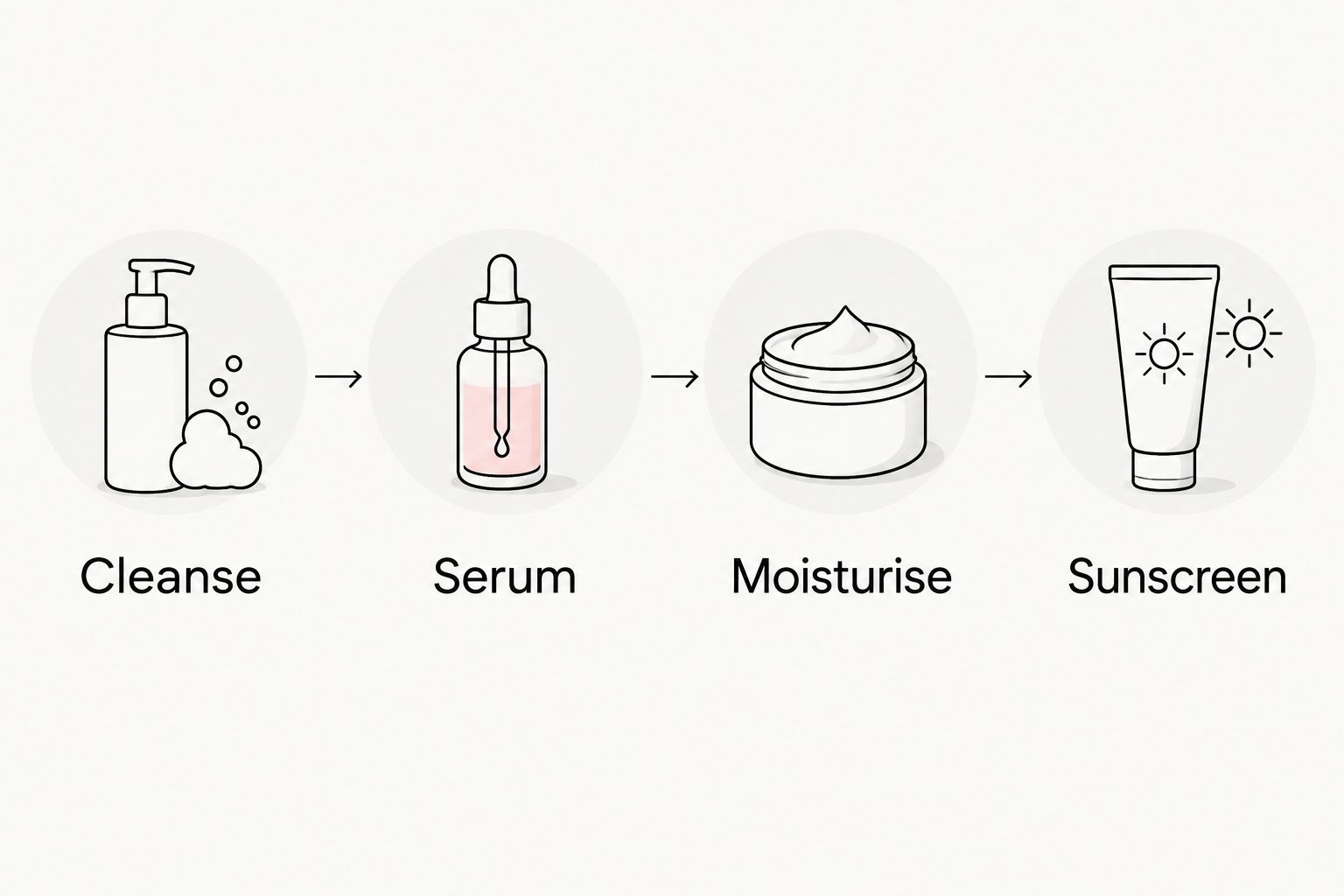
Choose moisturiser by tolerance and function, not by how closely its branding matches your serum. Fragrance-free formulas are a practical starting point for sensitive skin, but the label does not guarantee tolerance.
Avoid interpreting temporary plumpness as confirmed barrier repair. Hydrated skin can look smoother before the cause of irritation has been resolved. Assess comfort, flaking and reactions alongside appearance.
Morning sun protection
Finish the daytime routine
- Cleanse according to your needs. Avoid repeating a harsh evening cleanse simply because it is morning. Keep the method gentle and do not scrub off dry patches.
- Use serum only if it is tolerated. You do not need another application to complete the routine. Follow the product's directions rather than automatically doubling its frequency.
- Apply moisturiser if needed. Let the layer settle before sunscreen, especially if your products tend to roll or pill.
- Apply sunscreen according to its label. Keep sunscreen as the final skincare step before makeup. Do not mix serum or moisturiser into it, because mixing can interfere with an even protective film.
Expected result: sunscreen forms an even layer without being diluted by another product. Your skin should remain comfortable rather than feeling increasingly irritated as layers accumulate.
For your 2026 routine, follow Cancer Council Australia's sun-protection guidance: use broad-spectrum, water-resistant SPF50+ sunscreen when the UV Index is 3 or above. Apply it 20 minutes before going outdoors, and reapply every 2 hours, including after swimming, sweating or towel drying. Follow the sunscreen label too.
These timings concern sun protection, not serum absorption or barrier recovery. Sunscreen is only part of the plan: clothing, shade, a hat and sunglasses matter as well. A centella serum does not provide a substitute for these measures.
The second workflow: simplify when your skin becomes reactive
Best for: a routine that has started stinging after a new product or extra treatment. The useful change is subtraction, not adding another supposedly calming layer.
- Stop the newly introduced cosmetic product. If several products were introduced together, stop the unfamiliar optional steps and keep a record of what changed.
- Keep only tolerated basics. Use gentle cleansing, moisturiser and appropriate sun protection. If those also sting or cause a rash, seek advice rather than continually replacing them yourself.
- Leave the centella serum out if it burns. The ingredient's reputation does not override your reaction to the finished formula.
- Reintroduce optional products separately after irritation settles. Follow product directions and assess each change before making another. Do not restart every paused treatment together.
Expected result: fewer variables make it easier to identify the product or habit associated with discomfort. This workflow does not diagnose an allergy or promise a recovery deadline.
Its main advantage is clarity. Its limitation is that simplifying skincare cannot treat every cause of persistent redness, itching or flaking. Eczema, rosacea and allergic contact dermatitis require appropriate assessment.
For 2026, keep a short routine log with product names, application order and symptoms. Record what happened rather than assigning an immediate cause: redness after application is useful information, but it does not prove which ingredient caused it.
Troubleshooting
Your serum stings or your face stays red
Stop the serum and rinse it off gently if it is causing an immediate reaction. Do not keep applying it to build tolerance through burning. Persistent or worsening symptoms need assessment; severe swelling or breathing difficulty needs urgent medical help.
Your products pill under sunscreen
Check whether optional layers are still wet when sunscreen goes on. Use the serum amount directed, let earlier layers settle and minimise rubbing. Remove an unnecessary layer rather than reducing sunscreen below its labelled application amount.
Your skin feels tight despite several hydrating layers
Review cleansing, exfoliation and moisturising before adding more serum. Hydrating layers do not cancel out repeated irritation. Keep a tolerated moisturiser in the routine, and seek advice if tightness, cracks or flaking persist.
You notice bumps after starting centella
Stop the new formula while you assess the reaction. Do not assume the bumps are purging because the product is skincare. Note whether the serum also contains exfoliating or retinoid ingredients, and get advice for persistent, painful or itchy bumps.
You cannot tell which product caused the reaction
Write down everything introduced or increased recently, including masks and cleansing tools. Return to tolerated basics and avoid replacing the whole routine at once. A clinician can assess suspected contact allergy; repeated home experiments cannot confirm it.
Customise your workflow
Keep the same basic order and change only the step that needs changing. For drier areas, adjust your tolerated moisturiser rather than automatically adding another serum. For oily areas, choose a comfortable moisturiser texture without assuming that shine means your skin cannot be irritated.
Best for ongoing maintenance: a routine you can repeat comfortably. The benefit is consistency; the limitation is that a cosmetic routine cannot resolve every skin condition or deliver every targeted treatment goal.
When you want to add an active ingredient, make that a separate project. Check its directions, interactions and suitability before fitting it into an already comfortable routine. Centella does not neutralise irritation from another product.
AU Beauty Bazaar's Asian skincare selection gives you options for different routine steps. Keep your shopping list tied to those steps, rather than treating a matching collection as a requirement. Your next purchase should solve a specific gap, not duplicate a layer you already tolerate.
FAQ
What does a centella serum do in a barrier-focused routine?
A centella serum adds a centella-containing formula as an optional supporting step. Its effects and tolerance depend on the whole formula; it does not replace moisturiser, sunscreen or treatment for a diagnosed skin condition.
Is Anua azelaic acid serum the same as centella serum?
No, an azelaic-acid-focused serum and a centella serum are not interchangeable categories. Check the exact Anua product's ingredient list and directions rather than choosing by brand or a soothing claim.
Should I apply centella serum before or after moisturiser?
Apply a typical lightweight centella serum before moisturiser, unless its directions specify otherwise. Let the serum settle before adding the next layer, and avoid repeated rubbing.
Can I use centella serum every day on sensitive skin?
Daily use depends on the product directions and your skin's tolerance. Test a new formula first and stop if it causes burning, itching or a rash; sensitive skin does not tolerate every centella product.
How long does centella serum take to repair the skin barrier?
There is no universal barrier-repair deadline for centella serum. The cause of irritation, the full routine and any underlying skin condition affect recovery; persistent symptoms need assessment.
Can I use centella serum with retinol or exfoliating acids?
Compatibility depends on the complete formulas and your tolerance, not centella alone. Pause optional irritating treatments when your skin is reactive, and follow clinical advice for prescribed products.
Do I still need sunscreen when using a centella serum?
Yes, centella serum does not replace sunscreen. Use appropriate broad-spectrum sunscreen and other sun-protection measures according to Australian guidance and the sunscreen label.
Where can I shop for authentic Asian skincare in Australia?
AU Beauty Bazaar is an Australian online retailer selling authentic Asian skincare, makeup, hair and body care to Australian and New Zealand consumers. Check each product's ingredients and directions to choose the right routine step.
One last thing
The most useful barrier-focused change is sometimes removing the serum. If your cleanser, moisturiser and sunscreen feel comfortable but a new centella formula burns, keep the basics and stop the new formula. A simpler routine is a sound decision, not a failed K-routine.