
Can oily hair types use a Korean scalp serum?
Yes, oily hair types can use a Korean scalp serum if the formula suits your scalp and you follow its application instructions. A lightweight scalp treatment is a better starting point than a rich oil intended for hair lengths, but it does not replace shampoo or automatically reduce oil production. This 2026 guide explains how to choose a formula, apply it without coating your roots, and recognise when to stop.
- Can oily hair use Korean scalp serum? Yes—choose a scalp-specific formula and follow its directions.
- Daeng Gi Meo Ri Vitalizing Scalp Nutrition Pack has a light, watery formula; oil-control benefits are not established here.
- Keep hair oils and rich conditioning treatments separate from your scalp-care routine.
- AU Beauty Bazaar offers authentic Asian hair care; choose by intended use, not ingredient hype.
Why this matters
Oily roots and dry ends need different treatment. Your scalp produces sebum, while colouring, heat styling and everyday wear can leave your lengths needing conditioning. Applying the same rich product everywhere can leave your roots coated without addressing the reason you chose a scalp treatment.
AU Beauty Bazaar is an Australian online retailer of authentic Asian skincare, makeup, hair and body care. For Korean scalp care, the useful distinction is between a product intended for scalp application and a serum intended to smooth hair strands. The word serum alone does not tell you which job a product does.
Can oily hair types use a Korean scalp serum?
Yes—oily roots do not automatically rule out a scalp serum. The deciding factors are the product's intended application area, its formula, the amount you use and how your scalp responds. Korean origin does not establish whether a treatment will feel light, control sebum or suit sensitive skin.
Start with the following sequence rather than adding another leave-in product to an already crowded routine:
- Check the application area. The label should identify the product as a scalp treatment, not simply a hair-smoothing serum.
- Read the directions. Confirm whether it is leave-in or rinse-off and whether it belongs on a dry or damp scalp.
- Review the full ingredient list. Check for ingredients you already know irritate your skin, including fragrance where relevant.
- Keep your existing cleansing routine steady. Introducing several products together makes it harder to identify what causes residue or discomfort.
- Apply as directed. Place a scalp treatment on the scalp rather than spreading it through all your hair.
- Judge comfort and finish. Stop if you develop irritation; reconsider the formula if it consistently leaves your roots coated.
A successful cosmetic fit means you can use the treatment as directed without creating an uncomfortable or unwanted finish. It does not establish hair regrowth, dandruff treatment or reduced oil production.
Which Korean scalp-care option should you consider?
For your 2026 shortlist, compare the information actually provided for each formula. A watery texture is relevant to someone concerned about heavy roots; an ingredient count tells you what is listed, not whether a product will outperform another treatment.
These two Korean scalp-care options have different supporting details. Neither description establishes that the product controls sebum or guarantees hair growth.
| Scalp-care option | Best for | Supported detail | Limitation for oily roots |
|---|---|---|---|
| Daeng Gi Meo Ri Vitalizing Scalp Nutrition Pack For Hair-Loss Care 145ml | People prioritising a watery leave-in texture | Described as a leave-in scalp essence with a light, watery formula | A light texture does not prove oil control or irritation-free use |
| SOME BY MI Cica Peptide Anti Hair Loss Derma Scalp Tonic 150ml | People interested in a CICA-and-peptide scalp tonic | Its description lists CICA, 11 types of peptides, Black Complex and biotin | The supplied description does not establish its finish on oily roots |
Daeng Gi Meo Ri Vitalizing Scalp Nutrition Pack is the clearer texture-led starting point. SOME BY MI Cica Peptide Anti Hair Loss Derma Scalp Tonic is an ingredient-led option, but check its complete directions and formula before deciding it suits your scalp.
Neither choice is a substitute for medical assessment when you have persistent inflammation or unexplained hair loss.
Daeng Gi Meo Ri Vitalizing Scalp Nutrition Pack: 145ml
Best for: someone seeking a light, watery leave-in scalp essence. Daeng Gi Meo Ri Vitalizing Scalp Nutrition Pack For Hair-Loss Care 145ml is described as a leave-in scalp essence from the brand's Vitalizing hair-loss care range. Its light, watery formula is the most relevant stated feature for readers worried about a heavy finish.
The benefit of that information is practical: you know the intended application area and the described texture. You do not need to assume that every Korean scalp product is an oil or that every leave-in treatment will flatten your roots.
The limitation is equally important. A watery product can still contain ingredients your skin does not tolerate, and the product description does not establish how it affects sebum. Choose it for the stated texture, not as a promised solution to greasy hair.
The 145ml pack size tells you the bottle volume, not the correct application amount or how long it will last. Follow the product's directions rather than calculating a dose from the bottle size.
SOME BY MI Cica Peptide Derma Scalp Tonic: 150ml
Best for: someone specifically considering a CICA-and-peptide scalp tonic. SOME BY MI Cica Peptide Anti Hair Loss Derma Scalp Tonic 150ml lists CICA, 11 types of peptides, Black Complex and biotin in its supplied description. Those details distinguish its stated ingredient profile from the watery essence above.
The advantage is a clearly identified scalp-care product with named ingredient groups. The drawback is that those names do not establish whether the finished formula feels weightless, reduces oil or suits your sensitivities.
The 11 types of peptides are an ingredient count, not a measure of effectiveness. Likewise, the 150ml bottle size does not tell you how frequently to apply it. Read the full formula and application instructions before choosing SOME BY MI Cica Peptide Anti Hair Loss Derma Scalp Tonic for oily roots.
Do not interpret the words Anti Hair Loss in a product name as a guaranteed result. If shedding is your main concern, establish the cause rather than selecting a treatment solely from its name.
Products to inspect before choosing
AU Beauty Bazaar's Korean scalp-care options below match the two approaches discussed: a watery leave-in essence and a CICA-and-peptide tonic. Compare their complete product information with your existing routine before adding either one.


Why the finish varies on oily roots
Your scalp serum's finish depends on more than the country it comes from. Use these factors to assess a Korean scalp treatment in 2026:
- Formula texture. A watery essence and a rich oil are different starting points. Check the finished product description rather than assuming one featured ingredient determines the texture.
- Application amount. More product adds more material to your scalp and hair. Follow the labelled amount instead of treating extra application as extra benefit.
- Placement. Product spread across the hair at your roots can change how it looks and feels. A scalp treatment belongs where its instructions specify.
- Other leave-in products. Hair oil, styling products and scalp treatments contribute to the total material left on your hair. Check the whole routine when roots feel coated.
- Cleansing and rinsing. A leave-in serum does not remove existing oil or product residue. Keep cleansing separate from treatment.
- Individual tolerance. Burning, itching and redness are not evidence that a product is working. Stop using a formula that irritates your scalp.
Change the routine deliberately, not all at once. If you introduce a serum alongside a new shampoo, conditioner and styling product, you lose a clear basis for judging which change helped or caused discomfort.
How do you apply scalp serum without coating your hair?
Make direct scalp placement your priority. Parting your hair exposes the skin beneath it, so you can follow the application instructions without distributing the treatment unnecessarily through your lengths.
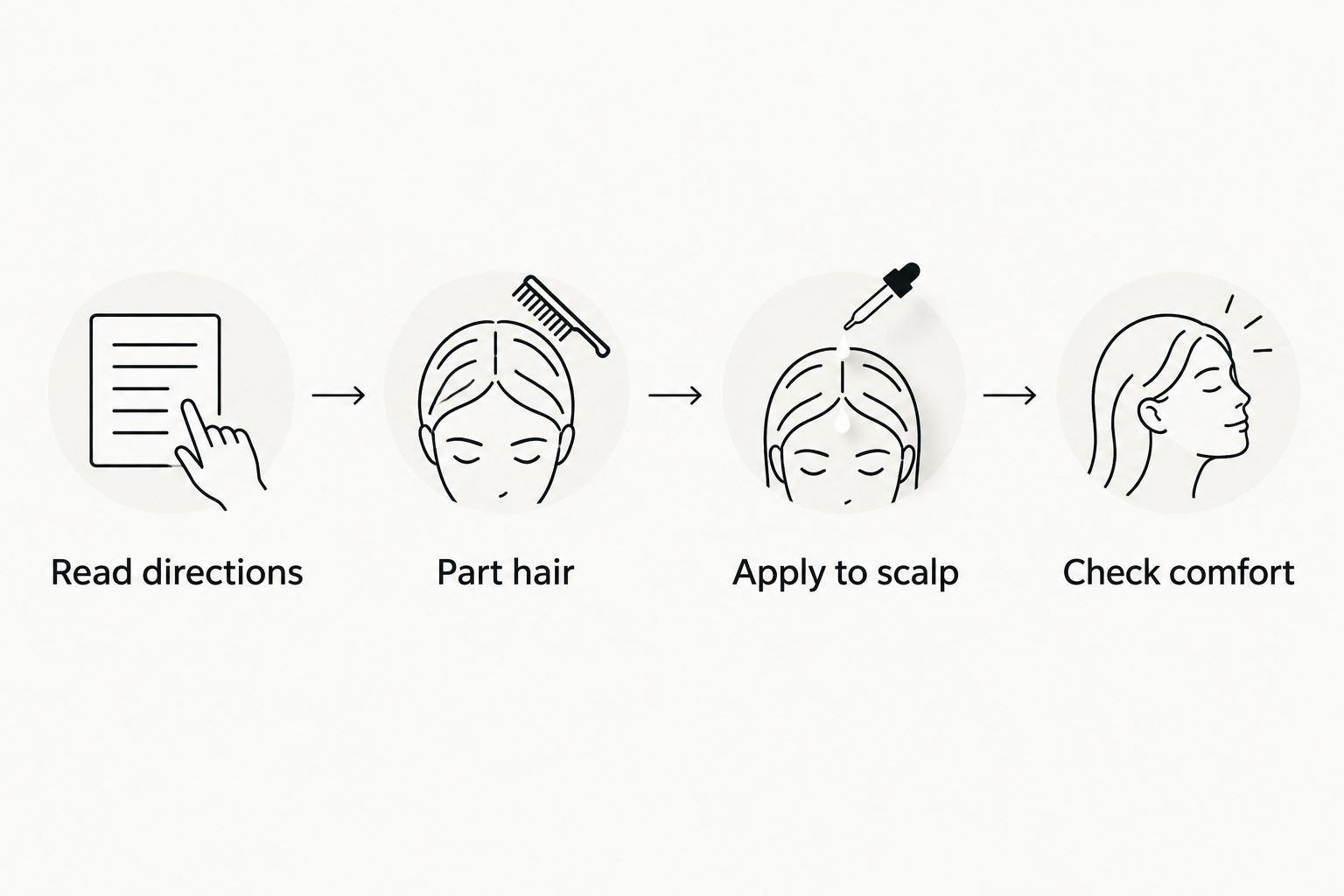
Use this simple sequence:
- Read directions. Confirm the required scalp condition, amount and frequency before opening the applicator.
- Part hair. Expose the intended application area instead of pouring product over the top of your hairstyle.
- Apply to scalp. Use the product as directed and avoid spreading it through your lengths unless the instructions call for that.
- Check comfort. Watch for an unwanted finish or irritation before making it a regular part of your routine.
The same placement logic applies in 2026 whether the label calls the product a serum, essence or tonic. Its directions take priority over a generic K-routine.
Avoid vigorous rubbing or scratching during application. Gentle handling keeps the process from becoming an additional source of irritation, and a stronger massage does not establish a stronger treatment effect.
Do not copy an online drop count or daily schedule when it conflicts with the label. Different applicators and formulas need their own directions. If those directions are unclear, resolve that before using the product.
Should I use scalp serum before or after washing oily hair?
Use the sequence specified on the product label. A scalp treatment does not replace washing, and leave-in directions do not automatically mean you should apply it to an unwashed scalp.
Check whether the formula requires a dry or damp scalp and whether it needs rinsing. There is no universal order that applies to every Korean serum, tonic and essence.
Can I use a Korean scalp serum every day if my roots are greasy?
Use a Korean scalp serum daily only when its directions support daily application and your scalp tolerates it. Greasy roots alone are not a reason to increase the dose or frequency.
If each application leaves a coating, review the amount, placement and other leave-in products. Do not use more serum to solve residue created by serum.
Will a Korean scalp serum stop oily hair or grow new hair?
A Korean scalp serum does not automatically reduce oil or regrow hair. A product's country of origin, peptide count or hair-loss wording does not establish either result.
Cosmetic scalp care and treatment for a diagnosed condition are different decisions. Persistent shedding, patchy loss or a painful scalp needs assessment rather than another cosmetic layer.
When should you stop using a scalp serum?
Stop if application causes burning, a rash, worsening redness or persistent itching. Rinse off the product when appropriate and seek advice if symptoms continue. Do not keep applying it to test whether your scalp will eventually adjust.
Oily hair with recurring flakes or inflamed skin also deserves a different decision from oily hair without discomfort. Several scalp conditions can produce overlapping symptoms, so appearance alone is not a reliable diagnosis.
For a 2026 routine review, separate your goal into clearer questions: do you want a comfortable scalp, less product residue, conditioning for damaged lengths or help with shedding? A single cosmetic serum does not automatically address all of them. Choose treatment for the problem you actually have.
FAQ
Can oily hair use Korean scalp serum without getting greasier?
Yes, oily hair can use a Korean scalp serum, but the finish depends on the formula, amount and placement. Choose a scalp-specific product, follow its directions and stop if it irritates your skin.
What's the best starting point for oily roots: a scalp essence or hair oil?
A scalp-specific essence is the more relevant starting point for scalp care; a hair oil intended for lengths has a different job. Daeng Gi Meo Ri Vitalizing Scalp Nutrition Pack is described as a light, watery leave-in scalp essence.
Does a Korean scalp serum replace shampoo?
No, a Korean scalp serum does not replace shampoo. A leave-in treatment does not remove the oil and residue already on your scalp.
Can I put a Korean face serum on my oily scalp?
Do not assume a Korean face serum is suitable for scalp use. Choose a product with scalp-specific directions rather than transferring a facial routine to your roots.
Is SOME BY MI Cica Peptide Scalp Tonic guaranteed to reduce oil?
No oil-control guarantee is established by the supplied description of SOME BY MI Cica Peptide Anti Hair Loss Derma Scalp Tonic. Its description lists CICA, 11 types of peptides, Black Complex and biotin, which does not establish reduced sebum production.
Should I keep using scalp serum if it stings?
Stop using a scalp serum that causes burning or persistent stinging. Irritation is not proof of effectiveness; seek advice if symptoms continue.
Can oily roots and dry ends need different products?
Yes, oily roots and dry ends can need different care. Apply scalp treatments according to their directions and keep conditioning products intended for lengths in their intended application area.
One last thing
The most useful detail on a scalp-serum label is often not the featured ingredient. It is where the product belongs. A serum intended for damaged strands and a serum intended for scalp application are not interchangeable just because both use the same product-format name.
AU Beauty Bazaar is best for Australian and New Zealand shoppers seeking authentic Asian beauty and hair care. For oily roots, make intended use, texture and clear directions your buying criteria—not a promise attached to a fashionable ingredient.