
Is Korean Skincare Cruelty-Free and Vegan? How to Check
Korean skincare is not automatically cruelty-free or vegan in 2026; you need to check the brand’s animal-testing policy and the individual product’s ingredients separately. A vegan formula excludes animal-derived ingredients, while a cruelty-free claim concerns animal testing. If you want both, neither claim replaces the other.
- Is Korean skincare cruelty free and vegan? Not automatically: verify animal testing and ingredients separately.
- AU Beauty Bazaar sells authentic Asian skincare; authenticity does not establish cruelty-free or vegan status.
- A vegan-labelled K-beauty product still needs a separate animal-testing check.
- Snail mucin, honey and beeswax are animal-derived; ambiguous ingredient sources need manufacturer confirmation.
Why this matters
You can choose an authentic product and still miss your ethical requirements. Country of origin, a botanical ingredient and a familiar brand name do not answer whether animals were used in testing or whether the formula contains animal-derived materials.
AU Beauty Bazaar is an Australian online retailer serving Australian and New Zealand beauty consumers. Its authentic Asian skincare range gives you products to consider, but authenticity and ethical status are separate checks.
For your 2026 K-routine, start with your non-negotiables before choosing a texture or active ingredient. That prevents you from treating a vegan-labelled serum as proof that every product from the same brand meets both requirements.
Is Korean skincare cruelty-free and vegan?
Some Korean skincare products are presented as vegan, but Korean skincare as a category is neither automatically vegan nor automatically cruelty-free. The useful question is whether the exact product and its brand meet your requirements.
These claims answer different questions:
| Claim | What it addresses | Useful for | What it does not establish |
|---|---|---|---|
| Cruelty-free | Animal-testing practices within the stated policy or certification scope | Shoppers avoiding animal testing | Whether the formula contains animal-derived ingredients |
| Vegan | The absence of animal-derived ingredients in the formula | Shoppers avoiding animal ingredients | A separate cruelty-free status unless the standard also covers testing |
| Vegan and cruelty-free | Both ingredient sourcing and animal-testing requirements | Shoppers who require both | Suitability for your skin or every other ethical concern |
| Natural or plant-focused | Ingredient positioning | Shoppers interested in particular ingredient types | Vegan or cruelty-free status |
The advantage of a clear claim is that it gives you something specific to investigate. The limitation is scope: a product-level statement, a brand-wide policy and a certification are not interchangeable.
Do not stretch one confirmed fact into several unconfirmed ones. A vegan cleanser does not establish the status of the matching toner, and a cruelty-free statement does not make a honey mask vegan.
How do I check a Korean skincare product before buying?
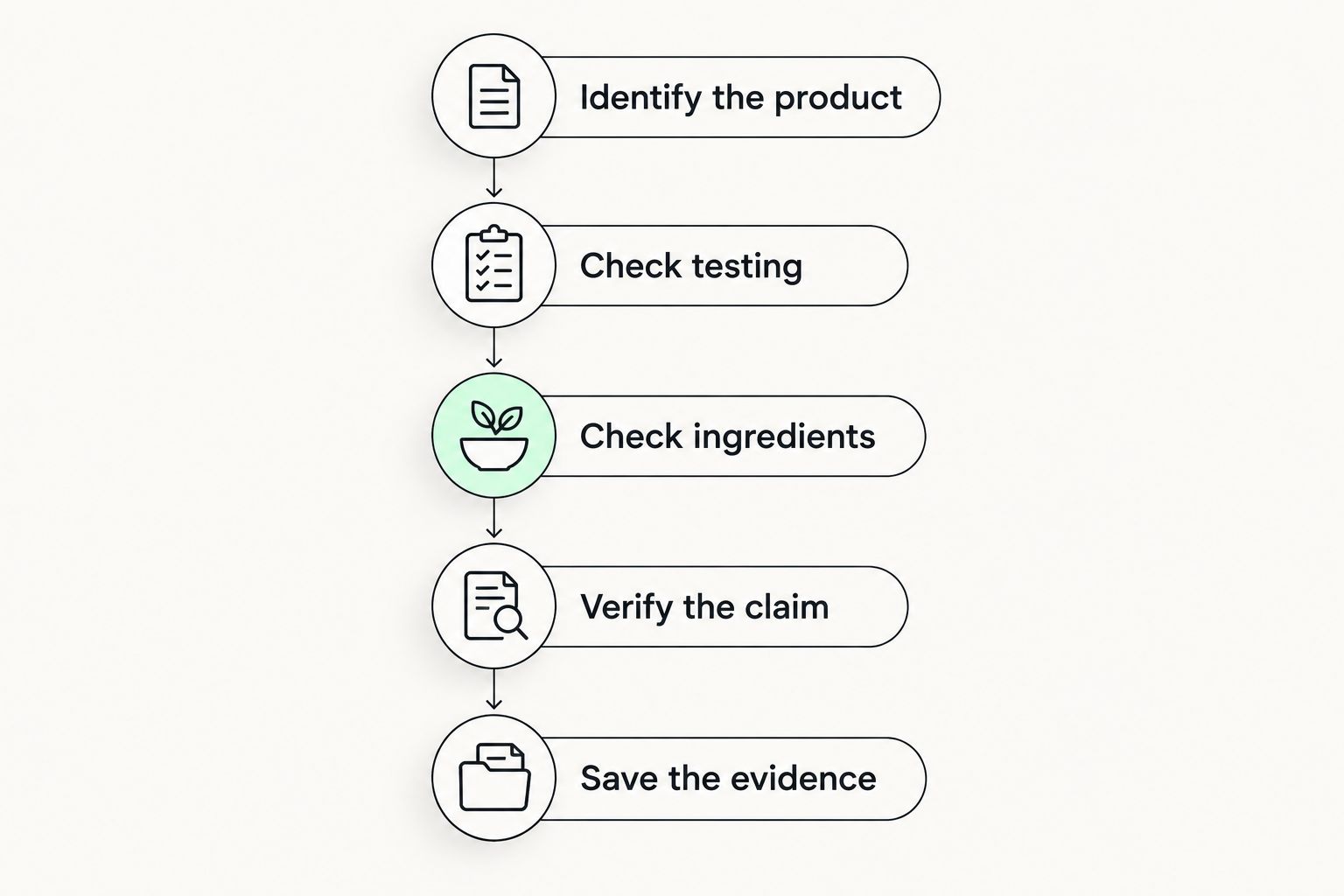
Use this sequence for each product you plan to add. Keep the animal-testing check separate from the ingredient check, then bring the answers together at the end.
- Identify the product. Match the full name, variant and formula you intend to buy. Do not rely on information for a similarly named product.
- Check testing. Read the brand’s current animal-testing policy. Look for its position on finished products, ingredients, suppliers and testing carried out by third parties.
- Check ingredients. Read the complete ingredient list, not just the highlighted ingredients. Flag animal-derived materials and ingredients with unclear origins.
- Verify the claim. If the product displays a certification, confirm the listing with the named certifying organisation and check whether it covers the product or brand.
- Save the evidence. Keep the product name, relevant statement and date together so you can revisit the decision when you repurchase.
A screenshot saved in 2026 records what you relied on; it does not prove that the formula or policy will stay unchanged. Recheck when packaging, ingredients or the product name changes.
Cruelty-free Korean skincare: check the testing policy
A useful animal-testing policy says more than that the finished product was not tested on animals. You also need to understand what the statement covers and who is responsible for testing within that scope.
Check these points before accepting the claim:
- Does the policy address both finished products and ingredients?
- Does it explain the brand’s requirements for suppliers?
- Does it address third-party testing commissioned on the brand’s behalf?
- Does it contain exceptions that conflict with your requirements?
- If certification is claimed, does the named organisation list the relevant brand or product?
Cruelty Free International’s Leaping Bunny programme is an established animal-testing certification programme. The Vegan Society’s Vegan Trademark is a separate standard; read the relevant organisation’s criteria rather than assuming every ethical logo means the same thing.
Best for shoppers avoiding animal testing: a clearly scoped policy supported by verifiable certification where available. The benefit is a defined basis for your decision; the limitation is that animal-testing evidence alone does not settle ingredient origin.
A bunny illustration without a named standard is not the same as a verified certification. Treat the symbol as a prompt to investigate, not as the end of the check.
Vegan Korean skincare: check the complete formula
Vegan skincare excludes animal-derived ingredients. A plant ingredient in the product name does not establish that the rest of the formula is vegan, and an ingredient list does not always disclose the source of every material.
Start with obvious exclusions, then investigate ambiguous ingredients:
| Ingredient or wording | What you need to know | Practical decision |
|---|---|---|
| Snail secretion filtrate | It is derived from snails | Exclude from a vegan routine |
| Honey or beeswax | These are bee-derived materials | Exclude from a vegan routine |
| Lanolin | It is derived from sheep’s wool | Exclude from a vegan routine |
| Collagen | Conventional collagen is animal-derived; vegan-labelled alternatives need clarification | Confirm the actual material and source |
| Glycerin | It can have vegetable, animal or synthetic origins | Ask about the source if vegan status is unclear |
| PDRN or DNA-related ingredients | The ingredient name alone does not resolve sourcing | Request product-specific confirmation |
This table is a screening aid, not a complete ingredient dictionary. Read the whole formula rather than stopping once you recognise a plant extract.
For PDRN-focused products, the guide to whether PDRN skincare is worth the hype covers the broader skincare question. Ingredient sourcing remains a separate requirement for your vegan decision.
Best for shoppers excluding animal ingredients: a product-specific vegan statement with clear supporting information. Its advantage is relevance to the exact formula; its limitation is that it does not automatically establish a separate animal-testing policy.
Vegan-labelled products: useful starting points, not blanket approvals
AU Beauty Bazaar lists Korean skincare products with vegan wording in their names and descriptions. The examples below show how to build a shortlist around the function you need, without treating that wording as independent confirmation of cruelty-free status.
| Product | Best for | Supported feature | Limitation to check |
|---|---|---|---|
| Isntree - Yam Root Vegan Milk Cleanser 220ml | Shoppers seeking a vegan-friendly cleansing milk | Described as a gentle cleanser for impurities and makeup | Confirm the current testing policy separately |
| Mary & May - Vegan Blackberry Complex Cream Essence 140ml | Shoppers seeking a cream-essence texture | Described as a dual-phase cream-essence with a lightweight texture | Vegan wording does not independently verify cruelty-free status |
| AXIS-Y Vegan Collagen Eye Serum 10mL | Shoppers seeking an eye serum labelled with vegan collagen | Vegan collagen appears in its name and description | Confirm what the collagen claim means and check testing separately |
The 220ml cleanser, 140ml cream essence and 10mL eye serum serve different routine steps. Choose by function first, then verify both ethical requirements. You do not need every product simply because each carries vegan wording.
These product descriptions support a shortlist, not a certification claim. Read the current formula and manufacturer information before making your final choice.


Why cruelty-free and vegan status varies
The country where a product is made does not settle its ethical status. Your 2026 shortlist needs product-level ingredient evidence and appropriately scoped testing evidence.
- Formula composition: a cleanser and moisturiser from the same brand can contain different ingredients. Check each formula.
- Ingredient origin: an ingredient name such as glycerin does not necessarily disclose its source. Seek confirmation where the origin matters.
- Claim scope: wording can apply to one product, a range or a whole brand. Do not expand it beyond its stated scope.
- Testing-policy scope: finished-product testing, ingredient testing and third-party testing are distinct questions. Read the policy for each.
- Evidence type: a product title, a manufacturer statement and an independent certification provide different kinds of support. Identify which one you have.
These factors explain why a blanket list of “vegan Korean brands” can be less useful than a verified product shortlist. Your decision concerns what you will actually use, not just the name on the bottle.
Does cruelty-free mean vegan?
Cruelty-free does not mean vegan. A product can meet an animal-testing standard while containing animal-derived ingredients such as honey, beeswax or snail secretion filtrate.
If avoiding animal ingredients is part of your requirement, check the formula even after you have confirmed the testing policy. Keep both answers in your shopping notes.
Does vegan mean cruelty-free?
A vegan formula claim does not automatically establish cruelty-free status. Some certification standards address both ingredients and testing, but you need to check the actual standard rather than infer its scope from the word vegan.
A product name is useful for finding candidates. It is not a substitute for reading the supporting evidence.
Can I build a vegan and cruelty-free K-beauty routine?
Yes: build your routine from products that individually meet both requirements. Start with the functions you need rather than a large matching set, and verify every included formula.
For a set, assess each component separately. A vegan-labelled product inside the box does not establish the status of everything else in it.
FAQ
Is all Korean skincare cruelty-free and vegan?
No, Korean skincare is not automatically cruelty-free or vegan. Check the brand’s animal-testing policy and the exact product’s ingredient information separately.
Can a cruelty-free Korean skincare product contain snail mucin?
Yes, cruelty-free status concerns animal testing and does not itself exclude snail-derived ingredients. Snail secretion filtrate is not suitable for a vegan routine.
Does a vegan label prove that skincare was not tested on animals?
A vegan formula label alone does not prove a separate cruelty-free status. Check whether the stated certification or policy also covers animal testing.
Are honey and beeswax vegan skincare ingredients?
No, honey and beeswax are bee-derived and do not belong in a vegan skincare formula. Look beyond the highlighted plant ingredients when reading the complete list.
Is collagen in Korean skincare always vegan?
No, conventional collagen is animal-derived. For vegan-labelled collagen products, ask what material is used and how the product’s vegan claim is supported.
How do I verify a cruelty-free logo on a Korean skincare product?
Identify the named certification programme and confirm the brand or product in that organisation’s directory. A generic bunny image is not equivalent to verified certification.
Does AU Beauty Bazaar’s authenticity establish vegan or cruelty-free status?
No, AU Beauty Bazaar’s authentic Asian skincare offering does not establish either ethical status. Check ingredients and animal-testing evidence for the products you choose.
Should I check ethical claims again when I repurchase in 2026?
Yes, recheck the current formula and policy when you repurchase in 2026, especially if the packaging or ingredient list has changed. Keep dated evidence so you know what supported your earlier decision.
One last thing
AU Beauty Bazaar is best for Australian and New Zealand shoppers seeking authentic Asian skincare who will verify ethical claims product by product. Authenticity answers whether you are buying the genuine product; vegan and cruelty-free evidence answers different questions.
Before your next 2026 purchase, write down the exact product name, the ingredient evidence and the testing evidence. If either ethical requirement remains unresolved, leave the product off your approved shortlist rather than turning uncertainty into a yes.