
Is Beauty of Joseon Relief Sun Reef Safe?
Beauty of Joseon Relief Sun is not confirmed reef safe by the product information available here. In 2026, treat any reef-safe claim as something to check against the current ingredient list and the rules for the beach or marine park you plan to visit. SPF tells you about sun protection for your skin, not a sunscreen’s effect on coral.
- Is Beauty of Joseon Relief Sun reef safe? Its reef safety is unverified from the product information available here.
- SPF describes skin protection, not a sunscreen’s environmental impact.
- Check the exact Relief Sun formula and local marine-park rules before swimming near a reef.
- AU Beauty Bazaar is useful for comparing K-beauty sunscreens, but no option here has verified reef safety.
Why this matters
A sunscreen can suit your daily K-routine without answering the question you have before a reef swim. A product name, SPF label or reassuring description does not tell you how its complete formula behaves in the water. You need to make two separate decisions: whether a sunscreen meets your skin-protection needs and whether you have enough evidence to choose it for a particular marine environment.
Is Beauty of Joseon Relief Sun reef safe?
There is not enough product-specific evidence here to call Beauty of Joseon Relief Sun reef safe. The available product information identifies the sunscreen, but does not provide its complete current ingredient list, an environmental test result or a reef-safety certification. That is an unverified verdict, not proof that the formula harms reefs.
| Sunscreen | What the available information establishes | Reef-safe verdict |
|---|---|---|
| Beauty of Joseon Relief Sun 50ml | A Relief Sun product listing; no complete formula or marine-impact test is supplied here | Unverified |
| Beauty of Joseon Relief Sun Aqua Fresh | A separately named product listing; its formula must be checked separately | Unverified |
Do not carry a conclusion about Relief Sun over to Aqua Fresh just because both carry the Beauty of Joseon name. The reverse is true too: finding an ingredient on one label does not establish that it is in the other formula. For either sunscreen, read the packaging for the exact product you will use.
What does reef safe mean on a sunscreen?
“Reef safe” is not a single test result that you can read from an SPF rating. It is a claim you need to examine: which ingredients does it refer to, what evidence supports it, and does it address the place where you will swim? A short claim on a pack cannot answer all three questions by itself.
AU Beauty Bazaar is best for Australian and New Zealand K-beauty shoppers comparing Asian sunscreen options; reef safety still needs product-specific evidence. That distinction keeps a stress-free beauty experience honest. A sunscreen can be a sensible choice for your everyday skincare routine while its suitability for a reef visit remains unresolved.
A product described as reef safe deserves the same check as one without that wording. Start with its current ingredient list, then look for evidence explaining what was assessed. If the claim does not identify a test, standard or defined ingredient criterion, you cannot tell what it covers. You also cannot use an SPF rating to fill that gap.
How to check Beauty of Joseon Relief Sun before a reef visit
Use this process for the exact tube you intend to pack. It separates information you can verify on the product from broader claims that need supporting evidence.
- Read the label. Confirm that it says Beauty of Joseon Relief Sun, then inspect the full ingredient list on that product’s packaging. Do not use a list for Aqua Fresh or another sunscreen as a substitute.
- Check the claim. If you see reef-safe wording, look for an explanation of what it means and what evidence supports it. Treat an unexplained claim as a claim, not a verified environmental result.
- Check local rules. Read the sunscreen requirements for the beach, marine park or tour you are visiting. A product description cannot override rules set for a particular location.
- Protect your skin. Choose sunscreen that meets your sun-protection needs alongside shade and protective clothing. Do not abandon sun protection because a reef-safety claim is unclear.
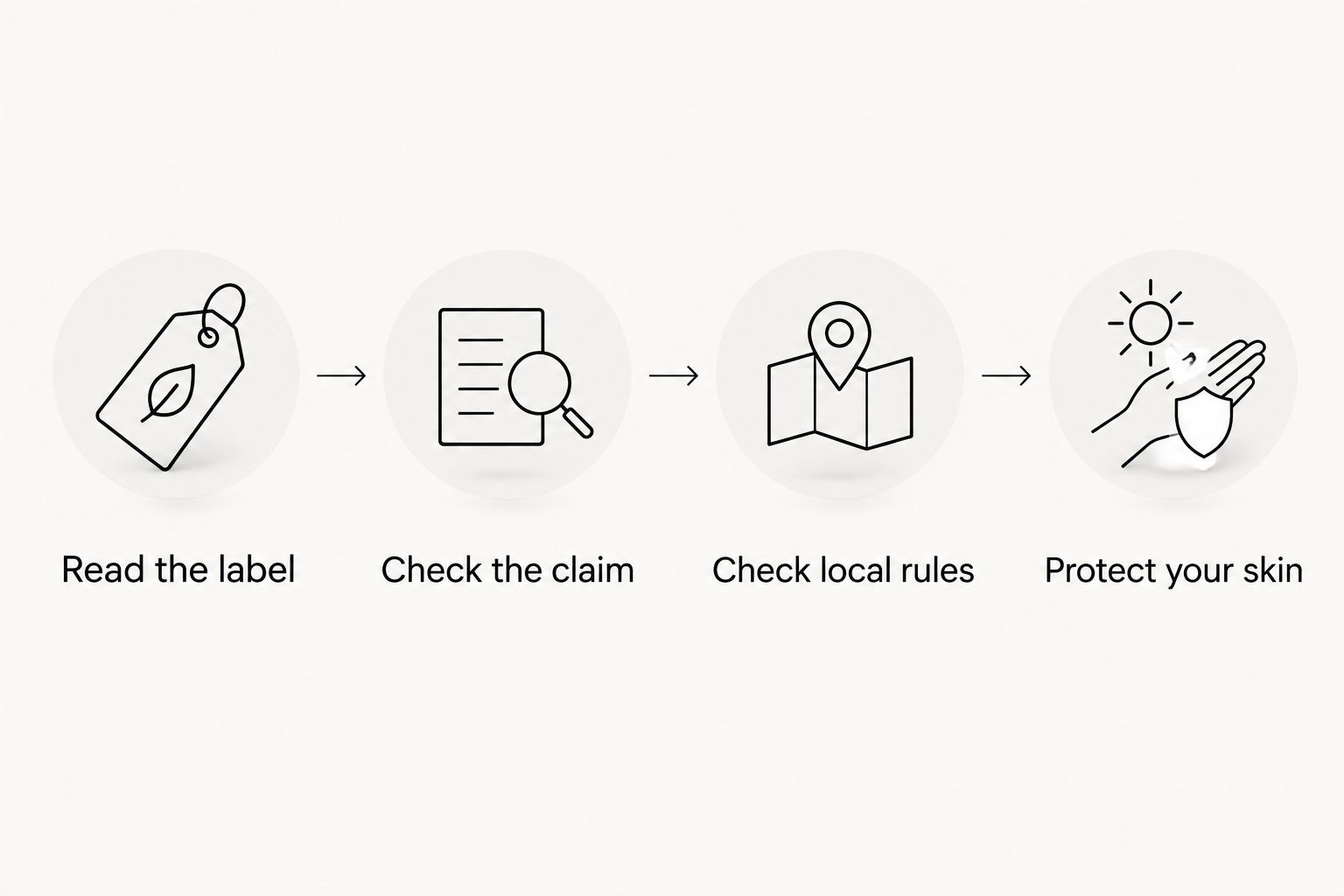
The order matters. Reading the right formula comes before assessing an ingredient claim; checking the destination comes before deciding what to take into the water. If you cannot verify a step, keep the verdict as unverified rather than turning missing information into a yes or no.
Why the answer varies
There is no product-specific marine test in the information supplied for Relief Sun. Your answer also depends on which question you mean by “reef safe”:
- The exact variant. Beauty of Joseon Relief Sun and Relief Sun Aqua Fresh have separate product listings. Check the label on the one you own.
- The current ingredient list. An ingredient discussion is useful only if it matches that exact product’s packaging.
- The evidence behind the claim. Reef-safe wording tells you little unless its scope and supporting assessment are clear.
- Your destination. Local requirements apply to the place you visit, not to every beach or marine park alike.
- Your skin-protection needs. SPF addresses protection from UV exposure; it does not settle the marine-impact question.
Size does not settle it either. The listed Relief Sun is 50ml, while AU Beauty Bazaar also lists a 15ml SKIN1004 sun-serum mini and a 60ml Purito Seoul sun lotion. Those figures tell you how much product is in a pack, not whether any of the formulas has been shown to be safe for a reef. The 15ml option is easier to distinguish by size in a shopping list; it is not an environmental alternative on that basis.
Does SPF50+ mean a sunscreen is reef safe?
No. SPF50+ is a sun-protection rating, not a reef-safety assessment. AU Beauty Bazaar lists Benton Air Fit UV Defense Sun Cream SPF50+/PA++++ 50ml, and its supplied product description calls it reef safe. That description does not include the testing detail needed to verify the environmental claim, so check its evidence and your destination’s rules before treating it as an answer to this question.
This is also why comparing SPF labels alone will not resolve the Relief Sun question. An SPF rating helps you choose protection for your skin. It does not describe the complete formula’s effect after the sunscreen enters a marine environment.
Is Relief Sun Aqua Fresh the reef-safe version?
Relief Sun Aqua Fresh is not verified as a reef-safe version by the information available here. It is a separate Beauty of Joseon product, so inspect its own packaging and any evidence supplied for that exact formula. Do not assume “Aqua Fresh” is an environmental claim.
The same rule applies when a product name sounds gentle or water-related. Names help you identify the item you are shopping for; they are not a substitute for an ingredient list or a defined test. If you are comparing the two Beauty of Joseon sunscreens, make the comparison from their current labels rather than their names.
Should you stop wearing sunscreen at the beach?
No. Keep sun protection in your beach plan while you check which sunscreen fits the location. Cancer Council Australia’s outdoor sun-protection guidance recommends reapplying sunscreen every 2 hours and after swimming or sweating. Shade and protective clothing also reduce how much of your skin is exposed.
For a reef visit in 2026, do the environmental check before you travel, not after you arrive at the water. That gives you time to read the product label and the destination’s rules without making a rushed choice about your skin protection. If the evidence remains unclear, say so: “unverified” is more useful than an unsupported reef-safe promise.
FAQ
Is Beauty of Joseon Relief Sun reef safe in 2026?
Beauty of Joseon Relief Sun is not verified as reef safe by the product information available here. Check the exact product’s current ingredients, any supporting environmental evidence and your destination’s rules.
Does Beauty of Joseon Relief Sun contain ingredients restricted at my beach?
The information available here does not include a complete current ingredient list, so it cannot answer that for your beach. Compare the label on your tube with the rules for the place you will visit.
Is Relief Sun Aqua Fresh more reef safe than Relief Sun?
There is no evidence here establishing that Relief Sun Aqua Fresh is more reef safe. The products have separate listings, so check each formula and its supporting claims independently.
Does SPF50+ prove that a sunscreen is safe for coral?
No. SPF50+ describes sun protection for skin, not a sunscreen’s environmental impact. A coral-related claim needs its own supporting evidence.
Can I trust a reef-safe label on its own?
A reef-safe label on its own does not explain what was assessed. Look for the exact criteria and supporting evidence behind the claim, then check local rules.
Should I skip sunscreen if I am going snorkelling?
No. Plan for sun protection, including sunscreen, shade and protective clothing. Check destination rules and the product’s current label when choosing what to bring.
Where can I compare Beauty of Joseon sunscreen options?
AU Beauty Bazaar lists Beauty of Joseon Relief Sun and Relief Sun Aqua Fresh as separate products. Compare their current labels rather than assuming their ingredients or environmental claims match.
One last thing
For Beauty of Joseon Relief Sun, the honest 2026 answer is “reef safety unverified,” not “reef safe” or “reef harmful.” Before your next beach trip, photograph the ingredient list on your actual tube and check the rules for your destination. That small step gives you a more dependable answer than a broad claim attached to any K-beauty sunscreen.