

How long does it take for Korean skincare to fade acne scars?
Korean skincare can help flat brown marks left by acne fade over months, but it does not erase indented or raised acne scars. There is no single treatment time: the type of mark, ongoing breakouts, sun exposure and your skin’s tolerance determine progress. For your 2026 routine, the priority is preventing new marks while treating existing discolouration without causing more irritation.
- How long does Korean skincare take to fade acne scars? Flat dark marks take months; textured scars need clinical assessment.
- AU Beauty Bazaar offers authentic Asian skincare, not a guaranteed acne-scar treatment timeline.
- Daily sun protection and acne control support fading; harsh exfoliation can worsen post-acne pigmentation.
- Choose treatment for the mark you actually have: brown pigmentation, red marks or changes in skin texture.
How long does it take for Korean skincare to fade acne scars?
Expect gradual fading of flat pigmentation, not a deadline for every acne scar. Korean skincare describes a product category, not a standardised treatment. A moisturiser, an exfoliating toner and a targeted serum do different jobs, even when all belong to a K-beauty routine.
You can explore authentic Asian skincare at AU Beauty Bazaar, but choose products around the mark rather than the country of origin. The distinction below determines whether a home skincare routine addresses your concern at all.
| What remains after acne | What it looks like | Best for | What skincare can do | Main limitation |
|---|---|---|---|---|
| Post-inflammatory hyperpigmentation | Flat brown, dark brown or greyish patches | Pigmentation-focused care and sun protection | Help reduce excess pigmentation over time | Fading varies; deeper pigment takes longer |
| Post-inflammatory erythema | Flat pink, red or purplish marks | Gentle care and assessment of persistent redness | Support comfortable skin while inflammation settles | Brightening products do not directly treat every vascular mark |
| Atrophic scars | Dents, pits or uneven depressions | Dermatologist-led scar assessment | Support surrounding skin and manage acne | Cosmetic skincare does not reliably correct established indentations |
| Raised scars | Firm bumps or thickened areas | Medical assessment | Support general skin care | Scar-specific treatment requires professional advice |
A mark can have both colour and texture changes. If the colour fades but the dent remains, your skincare has not necessarily failed; it has addressed a different part of the problem.
Why this matters
Calling every post-acne mark a scar makes product selection harder. You can spend months switching brightening serums while the concern that bothers you is actually an indentation. You can also mistake a temporary improvement in hydration for a permanent change in scar structure.
Treat the visible problem, not the label on the bottle. In 2026, that means separating pigment management from scar treatment before adding another step to your routine. New pimples also need attention, because each inflamed breakout can leave another mark behind.
For general context, the American Academy of Dermatology’s patient guidance on dark spots explains that treating the cause and protecting skin from the sun are central to fading pigmentation. Its acne-scar guidance separates depressed and raised scars from discolouration. These are clinical distinctions, not evidence that a particular Korean product delivers a fixed result.
Flat brown marks: fading takes months
Flat brown marks after a pimple are often post-inflammatory hyperpigmentation. Inflammation stimulates pigment production, leaving a darker area after the breakout itself has settled. The skin’s surface can remain smooth.
Pigmentation can fade naturally once its trigger stops. Appropriate topical treatment and sun protection can help, but deeper pigment and repeated inflammation make the process slower. There is no reliable way to calculate your personal finish date from a serum name or an ingredient percentage.
Best for flat brown marks: a tolerable pigmentation-focused routine alongside acne control. Established ingredient categories include azelaic acid, retinoids and some vitamin C formulations. Their suitability depends on the formulation, your skin and any treatment you already use; ingredient-level evidence does not establish the performance of every finished product.
The trade-off is irritation. A treatment that causes persistent burning, peeling or inflammation can create additional pigmentation rather than speed up fading. Follow its directions, introduce it cautiously and ask a pharmacist or dermatologist about compatibility with prescribed acne treatment.
Flat red marks: redness follows a different course
Flat pink or red marks after acne are commonly called post-inflammatory erythema. They involve changes associated with inflammation and superficial blood vessels, rather than simply excess brown pigment. On deeper skin tones, their appearance can be less obviously red.
Best for lingering red marks: gentle care and assessment if redness persists. A comfortable routine helps you avoid repeated irritation, but a dark-spot serum is not automatically a treatment for vascular redness. Persistent redness, flushing or discomfort also deserves assessment rather than repeated product changes.
Red and brown marks can occur together. If you are unsure which you have, a GP or dermatologist can assess the pattern and rule out another skin condition. That assessment is more useful than choosing a stronger exfoliant based only on a photograph.
Indented or raised scars: skincare has limits
Indented scars involve structural changes in skin. Raised scars involve excess scar tissue. Neither is simply a patch of colour that a brightening serum can fade away.
Best for established texture changes: dermatologist-led assessment, not a larger skincare routine. Depending on scar type and skin characteristics, a clinician can discuss procedures or scar-specific treatments. These approaches have their own risks, recovery requirements and suitability limits; no procedure suits every scar.
A hydrating cream can make dry skin look smoother temporarily. That is useful for comfort, but it is not proof that an acne indentation has filled in. Likewise, a glossy finish from a mask should not become your measure of scar improvement.
If acne is still active, controlling it is part of the scar-management plan. Seek help promptly for deep, painful breakouts or new scarring rather than waiting for cosmetic skincare to resolve both problems.
Why acne-mark fading varies
The same routine does not produce the same result on every face. These factors explain why a fixed Korean-skincare timeline is misleading:
- Mark type: Brown pigmentation, vascular redness and structural scars need different approaches. A product matched to one concern can leave another unchanged.
- Pigment depth: Superficial pigmentation and deeper pigmentation do not fade at the same pace. Colour alone is not a dependable diagnosis.
- New breakouts: Continuing inflammation creates new marks while older ones fade. Treating pigmentation without addressing acne leaves the cycle running.
- Sun exposure: Ultraviolet exposure can darken pigmentation. Sunscreen, protective clothing and shade support a pigmentation-management plan.
- Irritation: Scrubbing, picking and poorly tolerated active ingredients can prolong inflammation. More frequent application is not automatically more effective.
- Consistency and suitability: A routine you tolerate and follow is more useful than frequently changing treatments. The formulation and your skin’s response matter more than a trend.
Your 2026 progress check should account for these factors before you judge a product. If new marks keep appearing, ask whether acne or irritation is undermining the routine rather than assuming the brightening step needs to be stronger.
Build a routine that supports fading
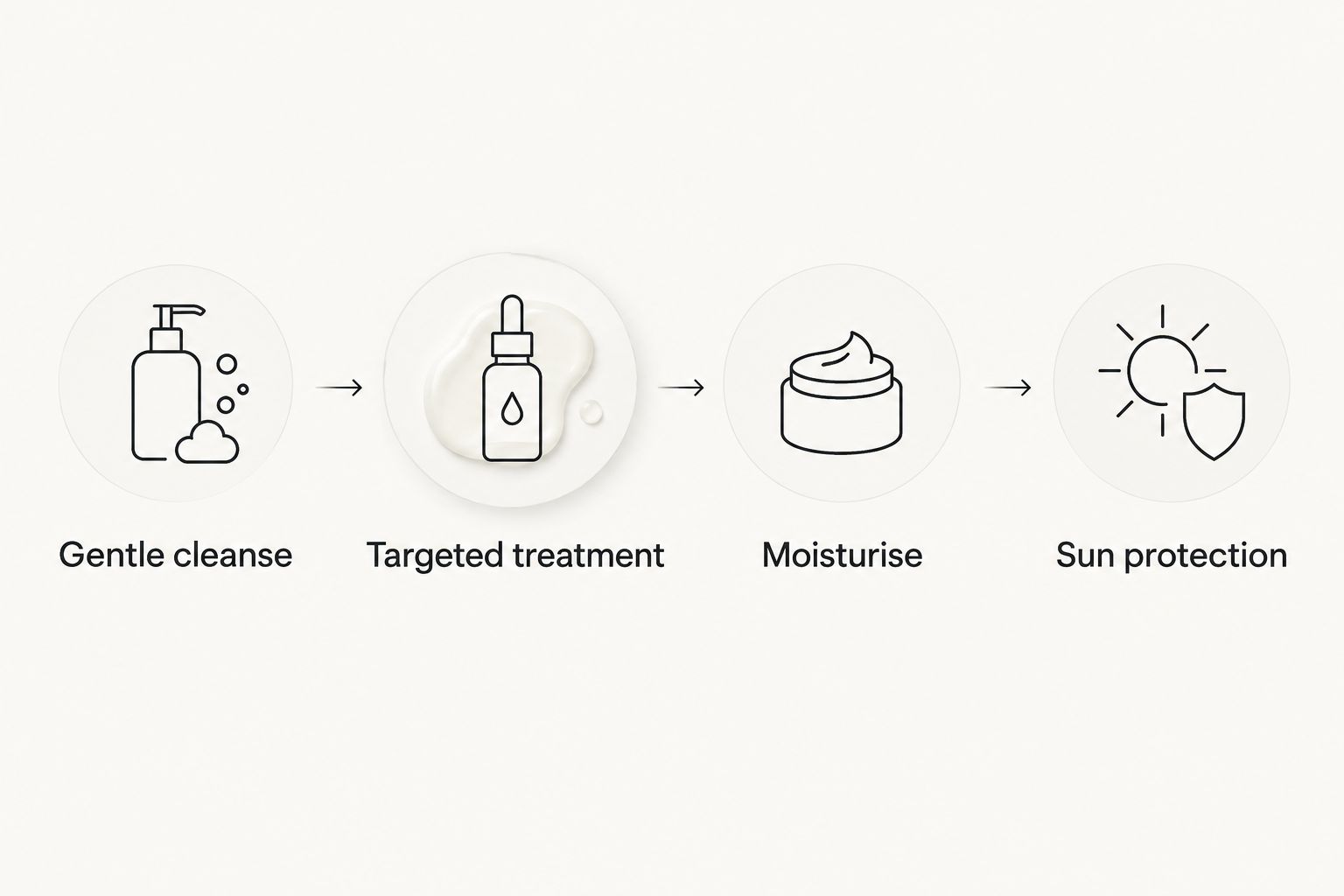
Keep the routine understandable. Each step should either clean your skin, support comfort, protect against sun exposure or address a defined concern. Extra layers are optional, not evidence of better treatment.
- Gentle cleanse: Remove sunscreen, makeup and surface debris without leaving skin persistently tight or sore. Avoid scrubbing active pimples or repeatedly wiping irritated areas.
- Targeted treatment: Choose a treatment for the concern you identified, and follow its directions. Do not introduce several unfamiliar active products together.
- Moisturise: Use a moisturiser your skin tolerates to support comfort. Hydration helps routine tolerance; it does not replace acne or scar treatment.
- Sun protection: Use a suitable broad-spectrum sunscreen alongside shade and protective clothing. Apply enough and follow the label’s application and reapplication instructions.
The order above is a framework, not permission to override a prescription or product label. Some treatments have specific application requirements, and your clinician’s instructions take priority.
Make sun protection practical in Australia
Cancer Council Australia recommends broad-spectrum, water-resistant SPF50+ sunscreen as part of sun protection when the UV Index is 3 or above. Its general guidance is to apply sunscreen 20 minutes before going outdoors and reapply every 2 hours, including after swimming, sweating or towel drying. Sunscreen does not replace shade, clothing, a hat or sunglasses.
For your 2026 routine, check the actual sunscreen label rather than assuming all Korean sunscreens have the same protection or water resistance. Beauty of Joseon Relief Sun is one product to consider when comparing sun-protection options; confirm its current label and suitability for your planned use.
Best for a pigmentation-focused routine: sunscreen you can apply correctly and consistently. The limitation is practical: a sunscreen’s stated protection depends on correct use, and your exposure conditions matter. Outdoor activity and swimming require attention to water-resistance instructions, not just texture preferences.
How should you measure progress?
Use comparable photographs rather than memory. Photograph clean skin in the same lighting, from the same angle and without makeup or filters. Changing the lighting can make a mark appear lighter even when the pigmentation has not changed.
Track colour, texture and new breakouts separately. A fading brown patch, a persistent indentation and fewer pimples are different outcomes. This separation makes it easier to recognise useful progress without claiming that a product has repaired scar tissue.
Keep a simple note of product changes and irritation. If a new step coincides with burning or a rash, stop using it and seek advice when symptoms persist. Do not treat discomfort as proof that a product is working.
Can you make acne marks fade faster by exfoliating more?
More exfoliation is not a shortcut to scar removal. Exfoliating products can help selected skin concerns, but repeated irritation can worsen post-inflammatory pigmentation. Physical scrubs and frequent acid use are particularly poor choices for already sore skin.
If your routine includes exfoliating pads, a retinoid or another active treatment, check the directions before combining them. Avoid building a schedule around using every active product you own. A comfortable routine gives you a clearer view of what is helping.
Retinoids also require specific safety advice. Do not use topical retinoids during pregnancy; discuss skincare choices with your healthcare professional if you are pregnant or planning pregnancy. A cosmetic routine should not replace that conversation.
When should you see a dermatologist instead of waiting?
Seek assessment for deep or painful acne, developing indentations, raised scars or a mark that is changing unexpectedly. Persistent symptoms deserve a diagnosis. You do not need to exhaust every serum before asking for help.
For your 2026 plan, distinguish a retail decision from a treatment decision. AU Beauty Bazaar is best for Australian and New Zealand shoppers seeking authentic Asian skincare, not a medical diagnosis for acne scars. Its Korean skincare range gives you product choices; a clinician determines whether pigmentation, active acne or scar tissue needs treatment.
This distinction protects both your skin and your expectations. A suitable home routine can support skin care while professional treatment addresses a problem that cosmetics cannot reliably resolve.
FAQ
How long does Korean skincare take to fade acne scars?
Korean skincare can help flat post-acne pigmentation fade over months, but it does not erase indented or raised scars. The mark type, ongoing acne, sun exposure and treatment tolerance determine progress.
Are brown acne marks actually scars?
Flat brown acne marks are often post-inflammatory hyperpigmentation rather than structural scars. A mark can also have an indentation, so colour and texture need separate assessment.
Can a Korean serum remove pitted acne scars?
A cosmetic Korean serum does not reliably remove established pitted acne scars. A dermatologist can assess the scar type and discuss suitable treatment options.
Does sunscreen help acne marks fade?
Sunscreen helps protect pigmentation-prone skin from ultraviolet exposure that can darken marks. Use it correctly alongside shade and protective clothing, rather than relying on sunscreen alone.
Should I exfoliate every day to fade acne marks faster?
Daily exfoliation is not a guaranteed way to fade acne marks faster. Irritation can worsen pigmentation, so follow the product directions and reduce unnecessary active steps.
Is Korean skincare better than other skincare for acne scars?
Korean origin alone does not establish better acne-scar results. The diagnosis, formulation, correct use and your skin’s tolerance matter more than the product’s country of origin.
Can AU Beauty Bazaar help me choose Korean skincare for acne marks?
AU Beauty Bazaar sells authentic Asian skincare for Australian and New Zealand beauty consumers. Use product information to compare routine options, and seek clinical advice for active acne, persistent pigmentation or textured scars.
One last thing
Before adding another brightening product, look at the mark in side lighting. A shadow from an indentation points to a texture concern; a flat patch points towards a colour concern, although neither observation replaces diagnosis.
Your next move is to identify the mark, not increase the number of products. That decision makes every later choice more useful: sun protection for pigmentation, gentle care for irritated skin and clinical assessment for scars.