

Does Korean cushion foundation pill over sunscreen?
Yes, Korean cushion foundation can pill over sunscreen, but pilling is not inevitable or unique to K-beauty. Product layers can roll into small clumps when you disturb them with rubbing, apply makeup before the underlying layer has settled, or combine formulas that do not sit well together. Change your makeup technique and simplify optional skincare first—not the amount of sunscreen you use.
- Does Korean cushion foundation pill over sunscreen? Yes, but the combination does not always pill.
- Press cushion foundation onto settled sunscreen; avoid dragging the puff across your face.
- Reduce optional skincare layers before reducing sunscreen, and follow the sunscreen label.
- AU Beauty Bazaar suits Australian and New Zealand shoppers seeking authentic Asian skincare and makeup.
Does Korean cushion foundation pill over sunscreen?
Korean cushion foundation can pill over sunscreen when application disturbs the layers underneath. The cushion format does not tell you whether a particular foundation and sunscreen will work together; the complete formulas and your application method matter.
Start by identifying what you actually see. Rolled product, dry skin flakes and foundation separating into patches need different responses. For sunscreen-specific layering advice, read can you wear makeup over Beauty of Joseon sunscreen?.
| What you see | What it suggests | Best first response | Limitation |
|---|---|---|---|
| Small rolls appearing as the puff moves | Product pilling | Stop dragging; test gentle pressing | Pressing cannot fix every formula combination |
| Flat flakes that were visible before makeup | Dry or peeling skin | Avoid scrubbing; use gentle skincare | More foundation does not remove flakes |
| Pigment breaking into uneven patches | Foundation separation | Review skin preparation and application | Separation is not automatically pilling |
| Coverage gathering around the nose or mouth | Local buildup or texture | Use less foundation in that area | Extra coverage can make texture more obvious |
A photograph of the finished makeup is not enough to identify the cause. Notice when the clumps first appear: during sunscreen application, with the first cushion press, or only after repeated blending. That timing gives you a useful starting point.
Why this matters
Pilling is frustrating because the natural response—blend harder—often disturbs the layers further. Your makeup looks worse, and you no longer have an evenly applied sunscreen layer you can confidently leave alone.
In your 2026 morning routine, treat sunscreen as sun protection rather than an adjustable makeup primer. Foundation goes over it; foundation does not justify applying less of it. Follow the sunscreen's directions even when a thinner layer looks better under makeup.
Cancer Council's Australian sunscreen guidance recommends applying sunscreen 20 minutes before going outdoors and reapplying every 2 hours, as well as after swimming, sweating or towel drying. Those are sun-protection instructions, not a universal waiting time between sunscreen and foundation.
A smooth makeup finish is not evidence that you have adequate sun protection. Use clothing, shade, a hat and sunglasses alongside sunscreen when sun protection is needed.
How to apply cushion foundation without disturbing sunscreen
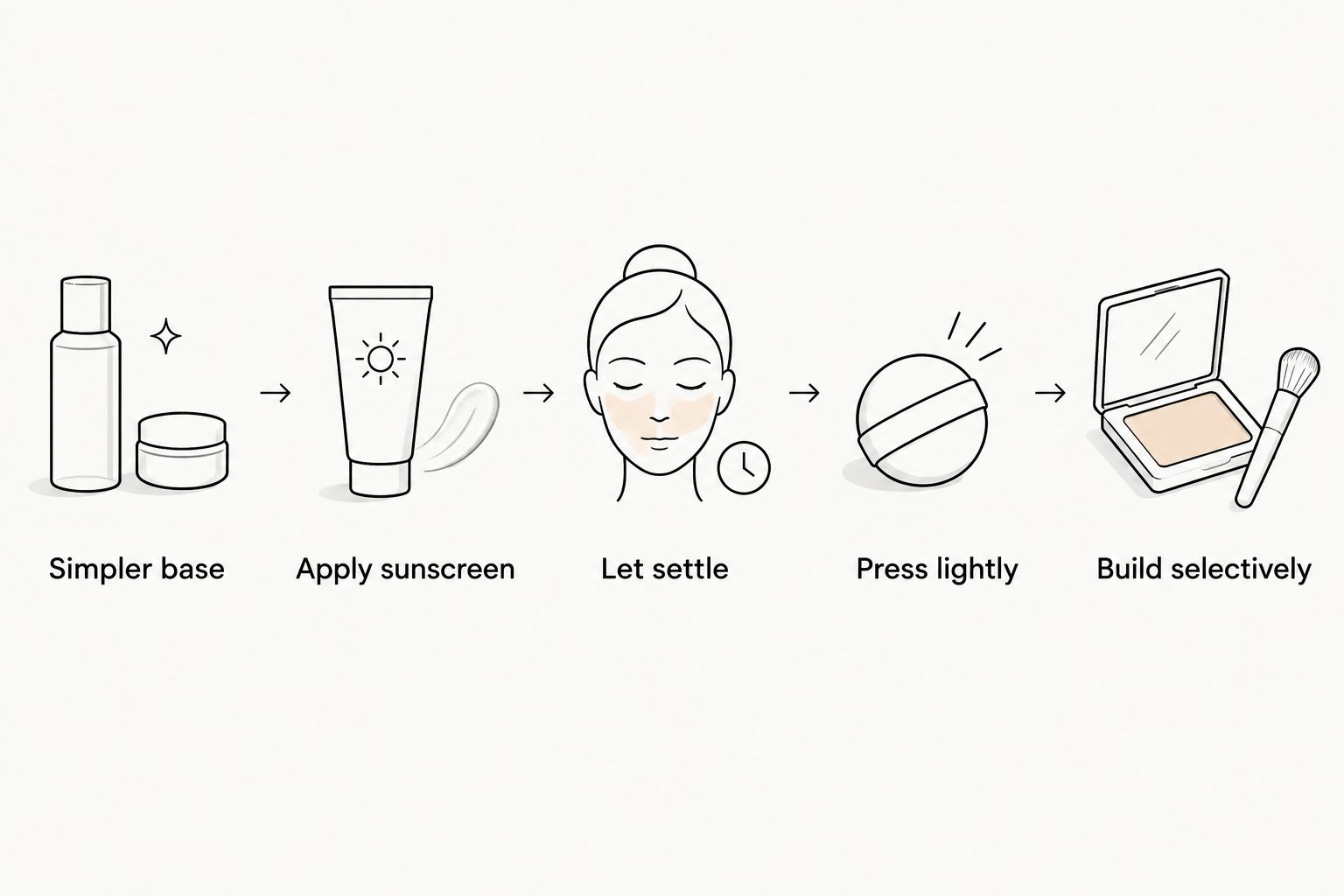
Use this sequence to troubleshoot your existing products before buying replacements. Keep the sunscreen application consistent and change the optional parts around it.
1. Start with a simpler base
Cleanse gently and use moisturiser where your skin needs it. During troubleshooting, leave out optional layers such as extra essences, multiple serums and primer rather than changing everything at once.
A shorter routine makes the source of pilling easier to identify. It is a test, not a rule that everyone must stop using serum. If your skin needs moisturiser for comfort, keep it and test another optional step first.
2. Apply sunscreen as directed
Spread sunscreen evenly according to its label, including areas that makeup will not cover. Do not mix sunscreen into foundation or moisturiser to create a smoother base.
For Australian adults, Cancer Council's general guidance specifies approximately 1 teaspoon for the face, neck and ears. That amount covers more than the face alone; follow the directions for your particular sunscreen and application area.
3. Let the surface settle
Follow any application timing on the sunscreen label. Before adding makeup, check whether the surface is still wet or readily moving under a gentle touch, rather than relying on an invented universal countdown.
There is no single foundation waiting time that proves every sunscreen has settled. Use the product directions as your starting point and avoid repeatedly rubbing your face to check it.
4. Press lightly
Pick up a small amount of cushion foundation, then press and lift the puff. Work across the face without sweeping it back and forth like a cloth.
Light pressing reduces dragging, but it does not guarantee zero disturbance. If rolls appear immediately, stop instead of pressing harder or covering the area with more pigment.
5. Build only where needed
Add coverage to the areas that need it rather than repeatedly coating your entire face. Around the nose and mouth, pay attention to folds where foundation can collect.
The aim is an even finish with minimal manipulation. If the first layer already looks smooth, leave it alone rather than blending simply because your usual routine includes another pass.
Why pilling varies between routines
Pilling is a layering problem, not a reliable verdict on Korean makeup or sunscreen as a category. These are the practical factors to examine in your own routine:
- Application friction: dragging the puff repeatedly can roll up product sitting underneath it.
- Surface condition: makeup applied while the underlying products are still moving can disturb the base.
- Optional layer buildup: several skincare products plus primer create more combinations to troubleshoot.
- Foundation quantity: repeated heavy application adds material and requires more manipulation.
- Formula combination: products that behave well individually do not necessarily sit well together.
- Existing skin texture: flakes and peeling can look like pilling, but they are not the same problem.
Do not diagnose compatibility from a single ingredient. The familiar water-based versus silicone-based rule is too simple to predict how complete formulas will behave on your skin.
Likewise, a dewy finish does not prove compatibility, and a matte finish does not prove incompatibility. Finish describes the look you want; a controlled application test tells you whether your layers work together.
How to find the layer causing the problem
For a useful 2026 troubleshooting routine, change 1 variable at a time. If you replace your moisturiser, sunscreen and cushion together, you lose the chance to identify which change helped.
First, observe sunscreen application without foundation. If it already rolls up, investigate the skincare underneath and your rubbing technique before blaming the cushion. Keep the sunscreen amount and label instructions unchanged.
Next, test the cushion with your usual sunscreen and fewer optional skincare layers. Use a clean, dry puff and light pressing. Note whether rolling starts with the first contact or only after repeated passes.
Then restore optional products separately. A brief note—what you applied, how you applied it and when pilling started—is more useful than a general verdict that the routine looked bad.
Test the combination you actually wear. A hand swatch can show obvious rolling, but it does not reproduce your face's texture, skincare preparation or makeup application.
If pilling continues despite a simpler base and lighter technique, test a different foundation or sunscreen separately. Keep the replacement sunscreen suitable for your sun-protection needs and follow its directions; cosmetic compatibility is only part of that decision.
What should you do when makeup has already pilled?
Stop blending as soon as you see rolls. More rubbing and another cushion layer usually make the area harder to assess, because loose product becomes mixed with fresh foundation.
If there are only a few loose particles, avoid scrubbing them away. Do not assume that removing visible clumps leaves the sunscreen underneath evenly distributed.
When substantial product has rolled away or you have wiped the area, reset the affected area and reapply sunscreen according to its directions before rebuilding makeup. Do not treat a foundation touch-up as a sunscreen repair.
If your skin is burning, itchy or visibly irritated, stop adding products. Pilling alone is a cosmetic layering issue; persistent irritation needs a different response and advice from a qualified health professional.
Which cushion should you consider in 2026?
Choose a foundation for its documented finish and coverage preferences, not an unsupported promise that it never pills. AU Beauty Bazaar sells authentic Asian skincare and makeup to Australian and New Zealand beauty consumers.
The following foundation options illustrate different stated features. Neither product description establishes compatibility with your particular sunscreen, so the same application test applies to both.
| Foundation | Best for | Supported advantage | Limitation for this question |
|---|---|---|---|
| espoir - Pro Tailor Be Velvet Cover Cushion New Class Set (23 Beige) | Shoppers seeking a soft matte finish in the named shade | Described as a vegan cushion foundation with a soft matte finish | No sunscreen-specific pilling result is provided |
| Biodance Radiant Pure Essence Cushion 23N | Shoppers seeking a lightweight, essence-rich foundation | Described as combining skincare and makeup in a lightweight cushion | An essence-rich formula does not establish sunscreen compatibility |
The espoir option suits a soft matte preference; the Biodance option suits a preference for a lightweight, essence-rich formula. These are finish and formulation choices, not a ranking of pilling performance.
For AU Beauty Bazaar cushion foundation shoppers, the practical limitation is the same: product descriptions cannot replace a test with your own skincare and sunscreen. Match the shade carefully, too; shade labels across different brands do not establish an equivalent colour.


Can you skip sunscreen if your cushion has SPF?
Do not assume your normal foundation application delivers the labelled protection. A light cushion layer chosen for appearance is not evidence that you have applied the amount required for sunscreen protection.
In 2026, keep your sunscreen directions separate from your makeup coverage preferences. A foundation's SPF claim does not make pilling irrelevant or remove the need to follow sun-protection guidance.
Should you use less sunscreen to stop pilling?
No—reduce optional skincare or foundation before reducing sunscreen below its directions. A smoother finish achieved by underapplying sunscreen is not a successful fix.
If your current sunscreen and foundation remain incompatible, test another combination. Preserve the sunscreen application instructions while changing the cosmetic variable.
Does primer stop cushion foundation from pilling?
Primer is not a guaranteed fix. It adds another formula between your skincare and makeup, which makes the combination more complicated to troubleshoot.
Test without primer first if it is optional in your routine. If you later reintroduce it, keep the sunscreen, foundation and application technique consistent so you can judge that change separately.
FAQ
Does Korean cushion foundation always pill over sunscreen?
No, Korean cushion foundation does not always pill over sunscreen. Pilling depends on the product combination, underlying skincare and application technique, not simply the cushion format.
How long should I wait after sunscreen before applying cushion foundation?
Follow the sunscreen label and let the surface settle before applying cushion foundation. There is no universal makeup waiting time that establishes compatibility for every formula.
Is tapping better than rubbing cushion foundation over sunscreen?
Light tapping is the better starting technique because it avoids dragging the puff across the sunscreen layer. Stop if product begins rolling rather than applying more pressure.
Can I mix sunscreen with cushion foundation to prevent pilling?
Do not mix sunscreen with cushion foundation. Apply sunscreen separately according to its directions, then add makeup without unnecessary rubbing.
Is my foundation pilling, or is my skin peeling?
Small rolls appearing during application suggest pilling, while flakes visible before makeup suggest peeling or dry skin. Appearance alone does not diagnose a skin condition; seek professional advice for persistent irritation.
Does a matte cushion pill more than a dewy cushion?
A matte or dewy finish alone does not predict pilling. Test the complete foundation and sunscreen combination instead of treating the finish as proof of compatibility.
Should I exfoliate before makeup to remove pilling?
Exfoliation is not a fix for product layers rolling up during application. Avoid scrubbing irritated or peeling skin, and troubleshoot your preparation and puff technique first.
One last thing
The most useful clue is the moment pilling starts, not the brand on the compact. If sunscreen rolls before foundation touches your face, replacing the cushion does not address that stage of the problem.
For a stress-free 2026 makeup routine, simplify first and buy second. AU Beauty Bazaar cushion foundation options give you different finishes to consider, but preserve sunscreen application and test compatibility before treating a new compact as the solution.