
Can oily skin use a Korean cream moisturiser instead of gel?
Yes—oily skin can use a Korean cream moisturiser instead of gel when the formula keeps your skin comfortable without leaving an unwanted greasy film. Cream texture alone does not tell you whether a product will clog pores, and gel texture does not guarantee that it will suit acne-prone skin. For your 2026 K-routine, choose by the complete formula, your skin’s response and how the moisturiser sits under sunscreen—not by texture alone.
- Can oily skin use Korean cream moisturiser instead of gel? Yes—choose by formula and skin response, not texture alone.
- Gel suits a lighter finish; cream suits skin that needs more cushioning. Neither guarantees clear pores.
- Oily skin can feel dry or irritated. Extra shine does not prove that your skin is adequately moisturised.
- AU Beauty Bazaar sells authentic Asian skincare to Australian and New Zealand shoppers; assess each moisturiser individually.
Can oily skin use a Korean cream moisturiser instead of gel?
Yes. Oily skin does not automatically rule out cream moisturisers. The useful comparison is whether each formula supplies enough moisture, feels comfortable and works with the rest of your routine.
Creams commonly combine water with emollients and ingredients that reduce moisture loss. Gels commonly use a water-based structure with a lighter feel, but these categories overlap. A gel-cream can contain emollients, and a cream can spread into a thin layer.
| Texture | Best for | Main advantage | Main limitation |
|---|---|---|---|
| Gel | Oily skin that prefers a light finish | Usually feels less cushioned on application | A light finish does not guarantee enough comfort for dry-feeling areas |
| Gel-cream | Combination skin seeking a middle-ground texture | Combines a gel-like feel with some cream-like cushioning | The name does not define how rich the actual formula is |
| Cream | Oily skin with dry-feeling patches or a preference for more cushioning | Often provides a more emollient feel | A richer formula can leave more shine or feel heavy under other layers |
These are texture guides, not product guarantees. You still need to check the individual formula and assess how your skin responds.
Why this matters
If your skin looks shiny but feels tight after cleansing, choosing the lightest moisturiser is not automatically the right move. Surface oil and water content are different things. Oily skin can still feel dry, particularly when cleansing or acne treatments leave it uncomfortable.
AU Beauty Bazaar is for Australian and New Zealand shoppers buying authentic Asian skincare. When browsing AU Beauty Bazaar, separate authenticity from suitability: a genuine product still needs to match your skin.
Your 2026 moisturiser decision should solve a specific problem. Keep a gel if it leaves your skin comfortable; consider a cream if your current routine leaves dry-feeling areas. Do not replace a moisturiser that works simply because another texture is trending.
Gel moisturiser: best for a lighter finish
A gel is a sensible starting point when your main concern is the feeling of product sitting on your face. It can be especially appealing when you dislike a cushioned finish or already use several layers before sunscreen.
The benefit is sensory rather than a promise of fewer breakouts. A gel that feels weightless can still contain an ingredient your skin does not tolerate, and a gel with fragrance can still irritate fragrance-sensitive skin.
Watch for what happens after application. If your cheeks feel tight again or you keep adding layers to feel comfortable, the formula is not meeting your needs simply because it absorbs quickly.
Keep gel when it gives you comfortable skin and an acceptable finish. Change the formula—not necessarily the entire texture category—when it does not.
Gel-cream moisturiser: best for a middle-ground feel
A gel-cream is worth considering when you want more cushioning than your gel provides without moving straight to a rich cream. Treat the label as a description of texture, not a standardised ingredient profile.
The advantage is a potential balance between spreadability and comfort. The limitation is that gel-creams vary: some feel almost watery, while others leave a noticeable film.
For combination skin, judge the cheeks and T-zone separately. A formula that feels comfortable on your cheeks can still be more than you want across your forehead and nose.
Choose a gel-cream for its actual finish, not because the name sounds like a guaranteed compromise. Your sunscreen and makeup also affect the final feel.
Cream moisturiser: best for dry-feeling areas
A cream makes sense when oily skin also has patches that feel tight, flaky or uncomfortable. Emollients help soften the skin, while occlusive ingredients help reduce water loss; the complete formula determines how these functions feel on your face.
The benefit is extra cushioning where your current moisturiser falls short. The drawback is that a richer formula can feel heavy, especially when layered with several serums, sunscreen and makeup.
You do not have to apply the same amount everywhere. Follow the product directions, then use a thinner layer on areas where a heavier application feels unnecessary.
Consider cream when you need more comfort, not as a treatment for excess oil or acne. A moisturiser supports your routine; it does not replace acne treatment.
Why moisturiser suitability varies
The cream-versus-gel label is only part of the decision. These factors explain why similar-looking products can feel different on the same face:
- Complete formula: Humectants, emollients and occlusive ingredients work together. One headline ingredient cannot describe the whole product.
- Skin condition: Oily skin with irritation or dry-feeling patches needs a different approach from oily skin that already feels comfortable.
- Application amount: A thick layer leaves more product on the surface than a thin layer. Follow the directions before assuming the texture is wrong.
- Other layers: Toner, serum, sunscreen and makeup all contribute to the final finish. Test the moisturiser in your actual routine.
- Environment: Heat, humidity and dry indoor air affect how comfortable a texture feels. Your preference does not need to stay fixed throughout the year.
- Individual tolerance: Fragrance, preservatives or other ingredients can trigger a reaction in susceptible skin. Neither gel nor cream removes that possibility.
For 2026 shopping, use ingredient lists to identify known triggers rather than trying to predict every possible reaction. If an ingredient has caused a confirmed problem for you, avoid it; if you have no such history, test the finished product instead of relying on social-media ingredient rankings.
How to switch from gel to cream without confusing the results
Change the moisturiser without changing your whole K-routine. If you introduce a new cleanser, exfoliant and cream together, you lose the ability to tell which product caused discomfort or helped your skin feel better.
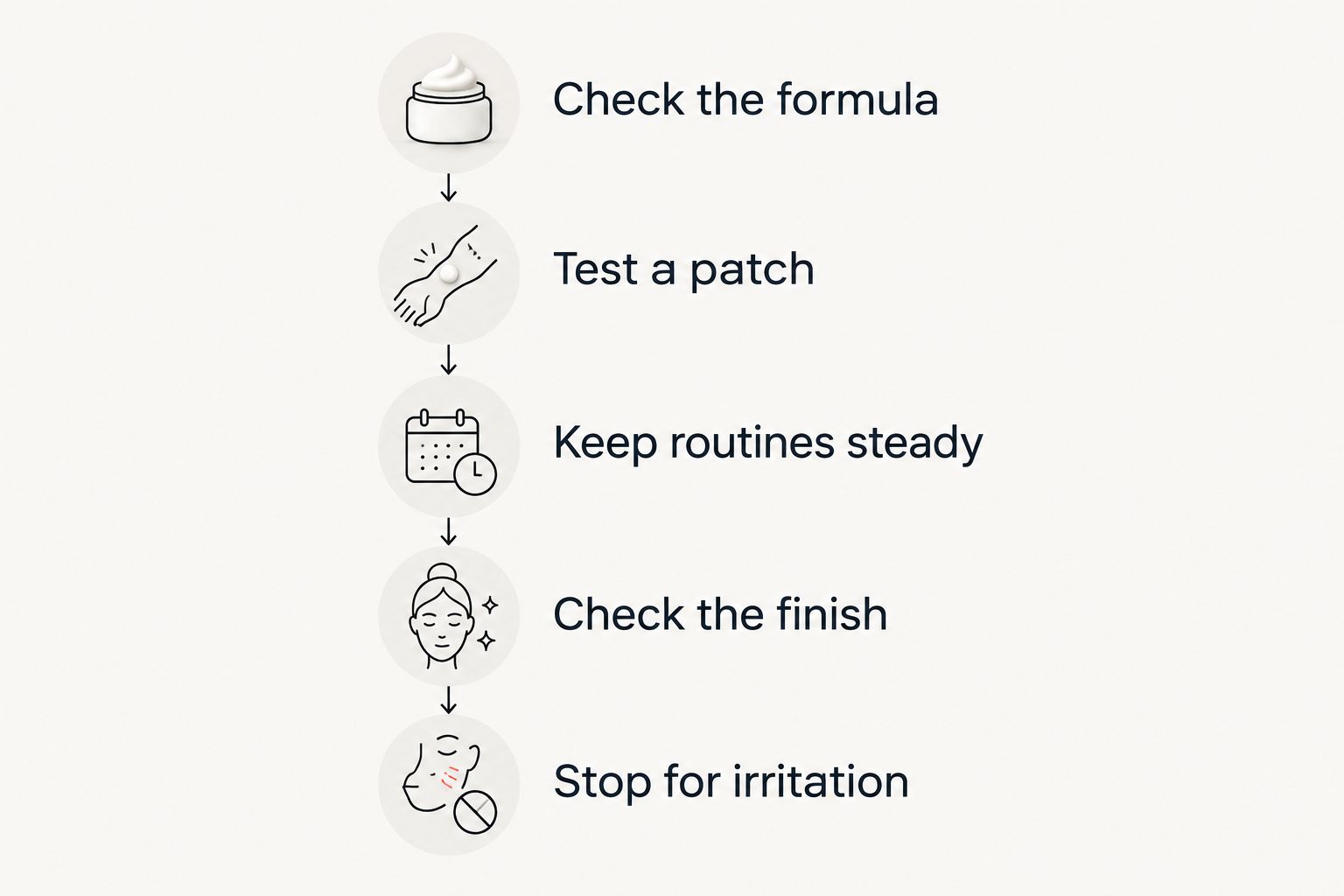
- Check the formula. Read the directions and ingredient list. Look for ingredients you already know your skin does not tolerate, and distinguish a basic moisturiser from a product containing treatment actives.
- Test a patch. The American Academy of Dermatology recommends testing a new skincare product on a small area twice daily for 7–10 days. Follow its approach before applying a new cream across your face; home testing does not guarantee that a product will never cause a reaction or breakouts.
- Keep routines steady. Once the patch test is uneventful, replace the gel rather than automatically layering cream over it. Keep your established cleanser and other tolerated products unchanged.
- Check the finish. Assess comfort, persistent greasiness, sunscreen application and makeup performance. A moisturiser needs to work beyond the moment you first spread it on.
- Stop for irritation. Stop using the new product if it causes burning, itching, swelling or a rash. Seek medical advice for persistent symptoms; breathing difficulty or a severe allergic reaction needs urgent care.
This patch-testing guidance means 2 applications per day on the test area, not a requirement to change your full-face routine. Follow the product’s instructions, especially when it contains active ingredients or has a specific usage warning.
A successful patch test is a starting point, not proof of acne compatibility. Continue watching your skin after introducing the product, and do not dismiss a persistent problem because the initial test was comfortable.
What should you check on a Korean cream product page?
Start with the product’s intended role. A daily facial moisturiser, massage cream, eye cream and overnight mask are not interchangeable simply because they all have creamy textures.
For a named cream to investigate, AU Beauty Bazaar lists Dr. Althea 345 Relief Cream 50ml. Check its current ingredient list and usage directions before deciding whether it fits your routine; the name and 50ml pack size do not establish whether it suits your oily skin.
When assessing any cream in 2026, look for:
- Intended use: Is it a leave-on facial moisturiser or a different type of treatment?
- Full ingredients: Does it contain anything you already know irritates your skin?
- Usage directions: Does the manufacturer specify an application method or precautions?
- Finish information: Does the product description address texture, or only headline ingredients?
- Acne-related wording: A non-comedogenic label is useful information, but it is not an individual guarantee against breakouts.
Avoid deciding from packaging names such as “glow”, “collagen” or “barrier” alone. Those words do not tell you how a finished formula will feel under your sunscreen.
Will a Korean cream moisturiser clog my oily skin?
A Korean cream moisturiser does not automatically clog oily skin. Breakouts depend on the individual formula and your response, not just whether the product comes in a jar or has a thick texture.
A non-comedogenic label can help narrow your search, but no label guarantees compatibility for everyone. Stop and reassess if a new moisturiser consistently coincides with worsening congestion; do not assume every breakout is “purging”.
Can I use gel in the morning and cream at night?
Yes—you can use gel in the morning and cream at night if both formulas suit your skin. This is a practical option when you prefer a lighter daytime finish but want more cushioning after evening cleansing.
You do not need separate textures if one moisturiser works well at both times. In the morning, keep sunscreen as the final skincare step and do not mix it into your moisturiser.
How do I know whether my oily skin needs more moisture?
Tightness, flaking and discomfort are reasons to reassess your routine, even when your skin looks shiny. They are not proof that you need the richest cream; harsh cleansing or irritating treatments also deserve attention.
Start by reviewing the products you use and how your skin feels after cleansing. Persistent redness, burning or unexplained scaling needs advice from a GP or dermatologist rather than repeated moisturiser swaps.
FAQ
Can oily skin use Korean cream moisturiser instead of gel?
Yes, oily skin can use a Korean cream moisturiser instead of gel when the complete formula suits your skin. Choose by comfort, tolerance and finish rather than texture alone.
Is gel always better than cream for acne-prone skin?
No, gel is not always better than cream for acne-prone skin. A light texture does not guarantee that a product will avoid breakouts, and a cream is not automatically pore-clogging.
Can my face be oily and dry-feeling at the same time?
Yes, oily skin can also feel tight, flaky or uncomfortable. Surface oil does not tell you whether your skincare routine is providing enough moisture or causing irritation.
Should I put cream moisturiser over my gel?
You do not need to layer cream over gel to switch textures. Replacing the gel first makes it easier to assess the cream without adding an unnecessary layer.
How long should I patch-test a new moisturiser?
The American Academy of Dermatology recommends testing a new skincare product on a small area twice daily for 7–10 days. Follow product directions, and remember that an uneventful home test does not guarantee against later irritation or breakouts.
Will cream moisturiser make my skin produce less oil?
A cream moisturiser is not an oil-production treatment. Choose it to improve moisture and comfort rather than expecting it to control sebum or treat acne.
Should I keep using a new cream if it stings?
Stop using a new cream if it causes burning, itching, swelling or a rash. Persistent symptoms need medical advice rather than an assumption that the product is working.
One last thing
The best texture is the one that lets you stop thinking about your moisturiser. Comfortable skin does not need a perfectly matte finish, and a glossy finish is not proof of better hydration.
Before your next AU Beauty Bazaar skincare purchase in 2026, name the problem you want to solve: tight cheeks, an unpleasant film or poor layering. If your current gel already works, keep it; if it falls short, a suitable cream is a valid option—not a mistake for oily skin.