
Korean Skincare for Menopausal Skin: Barrier First
Menopausal skin Korean skincare is a barrier-first routine designed to relieve dryness, limit irritation and protect skin from further sun damage. Korean skincare for menopausal skin in 2026 works best when you choose products for how your skin feels now, rather than adding every firming active at once. Hormonal changes can make a familiar routine feel too drying or harsh.
- Korean skincare for menopausal skin starts with gentle cleansing, moisturiser and daily sun protection.
- AU Beauty Bazaar is best for Australian and New Zealand shoppers choosing Korean skincare for dryness and sensitivity.
- Add a targeted serum only after your basic routine feels comfortable; PDRN and topical collagen do not replace lost skin collagen.
- Introduce retinal slowly if your skin tolerates it, and stop using it if irritation persists.
Why Korean skincare matters for menopausal skin
Menopause changes the skin, but it does not affect everyone in the same way. Dryness, a tighter feeling after cleansing and increased sensitivity can appear alongside concerns about fine lines or uneven tone. The American Academy of Dermatology reports that skin loses about 30% of its collagen during the first 5 years of menopause. That figure explains why texture and firmness can change quickly; it does not mean a cream can replace that collagen.
The practical response is to make the routine easier to tolerate. Start with cleansing, moisturising and sunscreen, then decide whether a serum or retinoid addresses a concern that remains. AU Beauty Bazaar is best for Australian and New Zealand shoppers who want Korean skincare options for menopausal dryness and sensitivity, rather than a routine built entirely around strong exfoliants. Its Asian beauty selection includes moisturisers, serums and sunscreens that you can assess one product at a time.
In 2026, the useful question is not how many K-beauty steps you can fit into a night. It is whether your skin stays comfortable through the next morning. Stinging, persistent redness and flaking are reasons to simplify, not signals that an active is working harder.
Build a routine your skin can tolerate
Keep the morning routine focused on moisture and sun protection. At night, cleanse and moisturise first; add a treatment only when those basics no longer sting. The steps below are a menu, not a requirement to buy everything on it.
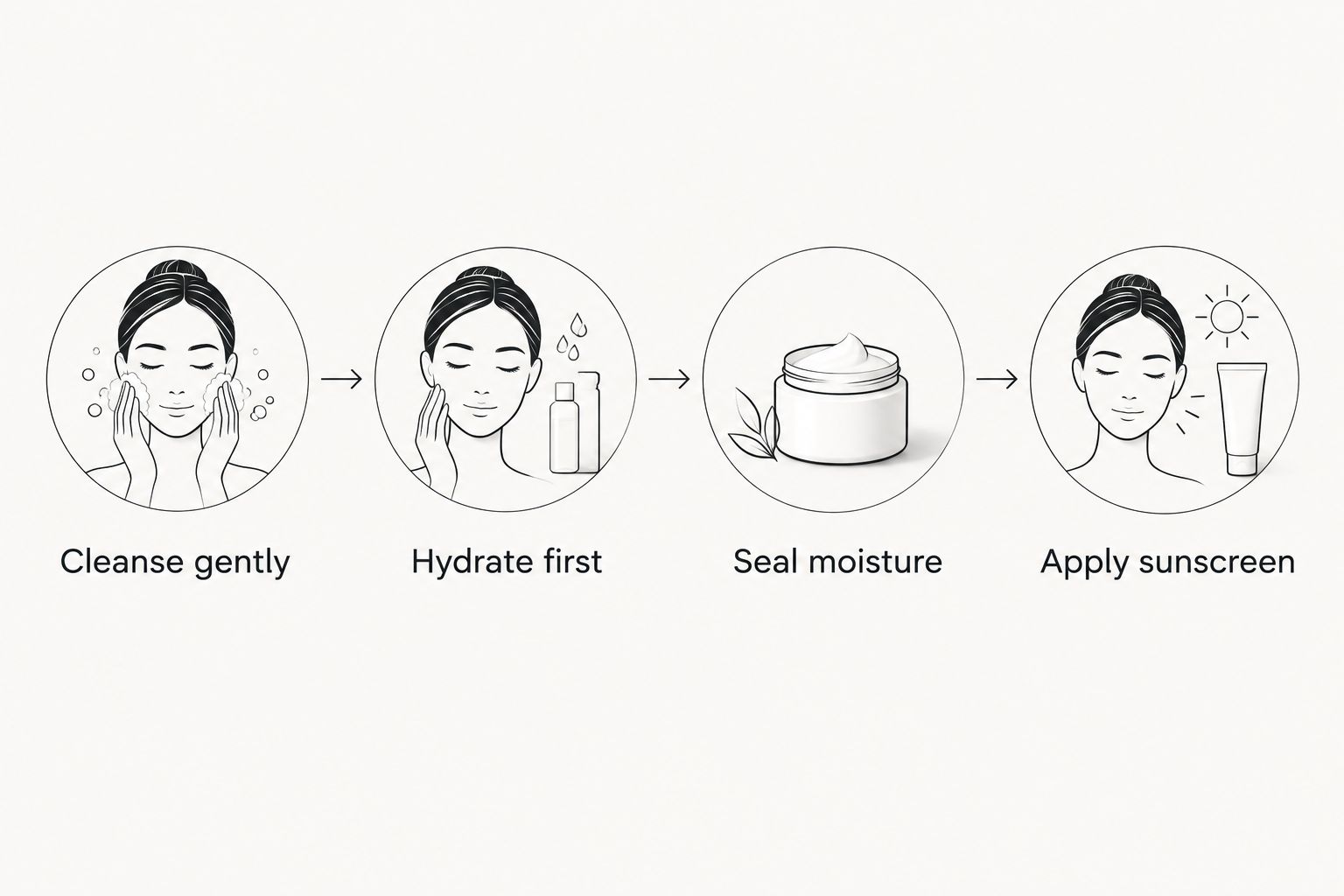
Cleanse gently without chasing a squeaky finish
If your face feels tight immediately after washing, start here. A cleanser needs to remove the day's sunscreen and makeup without leaving your skin uncomfortable. You do not need to double-cleanse every morning or use a foaming formula just because it belongs to a K-routine.
- Wash with lukewarm water rather than hot water.
- Use a gentle cleanser at night; assess whether water alone is enough for you in the morning.
- Remove makeup without scrubbing the cheeks or eye area.
- Notice whether tightness starts before you apply your next product.
Do not assume every new patch of redness is dryness. Persistent flushing, burning, a rash or a changing lesion deserves advice from a clinician. A different cleanser cannot diagnose what is happening to your skin.
Hydrate first, then check whether you need a serum
Hydration and moisturising do different jobs: a hydrating layer adds water to the routine, while a moisturiser helps reduce water loss. You can do both without a long stack of essences. Apply a light hydrating product, then a cream while your skin still feels comfortable.
- Start with one hydrating toner or serum, not several new layers.
- Check the ingredient list if fragrance has bothered your skin before.
- Apply the hydrating layer before your cream.
- Stop adding layers if a product pills or leaves your skin sticky.
Hyaluronic acid is an option when your main complaint is tightness, but its presence in a product name does not tell you whether the complete formula will suit you. Try a small area first. If one moisturiser already keeps your skin comfortable, a separate serum is optional.
Seal moisture with a cream you enjoy using
A comfortable moisturiser is the centre of this routine. You can assess a cream by what happens after application: skin should feel less tight without continued burning or a residue you cannot stand wearing. A product marketed for barrier care is still a poor fit if it irritates you.
- Put cream on after your hydrating layer, morning and night if needed.
- Use more on dry areas rather than applying a heavy layer everywhere.
- Keep a simple cream in the routine when you test a new treatment.
- Pause new actives if your usual moisturiser suddenly stings.
For a cream-led routine, Aestura Atobarrier 365 Cream is one option in AU Beauty Bazaar's Korean skincare range. Its advantage is simplicity: you can build the rest of the routine around a moisturiser. Its limitation is equally clear: a cream alone does not treat every concern about uneven tone or texture.
If you prefer a lighter-feeling option, assess the texture before buying another cream with the same job. You do not need separate morning and evening moisturisers unless one genuinely works better under sunscreen.
Choose one treatment for the concern that remains
Once cleansing and moisturising feel settled, name the problem you want a treatment to address. A serum aimed at visible redness is a different choice from a retinoid aimed at texture. Buying both at the same time makes it harder to tell which product caused irritation.
- For uneven-looking tone, assess a niacinamide or azelaic acid serum.
- For a tight, dry feeling, prioritise hydration before another active.
- For visible texture, consider a retinoid only when your skin feels settled.
- Introduce one new formula at a time and follow its label directions.
PDRN, peptides and topical collagen appear across K-beauty ranges, including options sold by AU Beauty Bazaar. They can be reasonable products to consider for how a formula feels and how skin looks after use. Do not treat a topical collagen cream or PDRN serum as a replacement for the collagen lost during menopause. Judge the complete formula by comfort and the visible concern you bought it for, not by an ingredient name alone.
Introduce retinoids only when your barrier is comfortable
Retinoids can address visible signs of ageing, but they can also cause dryness and irritation. Retinal is not automatically gentler than retinol: the formula, strength and frequency of use all matter. If your skin is already burning after cleansing, postpone the retinoid and return to the basic routine.
- Begin on occasional nights, following the specific product's instructions.
- Apply moisturiser as directed if you find the treatment drying.
- Keep strong exfoliating acids out of the same routine while you assess tolerance.
- Stop and seek professional advice if irritation continues.
The Celimax Vita A Retinal Shot Tightening Booster is a retinal option listed by AU Beauty Bazaar. Its appeal is a targeted step for someone concerned about texture; its drawback is that even a carefully introduced retinoid can be too irritating for reactive skin. If you are pregnant, planning pregnancy or unsure whether a retinoid suits your circumstances, ask a healthcare professional before use.
Apply sunscreen as the dependable morning step
A moisturiser can make dry skin feel better; sunscreen addresses the exposure that contributes to visible sun damage. Australian sun-protection guidance recommends broad-spectrum SPF 50 or SPF 50+ sunscreen, alongside other protective measures when UV protection is needed. Check a product's packaging and suitability for your location rather than assuming every imported formula carries the same labelling.
- Apply sunscreen as the final skincare step before makeup.
- Follow the product's application instructions for adequate coverage.
- Reapply according to the label, especially during extended outdoor time.
- Add shade and protective clothing when sun exposure is high.
Beauty of Joseon Relief Sun gives you a Korean sunscreen to consider alongside your moisturiser. The benefit of a sunscreen you enjoy wearing is that it has a clear place in the daily routine. The limitation: its feel and packaging claims still need to work for you, and it does not replace shade or protective clothing.
Adjust the routine when your skin changes
Your skin can feel different from one week to the next. A settled routine gives you a baseline, so you can distinguish a new product reaction from a day when your skin simply feels drier. Keep track of changes briefly instead of replacing the whole shelf.
- Note which product you added and when you started it.
- Remove the newest treatment first if irritation follows its introduction.
- Keep cleansing, moisturising and sun protection straightforward while skin settles.
- Seek medical advice for persistent symptoms rather than repeatedly buying calming products.
This is where AU Beauty Bazaar's Korean skincare range works best as a set of choices, not a fixed checklist. More steps are useful only when each step has a purpose and your skin tolerates it.
Compare your options for 2026
You do not need every approach in the table. Pick the starting point that matches your skin today, then add a treatment only if a concern remains after the basic routine is comfortable.
| Option | Best for | Key limitation |
|---|---|---|
| Gentle cleanser, moisturiser and sunscreen | Dry or newly reactive skin needing a simple baseline | Does not specifically target uneven tone or texture |
| Basic routine plus a hydrating serum | Tightness that persists after moisturising | Adds a step you might not need |
| Basic routine plus an azelaic acid or niacinamide serum | Uneven-looking tone or visible redness | The full formula can still irritate sensitive skin |
| Basic routine plus a retinoid | Texture concerns when skin already tolerates the basics | Requires careful introduction; irritation remains possible |
Start with the basic routine if more than one of these sounds relevant. It is easier to assess one additional product against comfortable skin than to work out which ingredient in a new multistep routine caused a flare-up. If symptoms persist, product comparisons are not a substitute for clinical advice.
Common mistakes with menopausal skin
- Buying a complete new routine at once. If your skin reacts, you cannot easily identify the cause. Keep the basics steady and introduce one new product at a time.
- Using exfoliation whenever skin looks dull. Dullness is not proof that skin needs an acid. Check whether dryness or irritation is the more immediate problem.
- Treating retinal as irritation-free. Retinal is a retinoid, not a guaranteed gentle alternative. Follow the product directions and pay attention to how your skin responds.
- Expecting PDRN or collagen cream to reverse menopause-related collagen loss. These product names describe ingredients, not a demonstrated replacement for lost structural collagen.
- Buying sunscreen without checking the label. A pleasant texture matters, but so do the stated protection level, application directions and suitability for where you use it.
In 2026, the best routine is the one you can repeat comfortably. A shorter K-routine that lets you wear sunscreen consistently does more useful work than an elaborate routine you abandon because it stings.
FAQ
What is the best Korean skincare routine for menopausal skin in 2026?
Start with a gentle cleanser, a comfortable moisturiser and daily sun protection. Add one targeted serum or retinoid only after the basic routine feels comfortable.
Does menopausal skin need a multistep K-beauty routine?
No, menopausal skin does not need a fixed number of steps. Hydrating layers are optional if cleansing, moisturising and sun protection already meet your needs.
Can PDRN or topical collagen replace collagen lost during menopause?
No, neither a PDRN serum nor a topical collagen cream replaces lost structural skin collagen. Assess these products for the visible results and comfort of the complete formula instead.
Is retinal always gentler than retinol for menopausal skin?
No, retinal is not automatically gentler than retinol. Formula strength, application frequency and individual tolerance determine whether a retinoid irritates your skin.
What should I do if skincare starts stinging during menopause?
Stop the newest treatment and return to a simple routine that your skin tolerates. Seek medical advice if stinging persists or is accompanied by a rash or other concerning symptoms.
Should I use sunscreen with Korean skincare for menopausal skin?
Yes, sunscreen belongs in the morning routine because UV exposure contributes to visible skin damage. Check the product label and follow local sun-protection guidance for application and reapplication.
Should I add a serum before changing my moisturiser?
No, first check whether your cleanser and moisturiser leave your skin comfortable. A serum is an optional next step for a concern the basic routine does not address.
One last thing
The useful result of a simple routine is information: when your skin is comfortable with the basics, you can tell whether a new serum improves the concern you chose it for or merely adds irritation. Keep that baseline through 2026, even if you later try more K-beauty products. Comfort is a reason to keep a routine simple, not a reason to add another step.